
Amazon ad types compared: Sponsored Products, Brands, Display and DSP
 By Monjur HossainFounder & Amazon Strategy Lead
·
Published
·
Last reviewed
·18 min read
By Monjur HossainFounder & Amazon Strategy Lead
·
Published
·
Last reviewed
·18 min read
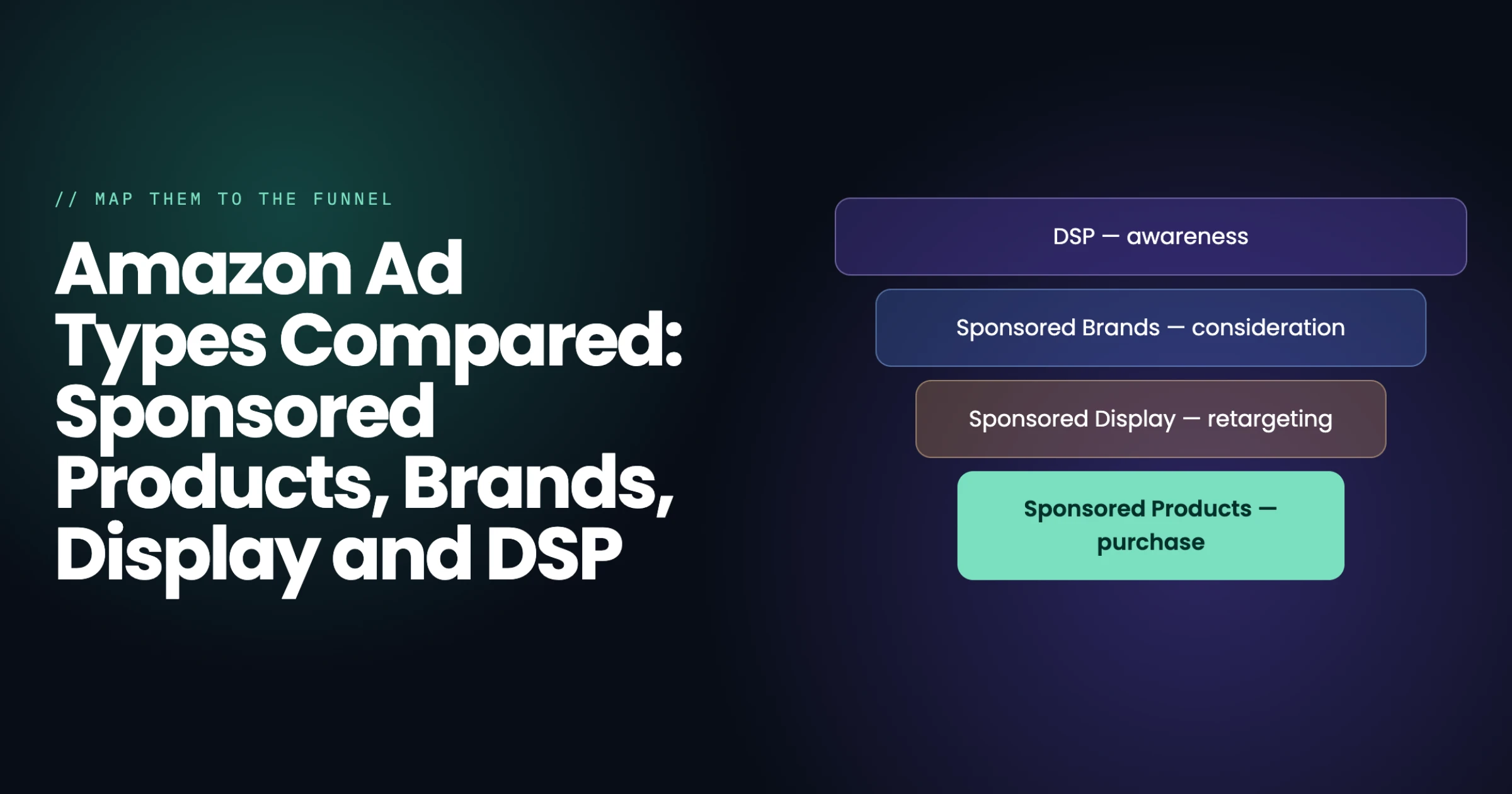
There are four core Amazon ad types: Sponsored Products, Sponsored Brands, Sponsored Display and Amazon DSP, plus self-serve streaming TV ads that began as Sponsored TV. Sponsored Products catches shoppers already searching and suits almost every seller first. Sponsored Brands needs Brand Registry. Display retargets past visitors, and DSP reaches people who are not shopping yet.
What are the four types of Amazon ads?
A lot of published guides still say there are three. There are four, and the fourth — Amazon DSP — is the one taking the most spend growth right now. Here is the whole picture before we go through them one at a time.
| Ad type | What it looks like | You pay | Eligibility | Best for |
|---|---|---|---|---|
| Sponsored Products | One product, inside search results and on product detail pages | Per click | Professional sellers, vendors, KDP authors | Demand that already exists |
| Sponsored Brands | Logo, headline and multiple products, usually above the results | Per click or per thousand viewable impressions | Brand Registry | Category-level terms and your own brand defense |
| Sponsored Display | Product creative on and off Amazon, including retargeting | Per click or per thousand viewable impressions | Contested — see below | Shoppers who looked and did not buy |
| Amazon DSP | Display, video, audio and streaming TV across Amazon and the open web | Media cost plus fees | Anyone, including non-sellers | Demand that does not exist yet |
The useful way to hold these in your head is not by format but by where the shopper already is. Sponsored Products meets someone who has typed what they want. Sponsored Brands meets someone who has typed a category but not chosen. Sponsored Display meets someone who came and left. DSP meets someone who was not shopping at all.
That ordering matters more than any feature comparison, because it tells you what happens when you add each one. Adding Sponsored Products to an account with none is usually immediately profitable, because you are intercepting purchase intent. Adding DSP to an account with weak listings is usually expensive, because you are manufacturing intent and then sending it somewhere that does not convert.
Amazon PPC audit tool
See where your ad spend is leaking
Before you add a new ad type, it's worth checking the one you already run. Our free audit tool takes about a minute and shows where we'd look first.
Run the free PPC auditSponsored Products: the one everybody should run first
Sponsored Products is a cost-per-click ad for one product. It appears at the top of, alongside and within shopping results, on product detail pages, and on third-party destinations. It is open to professional sellers, vendors, book vendors and KDP authors, and there is no monthly or upfront fee — and the minimum daily budget is $1.00.
There is one eligibility rule that catches people out. The product has to be eligible for the Featured Offer — what sellers still call the Buy Box. If you are not winning the Featured Offer, your ad will not serve, no matter what you bid. Adult products, used and refurbished items and closed categories are excluded outright, and listings have to be in new condition.
Automatic and manual targeting are not two strategies
Automatic targeting lets Amazon match your ad to searches it thinks are relevant. Manual targeting lets you name keywords or specific products. The common mistake is treating these as alternatives and picking one. They are a pipeline: automatic campaigns are a research instrument that happens to make sales, and the search term report they produce is where your manual keyword list comes from.
Run automatic at a modest budget permanently. Harvest the terms that convert into exact-match manual campaigns, and add the ones that never convert as negatives so the automatic campaign stops paying for them. That loop is most of what good Sponsored Products management is, and it is also where your keyword research gets validated against real money rather than a tool's estimate.
Video is now the default expectation
Amazon reports that video creatives in Sponsored Products deliver a 67% higher click-through rate and a 9% higher conversion rate than non-video creatives, attributed to its own US data from June 2026. Treat that as directional rather than as a promise about your account — it is Amazon measuring Amazon — but the direction is consistent enough that a category with video-heavy competitors is a category where a static-only ad is losing ground it does not need to lose.
Sponsored Brands: the banner at the top of search
Sponsored Brands shows your logo, a custom headline and several products, usually in the banner above search results. It is available to vendors, book vendors, KDP authors, agencies and professional sellers enrolled in Amazon Brand Registry. If you are not brand-registered, this ad type does not exist for you, and that alone is a reason to finish Brand Registry before you worry about ad strategy.
It bills in one of two ways: cost per click if you want visits, or cost per thousand viewable impressions if you are buying impression share. There is a third, less-discussed option — fixed upfront pricing through reserve share of voice for top-of-search placement on branded keywords, which is worth knowing exists if your brand terms are being bid on by resellers or competitors.
What it is actually good at
Two jobs, and they pull in opposite directions.
The first is category acquisition. Broad terms like "electric toothbrush" convert badly for a single product because the shopper has not decided what kind they want. A Sponsored Brands unit showing three variants at three price points answers that question inside the ad, which is why the format tolerates head terms that would bankrupt a Sponsored Products campaign.
The second is brand defense. When someone searches your brand name, the results page will show competitors. Bidding on your own name looks like paying for traffic you would have had anyway, and sometimes it is — but the click is cheap, the conversion rate is high, and the alternative is a rival buying the top of your own branded search. Measure it separately from everything else, because blending branded and non-branded performance into one number hides both.
Formats are static image, video, and collections or product showcase. The case studies on Amazon's own page are individual brands, not benchmarks — one cited ACoS of 17.68% belongs to a single advertiser in 2022 and should not be read as a target.
Sponsored Display, and the 2026 change nobody dated
Sponsored Display reaches shoppers with product creative both on Amazon — detail pages, review pages, search results, the homepage — and off it, across Prime Video, Twitch, Fire TV, Echo Show, and third-party sites and apps. It bills either per click or per thousand viewable impressions, with no minimum campaign spend and no management fee. Amazon does not publish default bid figures on the product page, so treat any specific number you are quoted as coming from somewhere other than Amazon.
Its most valuable use is the least glamorous one: retargeting. Someone viewed your product page and left. Bringing that person back is cheaper than acquiring a new one, and Sponsored Display is the only sponsored ad type that can do it. If you are going to run one campaign in this format, run views remarketing on your best-converting ASINs and leave the rest alone until that is working.
Two things Amazon has not made clear
First, the product is being folded into something larger. Amazon's Sponsored Display page now reads "Now part of Amazon Ads display ads offering", describing a single workspace that combines sponsored ads and Amazon DSP workflows. Existing campaigns "will continue to run uninterrupted". Amazon publishes no date for this transition. Anyone telling you when Sponsored Display goes away is guessing.
Second, the eligibility rules contradict each other across two Amazon pages. The display ads guide says you need to be a vendor or professional seller enrolled in Brand Registry.
The Amazon Ads FAQ says display ads are available to advertisers of any size, regardless of whether they sell products on Amazon. The likely reconciliation is that the endemic Sponsored Display product needs Brand Registry while the broader DSP-backed display offering does not, but Amazon has not said so plainly. If your eligibility is marginal, check in the console rather than trusting either page.
Amazon DSP: the one that is not really about Amazon
Amazon DSP is a demand-side platform. It buys display, video, audio and streaming TV inventory programmatically — Prime Video, Twitch, Fire TV, Kindle, Alexa, and thousands of third-party sites and apps through Amazon Publisher Direct and external exchanges. Amazon describes it as being for "brand advertisers, ad agencies, and tool providers", and states plainly that you do not need to sell on Amazon to use it.
That last point is the thing to understand. The other three ad types are retail media: they work because Amazon knows what the shopper is shopping for. DSP is an advertising business that happens to be attached to a retailer, and its value is the purchase data, not the placement. You use it to reach people who have bought from your category, or from a competitor, or who have viewed your products across a year — audiences the sponsored formats cannot construct.
What it costs, honestly
DSP has two service models. Self-service carries no management fees. Managed service, where Amazon's team runs the buying, "typically requires a minimum spend of $50,000 USD", and Amazon notes the minimum varies by country.
You will find other numbers quoted. Thirty-five thousand appears in older agency articles; some 2026 sources argue the floor has gone entirely for self-service. These cannot all be right, and Amazon publishes only the one figure above. The practical answer is that the self-service and managed-service distinction matters more than any single threshold: ask what service model you are being sold before you ask what the minimum is.
Pricing is not a simple percentage either. Amazon's pricing transparency guide lists a DSP technology fee as a percentage of media cost, audience fees charged on a CPM basis, a managed-service fee, and third-party targeting fees. The same page confirms that sponsored ads carry no demand-side fees at all — which is a real cost difference between DSP and the other three, and one that rarely appears in comparisons.
What Amazon calls things now
Two naming changes trip up anyone reading older material.
AMS no longer exists as a product name. Amazon Marketing Services was folded into Amazon Advertising years ago, and the sponsored formats above are what replaced it. If an article is still explaining "AMS versus DSP", it is old enough that its tactical advice should be checked rather than followed.
Rufus is now Alexa for Shopping. On 13 May 2026 Amazon introduced Alexa for Shopping, which in Amazon's own words "brings together Rufus's product expertise and Amazon shopping history with the personalized knowledge and context of Alexa+". Amazon does not use the words "renamed" or "retired"; the reporting that Rufus is gone from the shopping interface comes from GeekWire, not from Amazon.
For advertisers the practical consequence is small but worth knowing: Amazon states that existing sponsored ads campaigns automatically serve in Alexa for Shopping with no additional setup, and that prompt placements bill through your existing cost-per-click bids rather than as a separate product. You are already advertising inside the assistant whether or not you decided to.
Which Amazon ad type should you use?
Match the ad type to the problem, not to the budget.
| Your problem | Start with | Why |
|---|---|---|
| Nobody finds this product | Sponsored Products | Buys the searches you do not rank for yet, and tells you which ones convert |
| People find it and do not buy | Neither — fix the listing | Advertising a page that does not convert raises your cost per sale on every channel at once |
| Competitors sit on your brand name | Sponsored Brands | Only format that puts your logo and range above the results |
| Launching into a crowded category | Sponsored Products, then Brands | Exact-match terms first for data, then category terms once you know what converts |
| Traffic is fine, repeat rate is poor | Sponsored Display | Views remarketing reaches the people who already showed interest |
| The category itself is too small | Amazon DSP | The only format that reaches people who are not searching yet |
If you are new to Amazon advertising
Run Sponsored Products only, for at least sixty days, with automatic and exact-match manual campaigns running together. That is not conservatism; it is that the other three formats are hard to judge without a baseline, and the search term data from this period is what makes every later decision cheaper.
If you are launching a product
Sponsored Products from day one on tightly matched terms, because the goal of launch advertising is rank and relevance rather than immediate profit. Sponsored Brands once you have two or more products worth showing together. Expect the ratio to look bad early and read it against total sales rather than advertised sales — the difference between ACoS and TACoS matters more during a launch than at any other time. Our launch process treats the first thirty days as data collection, not as a profit window.
If you already spend five figures a month
This is where Sponsored Display retargeting and then DSP start to earn their place, and where the measurement question gets harder. Turn on Amazon's Benchmarks reporting, which went generally available worldwide on 18 May 2026 and covers eight metrics for Brand Registry advertisers. Its Sponsored Brands companion reports your performance against the category median, the bottom quartile and the top quartile. That is a far better reference point than any published industry average, because it is your category and your window rather than someone else's platform data.
Amazon product launch
Launching a product this quarter?
We plan launch ads in the same order this guide sets out, starting with tight Sponsored Products campaigns. If you'd like help with the first 30 days, we'd be glad to walk you through it.
See how we launch productsThe order to add them
If you do nothing else from this article, do it in this sequence.
One. Fix the listing first. Every ad type above sends traffic to a product page. Amazon cut product titles to 75 characters in all categories except media on 27 July 2026, with a new 125-character Item Highlights field displaying beneath the title from 10 August. Amazon states both are inputs for search and neither is prioritized. If your listing has not been rewritten since, your ads are paying to send traffic to a page Amazon may have rewritten on your behalf.
Two. Sponsored Products, properly, for sixty days. Automatic plus exact manual, harvesting search terms weekly, negatives applied weekly.
Three. Brand Registry, then Sponsored Brands. Brand defense first because it is the cheapest conversion you will buy, category terms second.
Four. Sponsored Display retargeting, on your best converters only.
Five. DSP, when the question has changed from "who is searching for this" to "who else should be".
Most accounts that come to us for a PPC rebuild have skipped straight from step two to step five, and the fix is almost always to go back rather than forward. If you want a read on which step yours is actually at, our PPC audit tool is free and takes about a minute, and a written audit comes back within 48 hours.
How do you measure and budget each of the Amazon ad types?
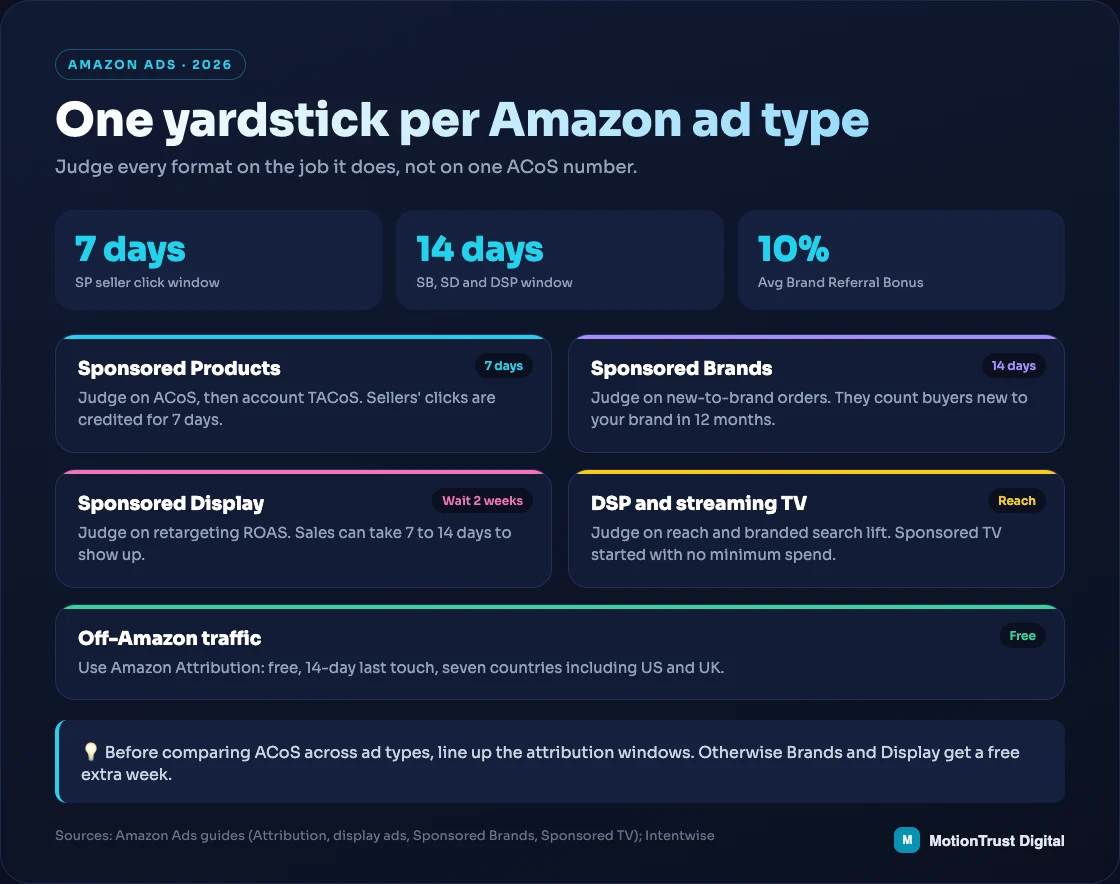
Most sellers judge all Amazon ad types on one number, usually ACoS. That makes Sponsored Products look brilliant and everything else look broken. Each type does a different job, so each needs its own yardstick.
One KPI per ad type
| Ad type | Judge it on | Why |
|---|---|---|
| Sponsored Products | ACoS, then account TACoS | It catches shoppers who already searched |
| Sponsored Brands | New-to-brand orders, branded search | Its job is winning first-time buyers |
| Sponsored Display | ROAS on retargeting audiences | It brings back people who looked and left |
| DSP and streaming TV | Reach, then lift in branded searches | Most viewers never click at all |
New-to-brand metrics count orders from shoppers who have not bought your brand on Amazon in the last 12 months. That is the honest test in Sponsored Products vs Sponsored Brands. A Sponsored Brands campaign with a higher ACoS can still be the one bringing in new customers.
Why ACoS across types is not like-for-like
The attribution windows differ between Amazon ad types. For sellers, Sponsored Products credits sales within 7 days of a click. Sponsored Brands, Sponsored Display and DSP use 14 days. A side-by-side ACoS table quietly gives the other formats a week of extra credit.
Display sales also arrive late. Amazon says it can take 7 to 14 days for a sale to be attributed, and advises waiting at least two weeks before you judge a campaign. So in any Amazon DSP vs Sponsored Display test, read results at least two weeks behind the calendar.
Sponsored TV: the self-serve TV option
Sponsored TV put ads on streaming TV with no minimum spend, for businesses of any size. Amazon has now folded it into its streaming TV ads offering across Prime Video, Twitch and Fire TV. Existing campaigns keep running. Check your console to see whether it is open in your marketplace.
Judge it on reach and branded search lift, never on ACoS.
Measuring Google and social traffic with Amazon Attribution
If you send shoppers from Google, Meta or email, Amazon Attribution shows which links sold. It is free and self-service. It uses a 14-day, last-touch model and works in seven countries, including the US and UK.
US brand owners get one more reason to set it up. The Brand Referral Bonus averages 10% of sales driven by non-Amazon marketing.
A sensible starting split across Amazon ad types for a new brand is mostly Sponsored Products, then a slice for Sponsored Brands once Brand Registry is done. Add Display and TV only when you can measure them. If you'd rather not juggle this yourself, our Amazon PPC management team sets each ad type its own target. You can also check our agency pricing, or see how we run Amazon product launch ads.
Amazon PPC management
Every ad type, measured on its own terms
If you'd rather spend your time on the product, we'll run your campaigns and give each ad type the target that fits its job, so nothing good gets cut by mistake.
See how we manage PPCQuestions people also ask
What are the different types of Amazon ads?
Four: Sponsored Products, Sponsored Brands, Sponsored Display and Amazon DSP. The first three are self-service sponsored ads bought inside the Amazon Ads console. The fourth is a demand-side platform that buys display, video, audio and streaming TV inventory across Amazon and the open web, and does not require you to sell on Amazon.
What is the difference between Amazon ad types and Amazon ad formats?
The type is the product you are buying — Sponsored Products, Sponsored Brands, Sponsored Display, DSP. The format is the creative inside it: static image, video, collections, audio, streaming TV. Sponsored Brands, for example, is one ad type with three formats.
Which Amazon ad types require Brand Registry?
Sponsored Brands requires enrollment in Amazon Brand Registry. Sponsored Display is less clear: Amazon's display ads guide says Brand Registry is required, while its FAQ says display ads are open to advertisers regardless of whether they sell on Amazon. Sponsored Products does not require Brand Registry, and neither does Amazon DSP.
What is the difference between Sponsored Display and Amazon DSP?
Sponsored Display is self-service, has no minimum spend and no management fee, and is bought in the Amazon Ads console. DSP has a self-service tier and a managed-service tier that typically requires a $50,000 minimum spend, carries a technology fee as a percentage of media cost, and reaches far more inventory including streaming TV and audio. Amazon is also consolidating the two into a single display offering, without publishing a transition date.
Which Amazon ad type is best for new sellers?
Sponsored Products, and only Sponsored Products, for the first sixty days. It has a $1 minimum daily budget, no eligibility barrier beyond a professional seller account and Featured Offer eligibility, and its search term report is what tells you which keywords are worth targeting in everything you do afterwards.
Which Amazon ad type is best for product launches?
Sponsored Products on tightly matched exact keywords, because launch advertising buys rank and relevance rather than immediate profit. Add Sponsored Brands once you have two or more products worth showing together. Judge the first thirty days on total sales rather than advertised sales.
How much do Amazon ads cost?
Sponsored Products and Sponsored Brands have a $1 minimum daily budget and no monthly or upfront fee. Sponsored Display has no minimum campaign spend, with default bids of $1 per click or $5 per thousand viewable impressions. Amazon DSP managed service typically requires a $50,000 minimum spend and adds a technology fee, audience fees and a managed-service fee on top of media cost.
Which Amazon ad type has the best ROI?
Sponsored Products, for almost every account, because it intercepts existing purchase intent rather than creating it. That is also why it saturates: once you are winning the searches that already exist, further growth has to come from formats with worse immediate ratios. A falling total advertising cost of sale across the whole account is a better signal than a good ACoS on one campaign.
Is Amazon Advertising the same as Amazon Marketing Services?
No. Amazon Marketing Services (AMS) was the older name and no longer exists as a product. The current products are Sponsored Products, Sponsored Brands, Sponsored Display and Amazon DSP. Material still written around "AMS" is old enough that its tactical advice should be checked before it is followed.
Is DSP part of Amazon?
Yes. Amazon DSP is Amazon’s own demand-side platform. It buys inventory on Amazon-owned properties including Prime Video, Twitch, Fire TV and Kindle, and on thousands of third-party sites and apps through Amazon Publisher Direct and external exchanges.
What is the difference between AMS and DSP?
AMS is a retired name for what is now Amazon Advertising’s sponsored ad products, bought per click inside the ads console. DSP is programmatic media buying, priced on media cost plus fees, reaching audiences who are not currently searching. They are not two tiers of the same thing.
Are Sponsored Products on Amazon better?
Better for the job most sellers have, which is converting demand that already exists. They are not better at building a brand, defending a branded search, retargeting a lapsed viewer, or reaching someone who has never heard of the category. Each of those has a format built for it.
Why is my Sponsored Brands ACoS higher than Sponsored Products?
Partly because the two do different jobs. Sponsored Brands bids on broader category terms and wins first-time buyers, while Sponsored Products often captures shoppers close to buying. The windows also differ: sellers' Sponsored Products ads credit sales within 7 days, Sponsored Brands within 14. Judge Sponsored Brands on new-to-brand orders as well as ACoS before cutting it.
Can I track sales from Google or Facebook ads to my Amazon listing?
Yes, with Amazon Attribution. It is free, self-service and available in seven countries including the US and UK. You create tagged links for each channel, and Amazon reports clicks, add-to-carts and sales within a 14-day, last-touch window. US brand owners can also earn a Brand Referral Bonus, which Amazon says averages 10% of the sales those links drive.
Written by Monjur Hossain, Founder & Amazon Strategy Lead at MotionTrust Digital, from the agency’s day-to-day work on client Amazon accounts and checked against the primary documentation listed under Sources below. Primary sources for this guide: Amazon Ads, About Amazon and Amazon Seller Central.
Every figure attributed to Amazon or to another named organisation links to that organisation’s own page, with the month it was accessed. Anything drawn from our own client accounts is labelled as ours rather than presented as an industry figure, and where no primary source publishes a number this guide says so instead of estimating one. Last reviewed .
- Amazon Ads — Sponsored Products, accessed September 2026.
- Amazon Ads — Sponsored Brands, accessed September 2026.
- Amazon Ads — Sponsored Display, accessed September 2026.
- Amazon Ads — Amazon DSP, accessed September 2026.
- Amazon Ads — Pricing transparency, accessed September 2026.
- Amazon Ads — Benchmarks reporting, 18 May 2026, accessed September 2026.
- Amazon Ads — Advertising in agentic shopping, 11 June 2026, accessed September 2026.
- About Amazon — Alexa for Shopping, 13 May 2026, accessed September 2026.
- Amazon Seller Central — Product title updates from 27 July 2026, accessed September 2026.
- Amazon Ads — Your complete guide to Amazon Attribution, accessed October 2026.
- Amazon Ads — Everything you need to know about display ads, accessed October 2026.
- Amazon Ads — Your complete guide to Sponsored Brands, accessed October 2026.
- Intentwise — Explained: How does Amazon attribute ad sales?, accessed October 2026.
Monjur Hossain
Founder & Amazon Strategy Lead, MotionTrust Digital
Monjur incorporated MotionTrust Digital in September 2022 and leads Amazon strategy across the client base. Eight years in e-commerce and marketplace marketing, now on Amazon only — keyword strategy, listing architecture and advertising structure for growing brands.
MonjurAgency