
What is ACoS, and what is a good ACoS?
 By Monjur HossainFounder & Amazon Strategy Lead
·
Published
·
Last reviewed
·9 min read
By Monjur HossainFounder & Amazon Strategy Lead
·
Published
·
Last reviewed
·9 min read
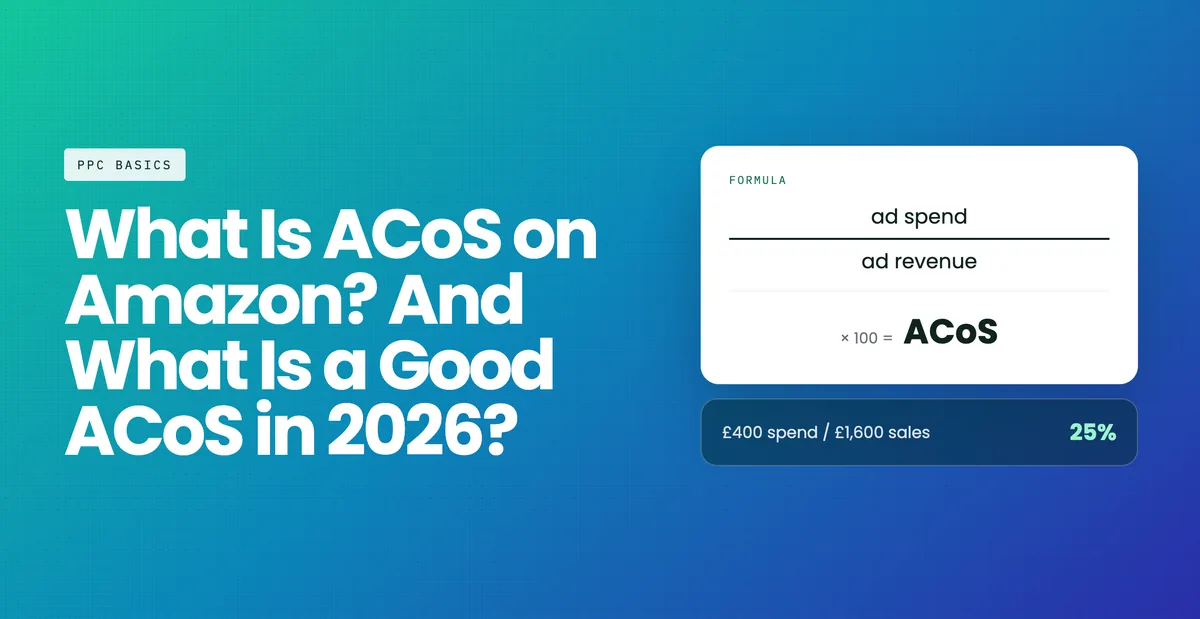
What is ACoS? It is advertising cost of sales: your ad spend divided by the sales those ads produced, times 100. Spend $50 and earn $100 in attributed sales, and your ACoS is 50%. A good ACoS sits below your profit margin before ad costs, so there is no single number that suits every seller.
How is ACoS calculated?
Spend £250 on Sponsored Products and generate £1,000 of advertised sales, and your ACoS is 25%. The figure counts only sales Amazon attributes to an ad click within the attribution window, which is why it never matches your total sales.
A lower ACoS is not automatically better. An ACoS of 5% usually means bids are too low to win meaningful volume — profitable, but on almost nothing.
What is a good ACoS?
Any ACoS below your break-even. The break-even is the point where an advertised sale contributes exactly nothing, and it comes from your own numbers:
Where net revenue is the selling price with VAT stripped out, and contribution is what remains after cost of goods, inbound shipping, the Amazon referral fee and the FBA fee.
| Contribution margin | Break-even ACoS | Sensible target |
|---|---|---|
| 45% | 45% | 25 – 30% |
| 35% | 35% | 20 – 25% |
| 25% | 25% | 12 – 18% |
| 15% | 15% | Under 10%, and advertising is marginal |
The profit and break-even ACoS calculator will work yours out from your own figures.
Break-even ACoS calculator
Get your own break-even in 30 seconds
Benchmarks tell you what other sellers spend. Our free calculator works from your price, fees and costs, so the target you set is one you can actually afford.
Work out my break-evenWhy do category benchmarks mislead?
Because ACoS is a ratio, and the denominator is your price while the numerator is an auction cost. Two sellers in the same category with the same ACoS can have completely different outcomes if their margins differ.
A quoted "average ACoS for Home & Kitchen" tells you what other people are spending, not what you can afford. It is a useful sanity check on whether your bids are wildly out of line, and nothing more. Anyone setting your target from a benchmark has skipped the only step that matters.
What is the difference between ACoS, TACoS and ROAS?
| Metric | Formula | What it tells you |
|---|---|---|
| ACoS | Ad spend ÷ ad sales | Efficiency of the advertising itself |
| TACoS | Ad spend ÷ total sales | How dependent the whole account is on advertising |
| ROAS | Ad sales ÷ ad spend | The same information as ACoS, inverted. 4× ROAS is a 25% ACoS |
TACoS is the number to watch at account level. A falling TACoS with flat ACoS means organic sales are growing underneath the advertising, which is what good work looks like. A rising TACoS means the account is becoming more dependent on paid traffic, even if ACoS looks healthy.
The reason TACoS moves at all is that advertising produces sales, and sales velocity feeds organic rank — the mechanism is set out in how Amazon's ranking algorithm works. That is also why a campaign generating clicks without conversions is worse than useless: it spends money and depresses the conversion rate that rank depends on. What a well-structured account looks like is covered on the PPC management page.
Free PPC audit tool
See where your ACoS is leaking
Paste your search term report and we will total the spend that produced no sales. It is usually the quickest way to bring ACoS down without losing volume.
Run my free PPC auditWhat if your ACoS is too high?
Four causes, in the order worth checking:
- Wasted spend on non-converting terms. Usually the largest single item. Pull the search term report and total the spend that produced no sales.
- Brand terms mixed into the blended figure. Brand defence converts at several times the rate of everything else; leaving it in flatters a struggling account and hides the real problem.
- A listing that does not convert. If clicks arrive and nobody buys, advertising is not the problem — the destination is. Fix that first.
- Bids set above what the term is worth. The last thing to adjust, not the first.
Our free PPC audit tool handles the first two in about a minute from a pasted search term report.
Does VAT change your break-even ACoS?
Yes, and it is the single most common error in UK break-even calculations. Amazon advertising costs are compared against the sales figure Amazon reports, which is VAT-inclusive for a VAT-registered seller — but the VAT portion is never yours. Working from the gross price overstates your margin and therefore your break-even, so the target ACoS you set is one you cannot actually afford.
The order that gets it right:
- Strip VAT from the selling price to get net revenue — at the standard 20% rate, that is the gross price divided by 1.2, though some categories are zero-rated or reduced.
- Subtract cost of goods, inbound shipping, the referral fee and the FBA fee from net revenue.
- Divide what remains by net revenue. That percentage is your break-even ACoS.
On a £24 item at the standard rate, net revenue is £20, not £24. If your costs are £13, contribution is £7 and break-even ACoS is 35% of net revenue — whereas the same sum run on the gross price suggests 46%. Advertising at 40% would look comfortably profitable and would in fact be losing money on every sale.
Which rate applies is a question for HMRC's rates guidance rather than for an advertising tool, and if you are below the registration threshold the calculation is simply the gross price — see when to register for VAT and our fuller guide to Amazon UK VAT for sellers. The profit calculator handles the VAT step for you, which is mostly why it exists.
What is ACoS made of, and how do you set a target you can trust?
Most guides stop at the formula. But when sellers ask what is ACoS, the useful answer is what moves it. Three numbers sit underneath every ACoS figure, and each needs a different fix.
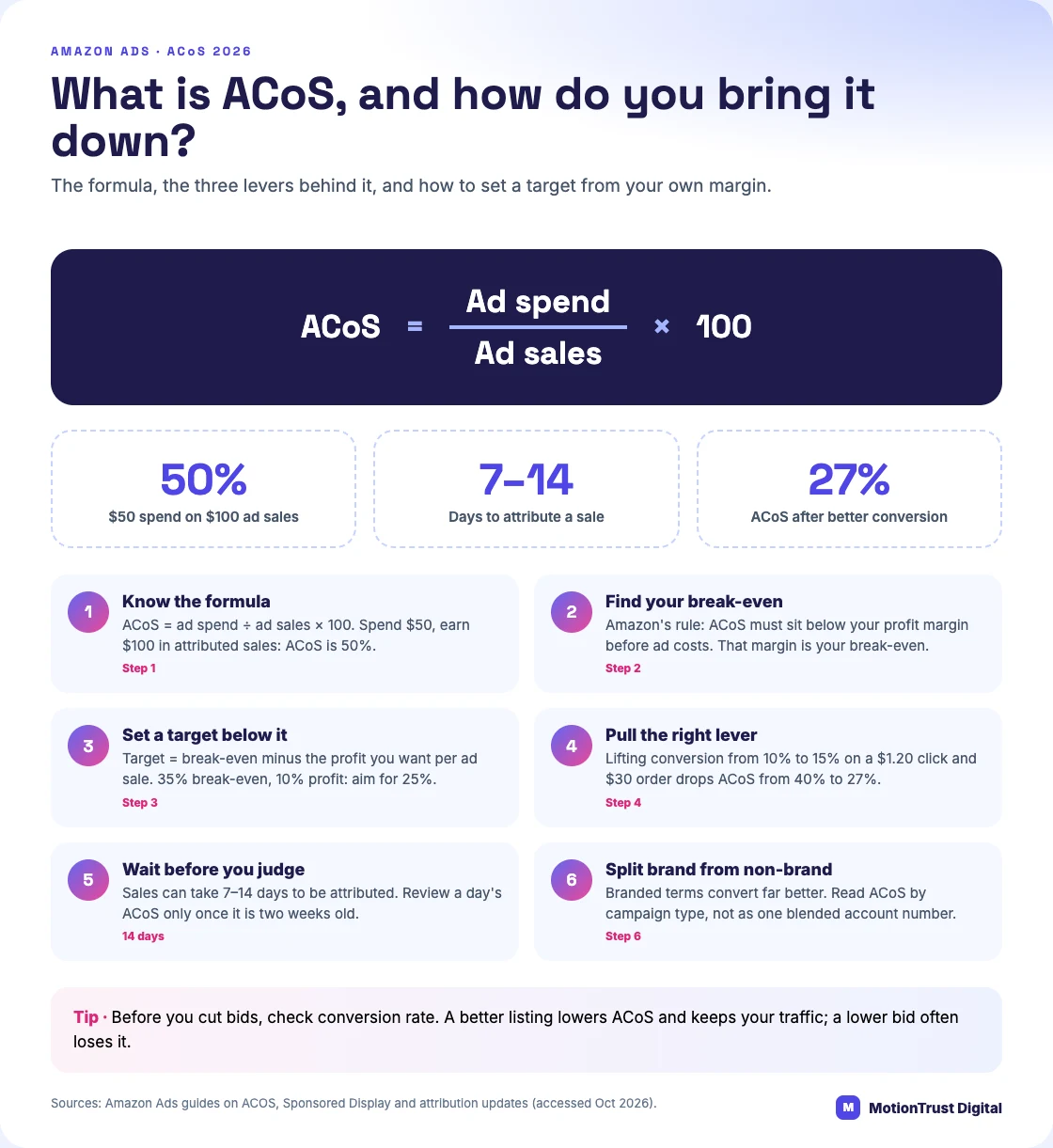
The three levers: cost per click, conversion rate and order value
ACoS is the cost of winning one sale, divided by the value of that sale. So it can be written as cost per click ÷ (conversion rate × average order value). Here is how each lever changes the result, starting from a $1.20 click.
| Scenario | CPC | Conversion | Order value | ACoS |
|---|---|---|---|---|
| Starting point | $1.20 | 10% | $30 | 40% |
| Better listing | $1.20 | 15% | $30 | 27% |
| Bundle raises order value | $1.20 | 10% | $40 | 30% |
| Lower bid | $0.90 | 10% | $30 | 30% |
Cutting bids is only one route, and it often costs you impressions. A listing that converts better lowers ACoS without losing volume. That is how to lower ACoS without shrinking the account.
Break-even ACoS vs target ACoS
Amazon's own guidance is simple: your ACoS needs to be lower than your profit margin. That margin, before ad costs, is your break-even ACoS. At that point an ad sale earns you nothing.
Your target ACoS is break-even minus the profit you want to keep on each advertised sale. With a 35% break-even and 10% profit wanted, your target is 25%. For a launch you might accept a target close to break-even for a few weeks. For a mature product, keep a wider gap.
Why last week's ACoS keeps changing
Amazon says it can take 7–14 days for sales to be attributed to a click or view on an ad. So Monday's ACoS can look poor on Tuesday and fine by the following week. Judge a day's results only after 14 days.
From 1 January 2026, Amazon also changed attribution for Sponsored Brands and Sponsored Display campaigns billed on viewable impressions. The default model now credits early discovery views more, with a shorter window. If you compare ACoS across that date, you are not comparing like with like.
Read it by campaign type
Branded searches convert far better than generic ones. Blend them, and one account figure hides a weak non-branded campaign. That is the honest answer to what is ACoS telling you: one ratio, best read campaign by campaign.
Work out your break-even with our break-even ACoS calculator, then run an Amazon PPC audit on your search terms. If you would rather hand it over, see our Amazon PPC management.
Amazon PPC management
Want ACoS handled against your real margin?
If you would rather not watch ACoS every morning, we can manage your campaigns against a target built from your own numbers, and explain every change we make.
See how we manage PPCQuestions people also ask
What does ACoS mean on Amazon?
ACoS stands for advertising cost of sale. It is your advertising spend divided by the sales those adverts produced, expressed as a percentage. Spend £250 and generate £1,000 in advertised sales and your ACoS is 25%.
What is a good ACoS on Amazon?
Any ACoS below your break-even, which is set by your contribution margin after Amazon fees and VAT rather than by a category benchmark. A brand on a 45% margin can profitably run 30% ACoS; a brand on 20% cannot.
Is a lower ACoS always better?
No. A very low ACoS usually means bids are too low to win meaningful volume — profitable on almost nothing. The aim is the most profit, not the lowest ratio, which often means accepting a higher ACoS on terms that scale.
What is the difference between ACoS and TACoS?
ACoS measures ad spend against advertised sales only. TACoS measures ad spend against total sales including organic. TACoS is the better account-level measure: a falling TACoS means organic sales are growing underneath the advertising.
How do I calculate my break-even ACoS?
Strip VAT from your selling price to get net revenue, then subtract cost of goods, inbound shipping, the Amazon referral fee and the FBA fee. What remains is contribution. Contribution divided by net revenue, as a percentage, is your break-even ACoS.
Should I use the VAT-inclusive price when working out ACoS?
No, if you are VAT-registered. Amazon reports sales gross, but the VAT portion is never yours, so calculating from the gross price overstates your margin and gives you a target ACoS you cannot afford. Strip VAT first: on a £24 item at the standard rate, net revenue is £20.
What is the difference between break-even ACoS and target ACoS?
Break-even ACoS is your profit margin before advertising, the point where an ad sale earns nothing. Target ACoS is lower: break-even minus the profit you want to keep on each advertised sale. With a 35% break-even and a 10% profit goal, your target is 25%. During a launch you might run closer to break-even for a short time.
Why does my ACoS change after the day has ended?
Because sales keep being credited to earlier clicks. Amazon says it can take 7–14 days for a sale to be attributed to the click or view that led to it. So a day's ACoS often starts high and falls as late sales arrive. Wait at least 14 days before judging a day or week, and compare periods of the same age.
Written by Monjur Hossain, Founder & Amazon Strategy Lead at MotionTrust Digital, from the agency’s day-to-day work on client Amazon accounts and checked against the primary documentation listed under Sources below. Primary sources for this guide: Amazon Ads, Amazon Seller Central UK and HM Revenue & Customs.
Every figure attributed to Amazon or to another named organisation links to that organisation’s own page, with the month it was accessed. Anything drawn from our own client accounts is labelled as ours rather than presented as an industry figure, and where no primary source publishes a number this guide says so instead of estimating one. Last reviewed .
- Amazon Ads — Amazon Ads help centre (UK), accessed August 2026.
- Amazon Seller Central UK — Referral and FBA fee schedule, accessed August 2026.
- HM Revenue & Customs — Rates of VAT on different goods and services, accessed August 2026.
- Amazon Ads — What is advertising cost of sales (ACOS)?, accessed October 2026.
- Amazon Ads — Everything you need to know about display ads, accessed October 2026.
- Amazon Ads — View attribution updates for Amazon Store ads, accessed October 2026.
Monjur Hossain
Founder & Amazon Strategy Lead, MotionTrust Digital
Monjur incorporated MotionTrust Digital in September 2022 and leads Amazon strategy across the client base. Eight years in e-commerce and marketplace marketing, now on Amazon only — keyword strategy, listing architecture and advertising structure for growing brands.
MonjurAgencyTry the free tools
Seven Amazon tools that run in your browser — profit and ACoS calculator, PPC auditor, listing checker and more. No account, nothing uploaded.
Try the free toolsLast reviewed . We update articles in place rather than republishing at a new URL, so the link you have keeps working.
Keep your ACoS target working for you
Break-even ACoS is the starting point. One email a week with our newest PPC articles on targets, bids and wasted spend, plus listings and SEO if you want them. Email us to join.