
What does an Amazon agency cost in the UK?
 By Monjur HossainFounder & Amazon Strategy Lead
·
Published
·
Last reviewed
·11 min read
By Monjur HossainFounder & Amazon Strategy Lead
·
Published
·
Last reviewed
·11 min read
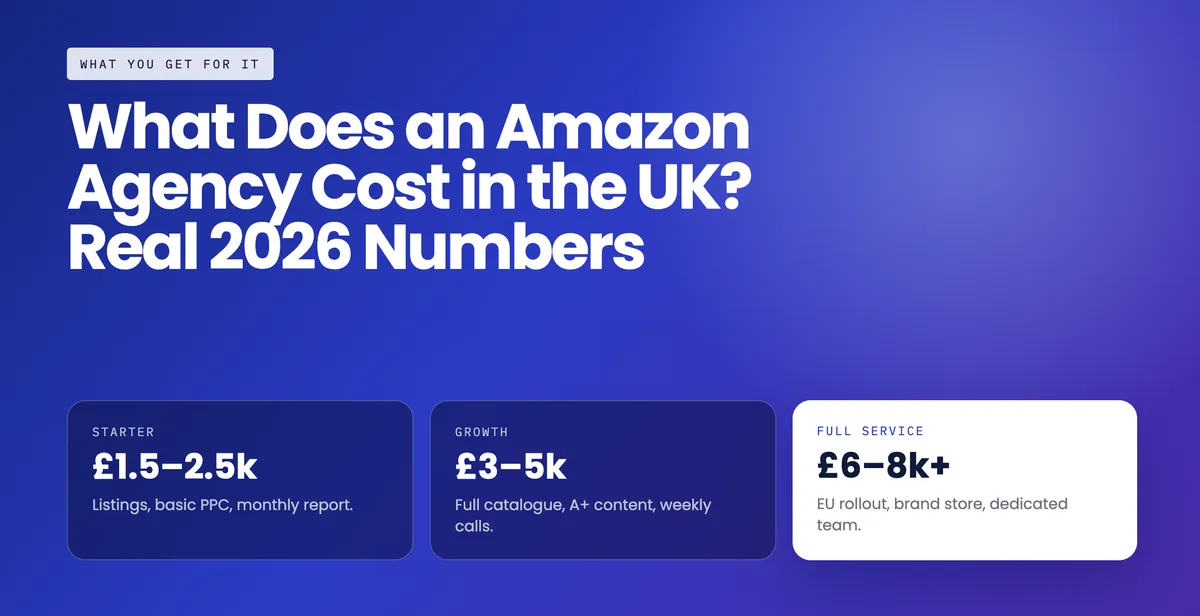
Amazon agency cost in the UK is usually £750 to £6,000 a month for a management retainer, with £1,000 to £2,500 covering most small and mid-sized sellers. Ad spend is paid to Amazon separately. A UK agency adds 20% VAT, which registered sellers reclaim. Project work usually costs £300 to £2,500.
What is the actual Amazon agency cost in 2026?
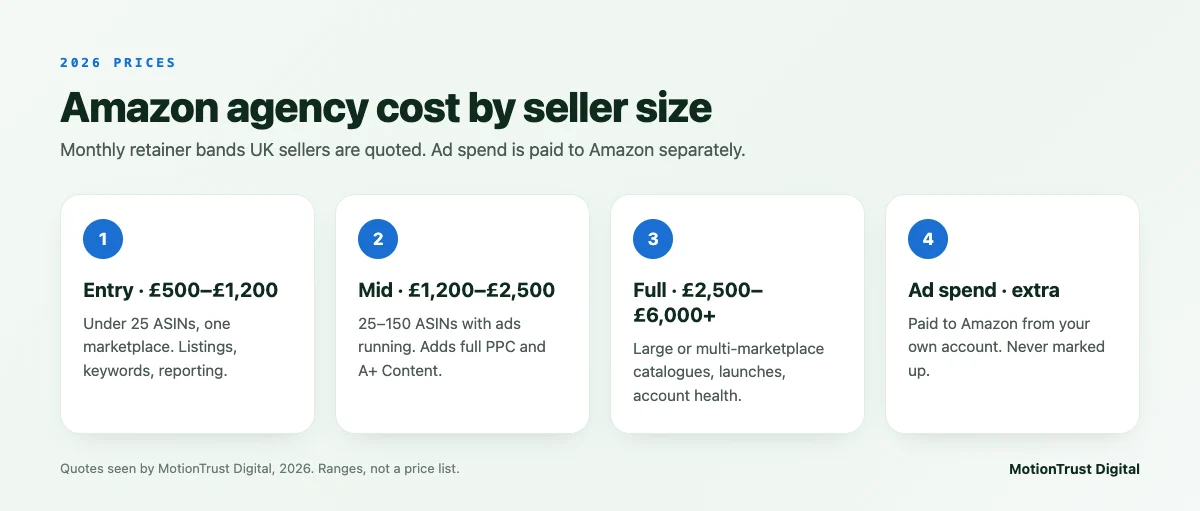
Retainers cluster into three bands. The figures below are what UK sellers are quoted; our own published tiers sit inside them, which is the point of publishing them.
| Band | Monthly fee | Who it suits | Typically includes |
|---|---|---|---|
| Entry | £500 – £1,200 | Under 25 ASINs, one marketplace | Listing work, keyword research, monthly reporting |
| Mid | £1,200 – £2,500 | 25–150 ASINs, advertising running | The above plus full PPC management and A+ Content |
| Full management | £2,500 – £6,000+ | Large catalogues, multi-marketplace | Catalogue management, launches, EU expansion, account health |
Anything materially below £500 a month is usually one junior person managing many accounts to a template. Anything above £6,000 is normally a team of specialists, which some catalogues genuinely need.
For comparison, our own retainers are $999, $1,999 and $3,499 a month, published in full with what is in each tier. UK clients are invoiced the GBP figure set in their written scope.
Amazon agency pricing
See exactly what our retainers include
We publish our tiers in full, with what is in each one, so you can compare us like for like with any other quote you have.
View our pricingHow do agencies actually charge — retainer, percentage or project?
Four models are common in the UK, and they behave very differently once your revenue moves.
| Model | How it works | Watch for |
|---|---|---|
| Flat retainer | A fixed monthly fee for an agreed scope | Scope creep in the agency's favour, or yours |
| Percentage of ad spend | Commonly 10–20% of monthly media spend | The incentive is to spend more, not to spend well |
| Percentage of revenue | Commonly 3–8% of Amazon sales | You pay on sales you would have made anyway |
| Per project | Fixed price for a defined deliverable | Nothing, if the deliverable is defined precisely |
A flat retainer is the only model where the agency's incentive and yours point the same way. A percentage of ad spend rewards spending; a percentage of revenue charges you for your own baseline. If you are offered a percentage model, ask what happens in a month where the right decision is to spend less.
What is never included in the fee?
Four costs sit outside almost every retainer. If a quote does not mention them, ask.
- Advertising spend. Paid to Amazon from your own account. It should never be invoiced by the agency and never marked up.
- Amazon Vine fees. Paid to Amazon per enrolled parent ASIN under its own Vine programme terms.
- Photography and design production. Most agencies brief and direct; the shoot is quoted separately.
- Translation for EU marketplaces. Priced per marketplace when you expand.
- "What is the total I will pay you in month one, and in month twelve?"
- "What is paid to Amazon rather than to you, and roughly how much?"
- "What would take this out of scope?"
What contract terms should you check before signing?
Five terms decide what a retainer really costs you: the initial term, the notice period, whether it auto-renews, who owns the work, and what happens to your advertising account if you leave. The monthly fee is the number people negotiate; these are the terms that cost them.
| Term | What to ask for | Why it matters |
|---|---|---|
| Initial term | The exact number of months, in writing | Amazon work takes a quarter to show, so a short term suits neither side — but twelve months before any review is a long time to be wrong |
| Notice period | Thirty days after the initial term is common | A ninety-day notice period on a monthly rolling contract is a nine-month contract wearing a disguise |
| Auto-renewal | Whether it renews silently, and when you must act | Auto-renewal with a long notice window is the single most common way sellers end up paying for a year they did not intend |
| Ownership of work | Copy, images, A+ modules and keyword research assigned to you | If the agency owns the creative, leaving means rebuilding your listings |
| Account access | Your Seller Central and Amazon Ads accounts stay in your name | An agency-owned ad account is not portable; your campaign history leaves with them |
Two of these are worth insisting on regardless of who you hire. Keep your own Amazon Ads account in your company's name, and keep Brand Registry enrolled to your business rather than to an agency's. Both are free, both are yours, and both are painful to unpick afterwards. Brand Registry needs a registered or pending trade mark, which you apply for through the UK Intellectual Property Office — in your own name, not your agency's.
Ask for the contract before the proposal call, not after it. An agency that will not send terms until you have agreed a price has told you something about how the rest of the relationship will go.
What makes the price go up or down?
Five things move a quote more than anything else:
- Catalogue size. The jump from 20 ASINs to 200 is the single biggest driver, because listing work scales with SKU count.
- Number of marketplaces. Adding Amazon.de or Amazon.fr adds translation, VAT and a separate advertising account.
- Whether advertising is included. PPC management is the most labour-intensive part of a retainer.
- Account health risk. A suspended or flagged account needs specialist time, usually priced per case.
- Brand Registry status. Without it there is no A+ Content, no Vine and no Sponsored Brands, so there is less work to do — and less that can be done.
Amazon profit calculator
Check your margin before you hire anyone
Whether a retainer pays for itself comes down to your contribution margin. Pop your numbers into our free calculator and you will know in a minute.
Work out my marginIs an agency worth it at your revenue?
Whether the Amazon agency cost pays for itself is arithmetic you can do yourself. A £1,200 monthly retainer needs to produce roughly £4,000 to £6,000 of additional monthly revenue to pay for itself at a typical 20–30% contribution margin. Below about £10,000 a month in Amazon revenue, that is a large ask.
Under roughly £10k a month, a one-off listing project or a few hours of consulting usually returns more than a retainer. Above £30k a month, the maths generally works, because the same percentage improvement is applied to a bigger base.
Our profit and break-even ACoS calculator will do the margin part for you in about thirty seconds.
How do you compare two quotes that are not like for like?
Put both quotes on the same basis before you compare the numbers: total twelve-month cost, scope written as deliverables rather than adjectives, and who does the work. Two quotes for “full Amazon management” can differ by a factor of three and still both be honest, because the phrase means nothing on its own.
Normalise four things:
- Total cost over twelve months, including setup. A £900 retainer with a £2,000 onboarding fee is £12,800 a year, not £10,800 — more than a £1,000 retainer with no setup charge.
- Scope as a list of deliverables. “Listing optimisation” should read as a number of ASINs, a number of revisions, and whether images and A+ Content are included or briefed.
- Advertising treatment. Is media spend included, excluded, or charged as a percentage? Percentage-of-spend quotes get more expensive precisely when you scale.
- Named people and hours. Ask who works on the account and roughly how many hours a month it gets. An agency that will not answer is quoting a template.
Then ask both agencies the same three questions and compare the answers rather than the decks: what would you do in the first thirty days, what would you refuse to do, and what does your monthly report actually look like. The CMA's guidance on unfair commercial practices is a useful yardstick for the claims in a pitch: performance figures presented without the context that makes them meaningful are a problem for the agency making them, not a selling point.
If the quotes are close and you still cannot separate them, take the free audit from each. What an agency notices about your account before it is being paid is the most reliable sample of the work you will get afterwards. Our own is a written document rather than a call, and there is a fuller picture of the day-to-day work in what an Amazon agency actually does and across the eight services we run.
What adds to the Amazon agency cost beyond the monthly retainer?
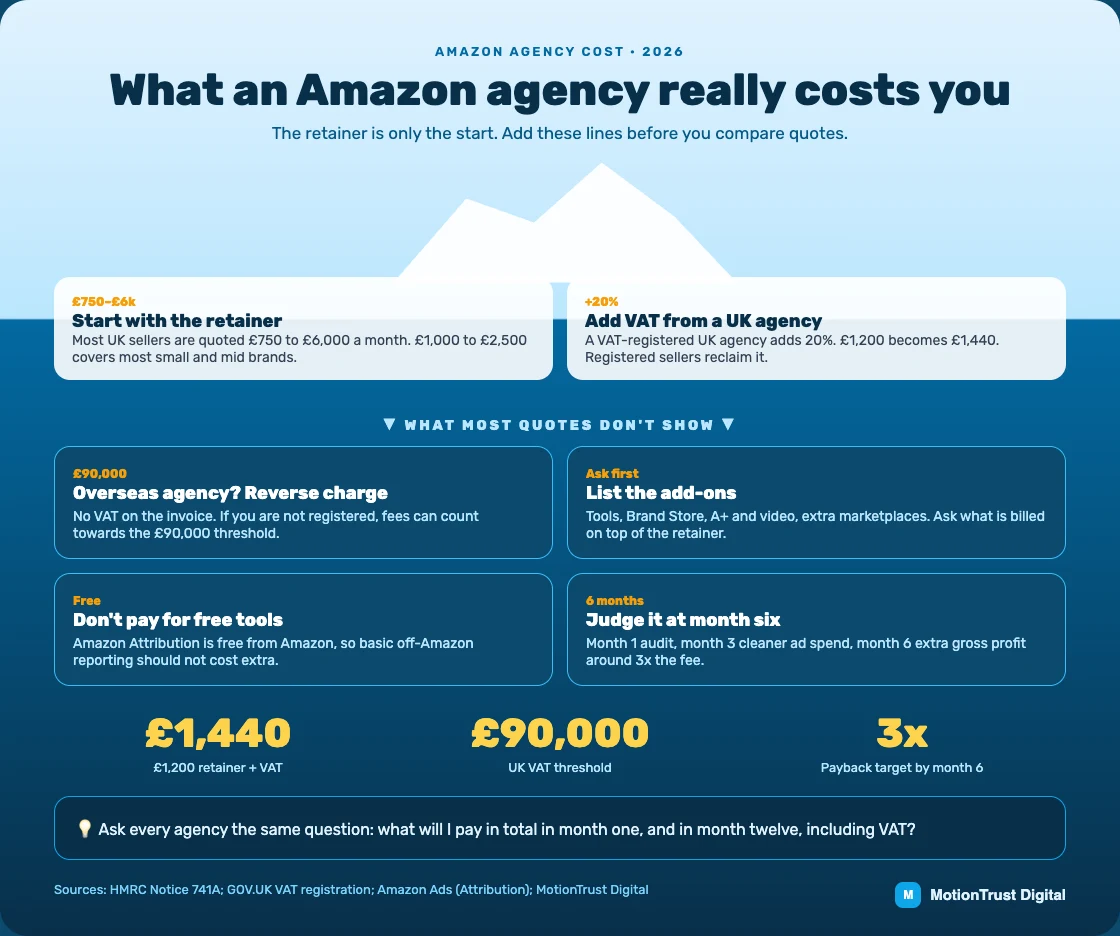
The retainer is the number on the proposal. It is rarely the whole Amazon agency cost. Three things change the real figure: VAT on the invoice, add-ons outside the scope, and how long the work takes to pay back. Here is how to price each one in before you sign.
Do you pay VAT on an Amazon agency's fees?
It depends on where the agency is based and whether you are VAT registered. This table shows the common cases for a UK seller on a £1,200 monthly retainer.
| Agency | You are VAT registered | You are not VAT registered |
|---|---|---|
| UK agency, VAT registered | Invoice is £1,440. You reclaim the £240 | You pay £1,440. The £240 is a cost |
| Agency based outside the UK | No VAT on the invoice. You apply the reverse charge, which usually nets to nil | No VAT on the invoice, but the fee can count towards your £90,000 registration threshold |
That last cell surprises people. HMRC says reverse-charge services you buy are added to your own taxable supplies when you test the threshold. A £3,000 monthly retainer from a US or EU agency adds £36,000 a year to that test. This is general guidance, not tax advice, so check your own position with your accountant.
The add-ons that sit outside most retainers
- Software pass-through. Some agencies recharge keyword or bid tools. Ask whether that is included or billed on top.
- Creative production. Brand Store builds, A+ modules and video are often quoted per project.
- Extra marketplaces. Each new Amazon store usually adds its own fee.
- Measurement. Amazon Attribution is free from Amazon, so basic off-Amazon reporting should not carry a premium.
How long before an agency pays for itself?
Give it a quarter before you judge. Month one is mostly audit and rebuild. By month three, you should see tidier ad spend and a falling TACoS. By month six, the extra profit should clearly exceed what you pay.
Our own rule of thumb is about 3x the fee in additional gross profit by then. If it is not there, ask why in writing.
Why Vendor Central and offshore quotes look different
Vendor Central work often costs more. It adds retail negotiations, chargebacks and purchase-order planning. Offshore agencies can quote lower, but check time-zone cover and who owns your Amazon Ads account.
The true Amazon agency cost is the retainer, plus any VAT you cannot reclaim, plus the add-ons. Compare that total against our published Amazon agency pricing UK. If you only need ads, see what Amazon PPC management costs on its own.
Free Amazon account audit
Get a feel for the work before you pay for it
Our free audit is a written review of your listings, ads and fees. It is the fairest sample of how we work, and it is yours to keep whoever you hire.
Request my free auditQuestions people also ask
How much does an Amazon agency cost per month in the UK?
Most UK Amazon agencies charge £750 to £6,000 a month, with £1,000 to £2,500 covering the majority of small and mid-sized sellers. Advertising spend is separate and paid to Amazon directly. Anything under £500 a month usually means one person managing many accounts to a template.
Do Amazon agencies charge a percentage of sales?
Some do — commonly 3–8% of Amazon revenue, or 10–20% of advertising spend. A flat retainer is generally fairer, because a percentage of ad spend rewards the agency for spending more and a percentage of revenue charges you for the baseline you would have had anyway.
Is ad spend included in an Amazon agency retainer?
It should not be. Advertising spend is paid to Amazon directly from your own Seller Central account, so you keep full visibility of it. If an agency invoices media spend through its own account, ask why and check whether it is marked up.
What is the minimum contract for an Amazon agency?
Three to twelve months is typical in the UK, and twelve-month auto-renewing terms are common. Ask for the initial term and the notice period in writing before signing. Our own retainers run month to month after an initial term, with no auto-renewal.
Should the agency own my Amazon Ads account?
No. Keep Seller Central, Amazon Ads and Brand Registry in your own company's name and grant the agency user-level access instead. An agency-owned advertising account is not portable, so your campaign and search-term history leaves with the agency when the engagement ends. Access can be revoked in a minute; rebuilding two years of advertising data cannot.
Is a setup or onboarding fee normal?
It is common, and reasonable when there is genuine one-off work — a catalogue audit, a keyword build, a listing rewrite. What matters is that you count it. Add any setup fee to twelve months of retainer before comparing two quotes, because a low monthly figure with a large onboarding charge often costs more over a year than the quote that looked dearer.
Do I pay VAT on an Amazon agency's fees in the UK?
If the agency is UK-based and VAT registered, it adds 20% to its invoice, so a £1,200 retainer becomes £1,440. Registered sellers reclaim that VAT. If the agency is overseas, there is no VAT on the invoice and you apply the reverse charge. If you are not registered, those fees can count towards the £90,000 registration threshold.
How long does an Amazon agency take to show results?
Allow about three months before judging. The first month is usually audit and rebuilding, so results lag the fee. By month three you should see cleaner ad spend and a falling TACoS. By month six, the extra gross profit should clearly exceed the retainer. If it does not, ask the agency to explain why in writing.
Written by Monjur Hossain, Founder & Amazon Strategy Lead at MotionTrust Digital, from the agency’s day-to-day work on client Amazon accounts and checked against the primary documentation listed under Sources below. Primary sources for this guide: Amazon Seller Central UK, Competition and Markets Authority, UK Intellectual Property Office and MotionTrust Digital.
Every figure attributed to Amazon or to another named organisation links to that organisation’s own page, with the month it was accessed. Anything drawn from our own client accounts is labelled as ours rather than presented as an industry figure, and where no primary source publishes a number this guide says so instead of estimating one. Last reviewed .
- Amazon Seller Central UK — Selling on Amazon fee schedule, accessed August 2026.
- Amazon Seller Central UK — Amazon Vine programme terms, accessed August 2026.
- Competition and Markets Authority — Unfair commercial practices (CMA207), accessed August 2026.
- UK Intellectual Property Office — Register a trade mark, accessed August 2026.
- MotionTrust Digital — published retainer pricing, August 2026.
- HM Revenue & Customs — VAT: place of supply of services (Notice 741A), accessed October 2026.
- GOV.UK — VAT registration: when to register, accessed October 2026.
- Amazon Ads — Amazon Attribution, accessed October 2026.
Monjur Hossain
Founder & Amazon Strategy Lead, MotionTrust Digital
Monjur incorporated MotionTrust Digital in September 2022 and leads Amazon strategy across the client base. Eight years in e-commerce and marketplace marketing, now on Amazon only — keyword strategy, listing architecture and advertising structure for growing brands.
MonjurAgencyBook a 30-minute call
No pitch deck, no obligation, and we will tell you plainly if we are not the right fit. Our pricing is published, so there is nothing to reveal on the call.
Book a Strategy CallLast reviewed . We update articles in place rather than republishing at a new URL, so the link you have keeps working.
Know what good Amazon work looks like before you pay for it
Our newest articles on PPC, listings, SEO and reviews, once a week: the same work an agency quote covers, explained so you can judge it for yourself. Email us to join.