
What does an Amazon agency actually do?
 By Monjur HossainFounder & Amazon Strategy Lead
·
Published
·
Last reviewed
·11 min read
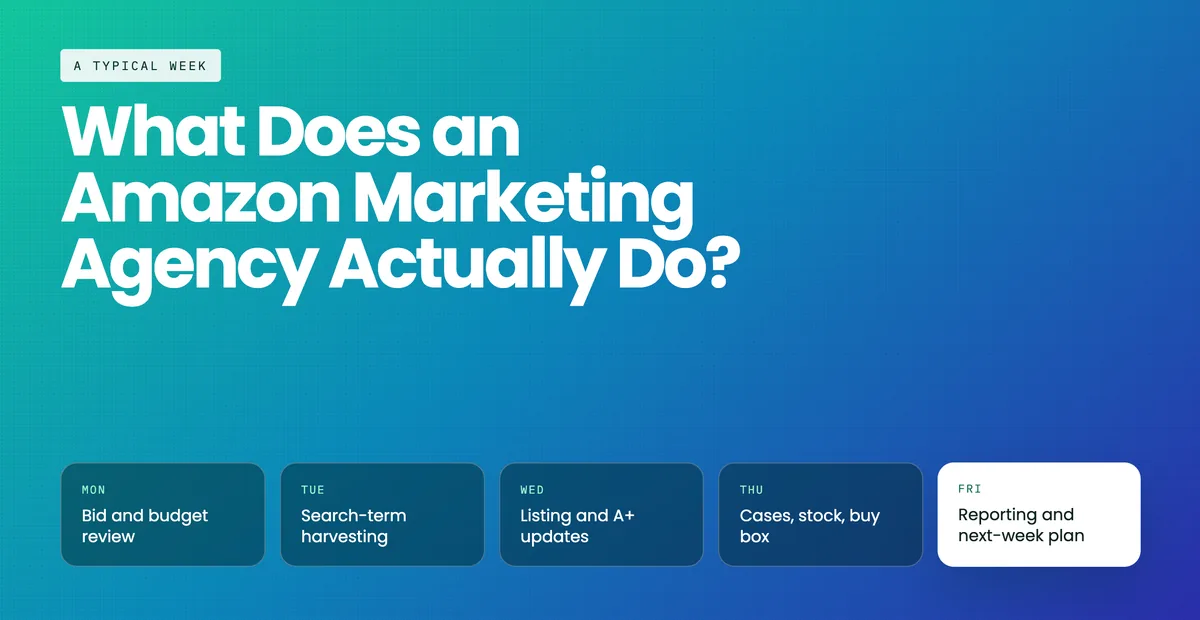
An Amazon agency runs the work that gets products found and bought on Amazon: keyword research, listing copy and images, Amazon SEO, PPC, launches, review compliance and account health. Some are full-service; others specialise in ads, creative, Vendor Central or brand protection. Most charge a monthly retainer and report against targets agreed in advance.
What services does an Amazon agency provide?
Seven pieces of work make up almost every Amazon retainer. An agency may do all of them or specialise in two or three.
| Service | What it involves | Who needs it |
|---|---|---|
| Keyword research | Building the term set from Amazon search data and mapping each term to a placement | Everyone, before anything else |
| Listing optimisation | Title, bullets, backend search terms, A+ Content, images | Sellers whose traffic does not convert |
| Amazon SEO | Organic rank: indexing, conversion rate, sales velocity | Sellers who convert but are not seen |
| PPC management | Sponsored Products, Brands and Display against a target ACoS | Anyone spending on Amazon Ads |
| Product launch | Pre-launch strategy through the first ninety days | New products and new categories |
| Review management | Vine, Request a Review, compliant inserts, responses | Products below the category review count |
| Account health | Policy monitoring, suppressed listings, appeals | Everyone, quietly, all the time |
Amazon PPC management
Most of the weekly work is in your ads
Search term reports, negatives and bid changes are where we spend most of our week for clients. If your campaigns have been left to run on their own, we are happy to take a look.
See our PPC managementWhat does an agency actually do in a normal month?
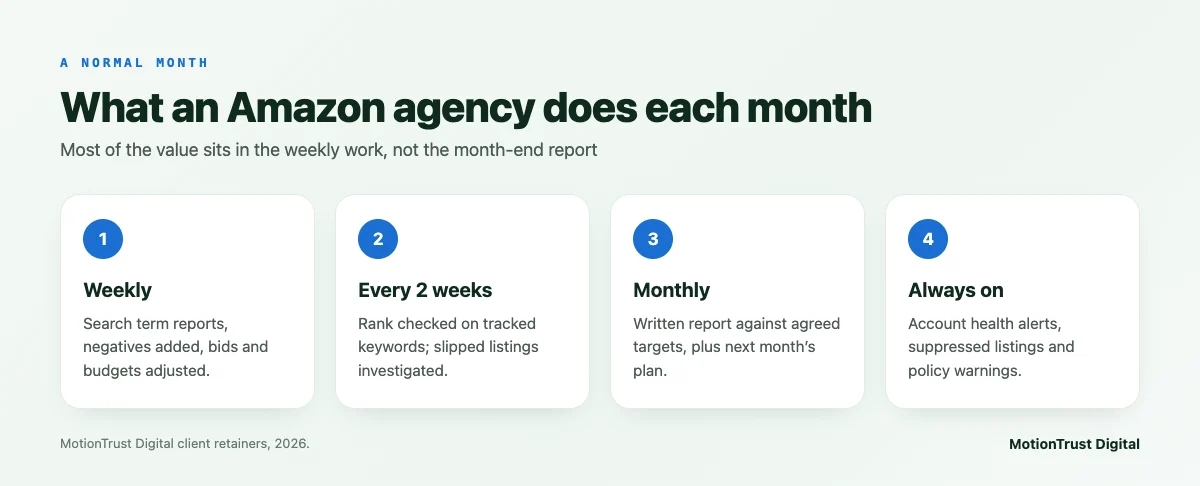
Stripped of the language, a month of retainer work usually looks like this:
- Weekly. Search term reports pulled, negatives added, bids adjusted, budget moved between campaigns.
- Fortnightly. Rank positions checked against the tracked keyword set; any listing that has slipped is investigated.
- Monthly. A written report against agreed targets, plus the plan for next month.
- Continuously. Account health notifications, suppressed listings and policy warnings dealt with as they arrive.
- As needed. New product listings built, A+ Content refreshed, seasonal pricing and advertising adjusted.
Most of the value is in the weekly work. An agency that only appears at month end to send a report is not managing the account, it is describing it.
On price, our own retainers are published at $999, $1,999 and $3,499 a month, with what each tier includes, on our agency pricing page.
Free Amazon audit
Start with an honest baseline
Before anyone changes a thing, we will look at your listings, ads and account health and tell you plainly what we would fix first. It is free, and you keep the findings either way.
Get my free auditWhat should an agency deliver in the first ninety days?
The first ninety days should produce a diagnosis, a rebuilt foundation and a measurable baseline — in that order. An agency that starts by raising advertising spend in week one has skipped the first two.
| Period | What should happen | What you should receive |
|---|---|---|
| Days 1–30 | Account audit, keyword build, listing and advertising diagnosis, account health check | A written audit and a prioritised plan, not a dashboard login |
| Days 31–60 | Listings rewritten and re-indexed, campaign structure rebuilt, negatives applied, tracking set up | A record of what changed on which ASIN, and when |
| Days 61–90 | Bids and budgets tuned against the target, rank tracked on the priority terms | The first report you can compare to the baseline |
Ask for the baseline in writing at the start: current sessions, conversion rate, organic rank on your top terms, advertising cost of sale and total advertising cost of sale. Without it, month three has nothing to be measured against, and every subsequent report becomes a story rather than a comparison. Our free listing checker and PPC audit tool will give you a rough version of that baseline yourself before anyone quotes you.
Ninety days is also the fairest point to judge the work. Amazon rank responds to conversion and sales velocity over weeks, not days, so a fortnight tells you nothing and a year is too long to wait to find out.
What can an Amazon agency not do?
This is the more useful list, and it is short.
- Guarantee a ranking position. Rank depends on your price, reviews, stock and competitors. Nobody controls all four.
- Guarantee an ACoS. Advertising cost of sale is set by an auction you do not own.
- Guarantee reinstatement. The decision belongs to Amazon alone.
- Get you reviews outside Amazon's rules. Buying, incentivising or gating reviews breaches the Amazon Community Guidelines and can suspend the account.
- Fix a product problem with marketing. If forty per cent of your reviews mention the same fault, no amount of optimisation outruns it.
An agency promising any of the first four is either inexperienced or telling you what you want to hear. Both cost the same.
Does it matter that an agency is UK-based?
For Amazon.co.uk sellers, yes — but not for the reason people assume. Time zone is the smallest part of it.
The substantive differences are that Amazon.co.uk has its own search volume distribution and its own vocabulary, that UK VAT is charged on the sale price before Amazon's referral fee is calculated, that category gating requirements differ from Amazon.com, and that UK product safety and Trading Standards information belongs in the listing itself.
A listing adapted from an Amazon.com original routinely indexes for terms British buyers never type. We wrote about that in more detail in Amazon UK VAT for sellers.
How do you tell a good Amazon agency from a bad one?
Four questions separate them quickly, and none of them is about price.
- "What is your pricing?" If the answer requires a call, ask why.
- "Show me a report you send clients." A real one, redacted. If reporting is a dashboard login rather than a written view, nobody is analysing anything.
- "What would you not do for us?" An agency with no refusals has no standards.
- "Who will actually work on the account?" The person in the pitch is often not the person doing the work.
There is a longer version of this in agency vs freelancer vs in-house.
What access does an agency need, and what should you keep?
An agency needs user-level access to your Seller Central and Amazon Ads accounts, at permissions matched to its scope — and nothing more. The accounts themselves, the Brand Registry enrolment and the trade mark behind it should all stay in your company's name.
Seller Central lets you set permissions per user rather than handing over the account, so the practical rule is to grant what the work needs and no more:
| Scope of work | Access that is needed | Access that is not |
|---|---|---|
| Advertising only | Campaign manager, reports, business reports | Bank details, tax settings, user permissions |
| Listings and content | Inventory, listing edits, A+ Content, Brand Registry as a user | Payments, VAT settings, account settings |
| Full management | The above plus account health, cases and performance notifications | Administrator rights and bank detail changes |
Three things are worth protecting whatever the scope. Keep the Brand Registry enrolment and the underlying trade mark — applied for through the UK IPO — in your own name.
Keep the Amazon Ads account in your company's name so the campaign history stays with you. And make sure the contract assigns copy, images and A+ modules to you, so leaving does not mean rewriting your catalogue. There is more on how those terms are usually written in what an Amazon agency costs in the UK, and the full list of services sets out what each scope covers.
Revoke access on the day an engagement ends. It takes a minute in Seller Central, and it is the step most sellers forget.
What types of Amazon agency are there, and what does each one do?
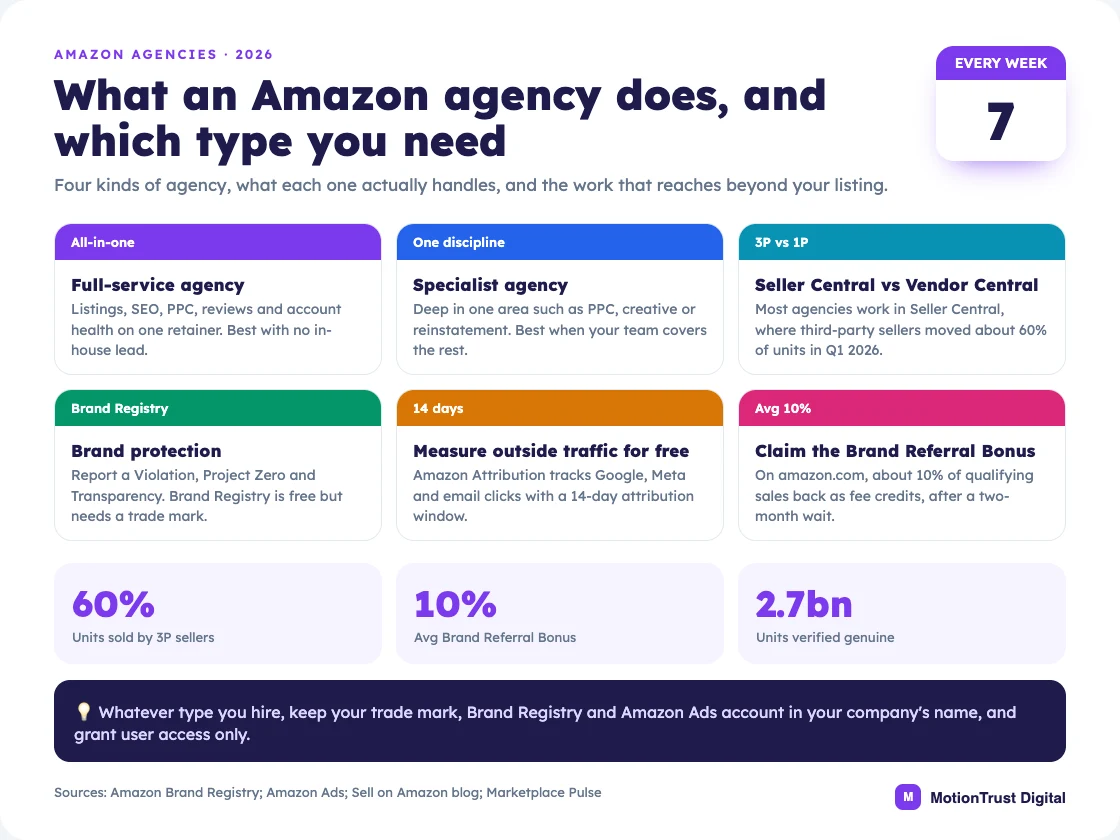
The phrase "Amazon agency" covers very different businesses. Some run every part of an account. Others do one thing, such as ads or images, and do it in depth. Knowing which type you are talking to saves weeks of mismatched expectations.
| Type | Typical scope | Best for |
| Full-service | Listings, SEO, PPC, reviews and account health on one retainer | Brands with no in-house Amazon lead |
| Specialist | One discipline, such as PPC, creative or reinstatement | Teams that already cover the rest |
| Vendor Central (1P) | Purchase orders, pricing and chargebacks with Amazon as the buyer | Brands selling wholesale to Amazon |
| Brand protection | Hijackers, counterfeits and trade mark enforcement | Brands with unauthorised sellers on their listings |
Full-service or specialist?
A full-service Amazon agency suits you if nobody in-house owns the account. One team sees how a listing change affects ad costs. A specialist suits you if you already have a strong operator and need depth in one area, such as Amazon PPC management. Ask either type who decides when SEO and advertising disagree.
Seller Central or Vendor Central?
Most agencies work in Seller Central, where you sell to customers directly. That is where most of the volume is. Third-party sellers accounted for about 60% of paid units sold on Amazon in Q1 2026. Vendor Central is a different job. Amazon buys your stock, so the work is purchase orders, cost prices and chargeback disputes. Ask for proof an agency has done it before.
Brand protection: the service lists often leave out
Good agencies also watch who else is selling on your listings. With Brand Registry, they can use Report a Violation and, where you qualify, Project Zero and Transparency. Amazon says more than 2.7 billion units have been verified as genuine through Transparency. Brand Registry is free, but it needs a pending or registered trade mark. Keep that trade mark in your own name.
Work beyond the listing: traffic from outside Amazon
Larger brands send shoppers from Google, Meta or email to their Amazon listings. Amazon Attribution measures that traffic for free, using a 14-day attribution window. On amazon.com, the Brand Referral Bonus then returns an average of 10% of qualifying sales as credits against referral fees. The full credit lands after a two-month wait for returns. Set up well, this lowers your real cost of selling.
Most sellers need the core work first: organic rank, efficient ads and clean account health. If search visibility is the gap, talk to an Amazon SEO agency. If you want one team to own all of it, see our Amazon marketing agency services.
Amazon marketing services
Want one team looking after the whole account?
We handle keyword research, listings, Amazon SEO, PPC, reviews and account health for sellers on amazon.com and beyond. If you would rather focus on product and stock, we would be glad to help with the rest.
See what we can take onQuestions people also ask
What does an Amazon marketing agency do?
It manages the work that gets products found and bought on Amazon: keyword research, listing copy and images, organic search ranking, Sponsored Products advertising, product launches, review compliance and account health monitoring. Most agencies work on a monthly retainer with reporting against agreed targets.
Is an Amazon agency the same as an Amazon consultant?
No. A consultant advises and hands the work back to you; an agency does the work. Consultants are usually charged by the hour or by the project and suit sellers with an in-house team. Agencies suit sellers who want the execution handled.
Do Amazon agencies need access to my Seller Central account?
Usually yes, at a permission level matched to the scope. Amazon lets you grant granular user permissions, so an advertising-only agency does not need access to your bank details or tax settings. Grant the minimum needed and revoke it when the engagement ends.
Can an Amazon agency guarantee results?
No honest one will. Rankings, ACoS and reinstatement all depend on factors outside any agency's control. What an agency can commit to is the work itself, reported monthly against targets agreed in advance.
How long before an Amazon agency shows results?
Expect a diagnosis and rebuilt foundations in the first thirty days, changes landing through days 31 to 60, and the first comparable report at around ninety days. Amazon rank responds to conversion rate and sales velocity over weeks, so a fortnight is too early to judge anything. Agree the starting baseline in writing on day one, or month three has nothing to be measured against.
Do I need Brand Registry before hiring an agency?
Not before, but it changes what an agency can do. Without Brand Registry there is no A+ Content, no Sponsored Brands and no Vine, so a large part of a normal retainer is unavailable. Enrolment is free but needs a registered or pending trade mark, which takes a few months through the UK IPO — so it is worth starting early, in your own company's name rather than an agency's.
Do Amazon agencies handle brand protection and unauthorised sellers?
Many do, but check before you sign. Brand protection means watching for hijackers and counterfeits, then using Brand Registry tools such as Report a Violation, Project Zero and Transparency. The agency needs your Brand Registry access, so add them as a user. Keep the trade mark and the Brand Registry enrolment in your own company's name, never the agency's.
Can an Amazon agency manage Vendor Central?
Some can, but it is a different skill set from Seller Central. In Vendor Central, Amazon is your customer. The work is purchase orders, cost price negotiation, chargebacks and retail analytics. Many agencies, including those focused on third-party sellers, only work in Seller Central. Ask for a Vendor Central client example and who on the team has handled chargeback disputes.
Written by Monjur Hossain, Founder & Amazon Strategy Lead at MotionTrust Digital, from the agency’s day-to-day work on client Amazon accounts and checked against the primary documentation listed under Sources below. Primary sources for this guide: Amazon, GOV.UK, UK Intellectual Property Office and Amazon Seller Central UK.
Every figure attributed to Amazon or to another named organisation links to that organisation’s own page, with the month it was accessed. Anything drawn from our own client accounts is labelled as ours rather than presented as an industry figure, and where no primary source publishes a number this guide says so instead of estimating one. Last reviewed .
- Amazon — Community Guidelines, accessed August 2026.
- GOV.UK — Product safety for businesses, accessed August 2026.
- Amazon — Brand Registry (Amazon UK), accessed August 2026.
- UK Intellectual Property Office — Register a trade mark, accessed August 2026.
- Amazon Seller Central UK — Fee schedule, accessed August 2026.
- Amazon (Sell on Amazon) — Amazon Brand Registry, accessed October 2026.
- Amazon Ads — Amazon Attribution, accessed October 2026.
- Amazon (Sell on Amazon blog) — Brand Referral Bonus: Drive traffic and boost your bottom line, accessed October 2026.
- Marketplace Pulse — Amazon Is Regaining 1P Unit Share (30 April 2026), accessed October 2026.
Monjur Hossain
Founder & Amazon Strategy Lead, MotionTrust Digital
Monjur incorporated MotionTrust Digital in September 2022 and leads Amazon strategy across the client base. Eight years in e-commerce and marketplace marketing, now on Amazon only — keyword strategy, listing architecture and advertising structure for growing brands.
MonjurAgencyTry the free tools
Seven Amazon tools that run in your browser — profit and ACoS calculator, PPC auditor, listing checker and more. No account, nothing uploaded.
Try the free toolsLast reviewed . We update articles in place rather than republishing at a new URL, so the link you have keeps working.
See the work, one article at a time
Get our newest articles on the jobs this page lists, from PPC and listings to SEO and reviews, in one email a week. Email us to join.