
Amazon agency vs freelancer vs in-house: how should sellers choose?
 By Monjur HossainFounder & Amazon Strategy Lead
·
Published
·
Last reviewed
·10 min read
By Monjur HossainFounder & Amazon Strategy Lead
·
Published
·
Last reviewed
·10 min read
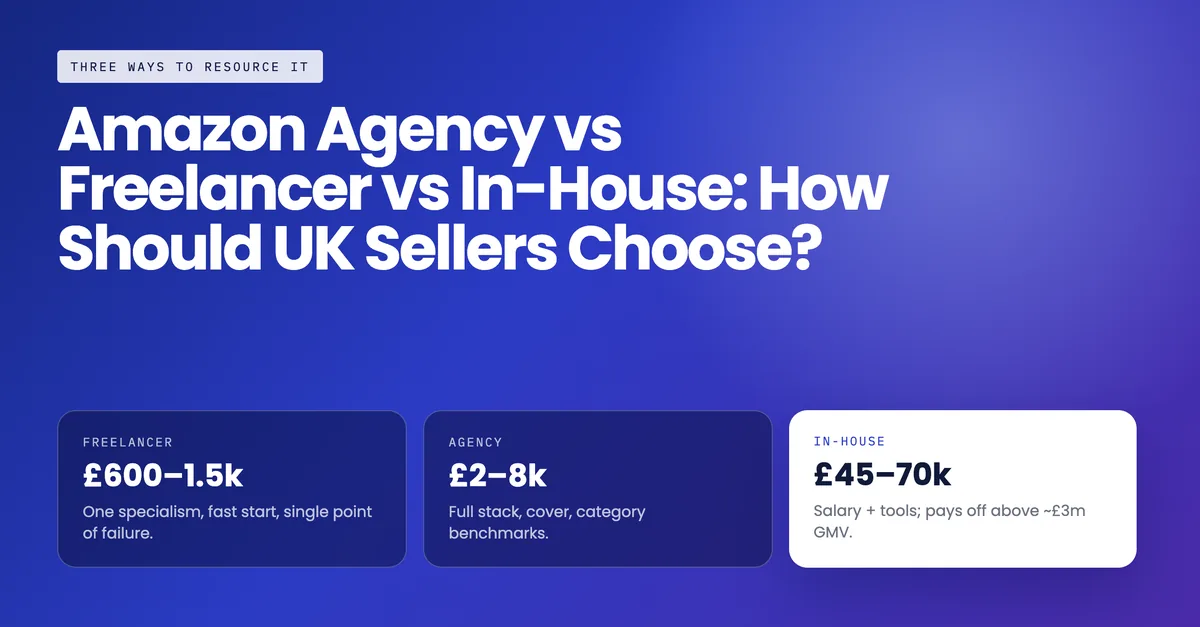
Amazon agency vs freelancer comes down mostly to revenue. Below roughly £20k a month on Amazon, a freelancer or one-off project usually returns more than a retainer. Between £20k and £150k, an agency generally wins on breadth of skill. Above that, an in-house hire backed by specialists is cheaper per hour.
Amazon agency vs freelancer vs in-house: how do they compare?
| Criterion | Freelancer | Agency | In-house |
|---|---|---|---|
| Typical UK cost | £25–£75/hr, or £400–£1,200/mo | £750–£6,000/mo | £32k–£55k salary plus employer costs |
| Breadth of skill | One or two disciplines | All of them, at some depth | Whatever that person knows |
| Time to productive | Days | 2–4 weeks | 2–4 months including hiring |
| Key-person risk | High | Low | High |
| Institutional knowledge | Leaves with them | Leaves with them | Stays with you |
| Category experience | Variable | Across many accounts | Yours only |
| Exit cost | Low | Notice period | Redundancy |
Amazon listing optimisation
Need a listing fixed, not a retainer?
Plenty of sellers only need a few listings rebuilt properly. We take on one-off listing projects with a fixed scope, so you get the work without signing up for months.
See listing optimisationWhen is a freelancer the right answer?
When the work is narrow, defined and finite. A freelance copywriter rewriting twelve listings is often better value than an agency doing the same job, because you are paying for one skill rather than a team.
Choose a freelancer if: you are under about £20k a month on Amazon, you know specifically what needs doing, you have someone internally who can brief and review, and you can tolerate the work stopping if that person becomes unavailable.
Avoid if: you need several disciplines at once, or if nobody in your business can tell good Amazon work from bad. A freelancer needs a competent client to be effective.
When does an agency make sense?
When you need four or five skills and cannot justify four or five hires. A retainer buys keyword research, copywriting, advertising, design direction and compliance monitoring from one contract.
Choose an agency if: you are between roughly £20k and £150k a month, advertising is running and needs weekly attention, you want one accountable party, and you value not carrying the recruitment risk.
Avoid if: your budget only stretches to the bottom of the market. Under about £500 a month you are usually buying one person managing many accounts to a template, and a good freelancer at the same price will do more.
When is in-house cheaper?
Later than most people think. A £40,000 salary is roughly £48,000 once employer National Insurance and pension are included — about £4,000 a month for one person's knowledge.
That is more than most agency retainers, and it buys one skill set rather than several. The advantage is that the knowledge stays in the business, which compounds.
Choose in-house if: Amazon is above roughly £150k a month, it is strategic rather than a channel, and you can give that person enough work to fill a week. Most in-house Amazon hires under that threshold end up doing something else half the time.
Amazon PPC management
Keep the account in-house, hand us the ads
If you have someone who owns the account but ads eat their week, we can run PPC alongside them. They keep the context, we bring the bid work.
See how we manage PPCIs a hybrid better than any of the three?
Frequently, and it is the arrangement we see working best above about £100k a month: one in-house person who owns the account and the relationships, with specialist support bought in for advertising, listing rebuilds or launches.
The in-house person keeps the knowledge and the context. The specialists bring the pattern recognition that only comes from seeing many accounts. It costs more than either alone and usually returns more than both.
The split that works most often puts advertising and listing rebuilds outside and everything else inside, because those two are the most technical and the most time-hungry. Our PPC management and listing optimisation are sold separately for exactly this arrangement, and the pricing page shows what each costs on its own rather than only as part of a full retainer.
What are the failure modes of each option?
Each of the three fails in a predictable way, and knowing which failure you can least afford is often a better basis for the decision than the cost comparison.
| Option | How it usually fails | The early warning sign | What reduces the risk |
|---|---|---|---|
| Freelancer | Single point of failure — illness, a bigger client, or simply moving on | Replies slow down before the work does | Documented processes, and Brand Registry plus Amazon Ads in your own name, not theirs |
| Agency | The person who sold it is not the person doing it; the account drifts to a template | Reports become descriptions rather than decisions | Named people, a written scope, and a review point at ninety days |
| In-house | One person cannot cover keywords, copy, advertising, creative and compliance — see the seven disciplines | Advertising is tuned weekly, listings untouched for months | Buy in the specialisms the role cannot cover |
Two of these are cheap to insure against and worth doing in every case. Keep Seller Central, Amazon Ads and Brand Registry in your own company's name whoever runs them — there is more on why in what an Amazon agency actually does. And keep a written record of what changed and when, because that log is the only thing that survives a handover intact.
The third risk is the one nobody quotes for: the cost of a bad month going unnoticed. A freelancer on holiday and an agency mid-handover both look the same from the outside, which is a suppressed listing or a policy warning sitting unattended. Whatever you choose, make sure someone is named as responsible for account health notifications — that is the failure that turns expensive fastest, as the suspension guide sets out.
A decision guide by monthly revenue
| Monthly Amazon revenue | Usually the best fit | Why |
|---|---|---|
| Under £10k | One-off project, or DIY with tools | No ongoing fee can pay for itself at this base |
| £10k – £20k | Freelancer, or a small entry retainer | Narrow, well-defined work returns most |
| £20k – £75k | Agency retainer | Several disciplines needed at once; breadth wins |
| £75k – £150k | Agency, or first in-house hire plus specialists | Depends on whether Amazon is strategic for you |
| £150k+ | In-house team plus specialist support | Cheaper per hour and the knowledge compounds |
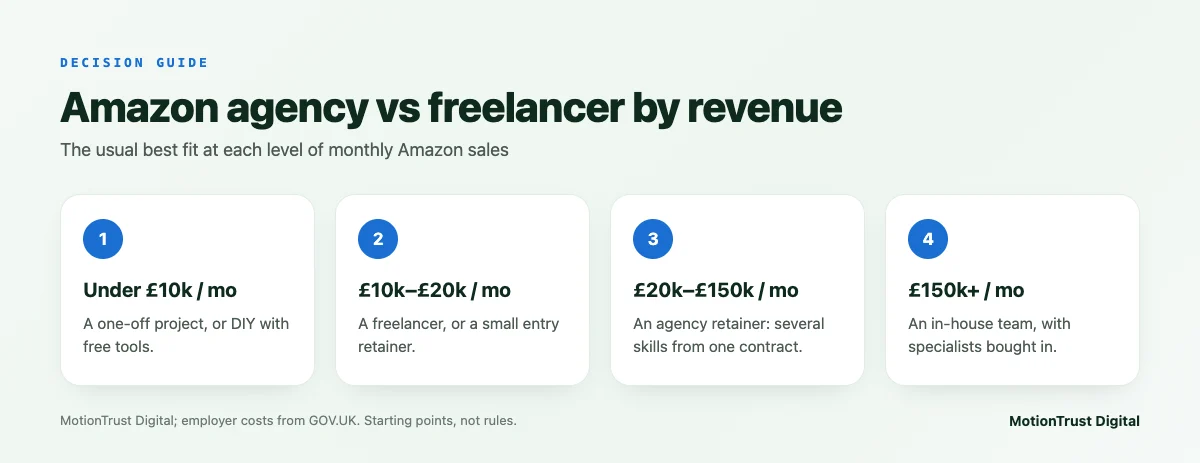
These are starting points, not rules. A complex catalogue at £30k a month can need more help than a simple one at £100k. If you want a read on your own account before deciding, the free audit will tell you which of the three we would actually recommend — including when the answer is none of them.
Amazon agency vs freelancer: where do you find each, and how do you vet them?
Choosing between an Amazon agency vs freelancer is half the job. The other half is finding a good one and keeping your account safe while they work in it. Most comparisons skip this part, and it is where sellers lose the most money.
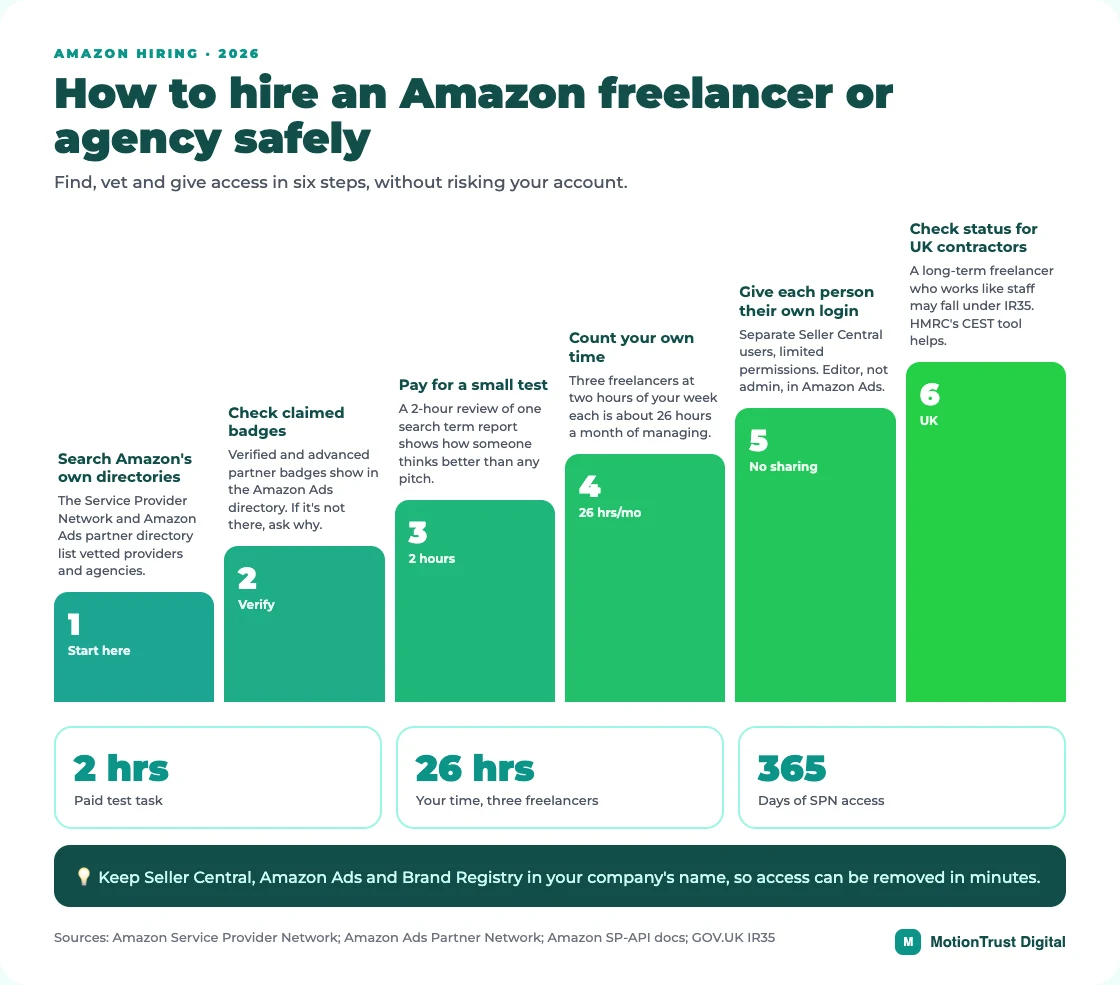
Where to find an Amazon freelancer or agency
Freelancers mostly turn up on Upwork, Fiverr and LinkedIn. Quality varies a lot, and the reviews there often rate friendliness more than results.
Amazon runs two directories worth checking first. The Service Provider Network lists account management and advertising providers, among others. The Amazon Ads partner directory lists ad agencies, with verified and advanced badges that Amazon awards for expertise and results. If someone claims a badge you cannot find there, ask why.
How to vet an Amazon PPC freelancer: a paid test, not a pitch
- Pay for a small, fixed task, such as a 2-hour review of one campaign's search term report.
- Ask what they would cut, what they would scale, and why.
- Ask for a reference from a client they still work with today.
- Ask how they want account access set up before you agree anything.
Good answers name actual search terms and numbers. Weak answers talk about "optimising" in general terms.
What a freelancer costs once you count your own time
A day rate is not the full price of the Amazon agency vs freelancer decision. Someone has to brief, review and join the dots between people. Say you use three freelancers for ads, copy and images. If each needs two hours of your week, that is about 26 hours a month of management. Value your time at £50 an hour and that is £1,300 a month.
Access, contracts and IR35
- Never share your login. Add each person as their own Seller Central user, with only the permissions their work needs.
- In Amazon Ads, give editor rather than admin access, so they can run campaigns without managing users or billing.
- Providers you authorise through the Service Provider Network get access for 365 days at a time.
- In the UK, a long-term freelancer who works like staff may fall under IR35. HMRC's free CEST tool helps you check.
Whichever side of the Amazon agency vs freelancer question you land on, keep every account in your company's name. If ads are the main gap, our Amazon PPC management service runs on access you control. Not sure which route fits? Our free Amazon audit will tell you honestly.
Free Amazon audit
Not sure which option suits your account?
Tell us about your account and we will send a written review, with an honest view on agency, freelancer or in-house. Sometimes the answer is that you don't need anyone yet.
Get my free auditQuestions people also ask
Is an Amazon agency better than a freelancer?
Not universally. A freelancer is better for narrow, well-defined work and for sellers under roughly £20k a month. An agency is better when several disciplines are needed at once — keyword research, copywriting, advertising and compliance — and you want one accountable party.
How much does an in-house Amazon manager cost in the UK?
A salary of roughly £32,000 to £55,000 depending on experience, which is about £38,000 to £66,000 once employer National Insurance and pension are included. That is more than most agency retainers, for one skill set rather than several.
At what revenue should I hire an Amazon agency?
Around £20k a month is where a retainer typically starts paying for itself, because the same percentage improvement is applied to a large enough base. Below roughly £10k a month, a one-off project usually returns more than any ongoing fee.
Can I do Amazon marketing myself?
Yes, and plenty of sellers do it well up to a point. The constraint is usually time rather than knowledge. Free tools handle the calculations; what an agency adds is the weekly attention and the pattern recognition from other accounts.
What is the biggest risk of hiring a freelancer for Amazon?
A single point of failure. Illness, a larger client or a change of direction leaves the account unattended, and the usual early sign is replies slowing down before the work does. Keep Seller Central, Amazon Ads and Brand Registry in your own company's name, insist on a written record of changes, and name someone responsible for account health notifications.
Should I keep my Amazon account access if an agency runs it?
Always. Whoever does the work, the Seller Central account, the Amazon Ads account and the Brand Registry enrolment should be in your company's name, with the agency or freelancer added as a user. Access can be granted and revoked in minutes; rebuilding advertising history or re-enrolling a brand cannot.
Where can I find a reliable Amazon freelancer or agency?
Start with Amazon's own directories. The Service Provider Network lists account management and advertising providers, and the Amazon Ads partner directory shows agencies with verified or advanced partner badges. Upwork, Fiverr and LinkedIn have good freelancers too, but vet them with a small paid task and a live reference rather than relying on platform reviews.
How should I give a freelancer access to my Amazon account?
Never share your own login. Add the freelancer as a separate Seller Central user with only the permissions their work needs, and give editor rather than admin access in Amazon Ads so they cannot manage users or billing. Keep every account in your company's name, so you can remove access in minutes if the work ends.
Written by Monjur Hossain, Founder & Amazon Strategy Lead at MotionTrust Digital, from the agency’s day-to-day work on client Amazon accounts and checked against the primary documentation listed under Sources below. Primary sources for this guide: GOV.UK, Amazon and MotionTrust Digital.
Every figure attributed to Amazon or to another named organisation links to that organisation’s own page, with the month it was accessed. Anything drawn from our own client accounts is labelled as ours rather than presented as an industry figure, and where no primary source publishes a number this guide says so instead of estimating one. Last reviewed .
- GOV.UK — Employer National Insurance rates, accessed August 2026.
- Amazon — Brand Registry (Amazon UK), accessed August 2026.
- MotionTrust Digital — published retainer pricing, August 2026.
- Amazon — Service Provider Network (Amazon UK), accessed October 2026.
- Amazon Ads — Amazon Ads Partner Network, accessed October 2026.
- Amazon Selling Partner API — Learn how sellers authorize service providers, accessed October 2026.
- GOV.UK — Understanding off-payroll working (IR35), accessed October 2026.
Monjur Hossain
Founder & Amazon Strategy Lead, MotionTrust Digital
Monjur incorporated MotionTrust Digital in September 2022 and leads Amazon strategy across the client base. Eight years in e-commerce and marketplace marketing, now on Amazon only — keyword strategy, listing architecture and advertising structure for growing brands.
MonjurAgencyGet a free Amazon audit
Send your storefront and we will send back a written audit of your listings, keywords, advertising and account health. Back within 48 hours, and yours to keep.
Get Your Free Amazon AuditLast reviewed . We update articles in place rather than republishing at a new URL, so the link you have keeps working.
Whoever runs your account, stay across the work
Agency, freelancer or in-house, the decisions stay yours. One email a week with our newest articles on PPC, listings, SEO and reviews, so you can ask better questions of whoever does it. Email us to join.