
How to choose an Amazon agency: a seller’s checklist
 By Monjur HossainFounder & Amazon Strategy Lead
·
Published
·
Last reviewed
·18 min read
By Monjur HossainFounder & Amazon Strategy Lead
·
Published
·
Last reviewed
·18 min read
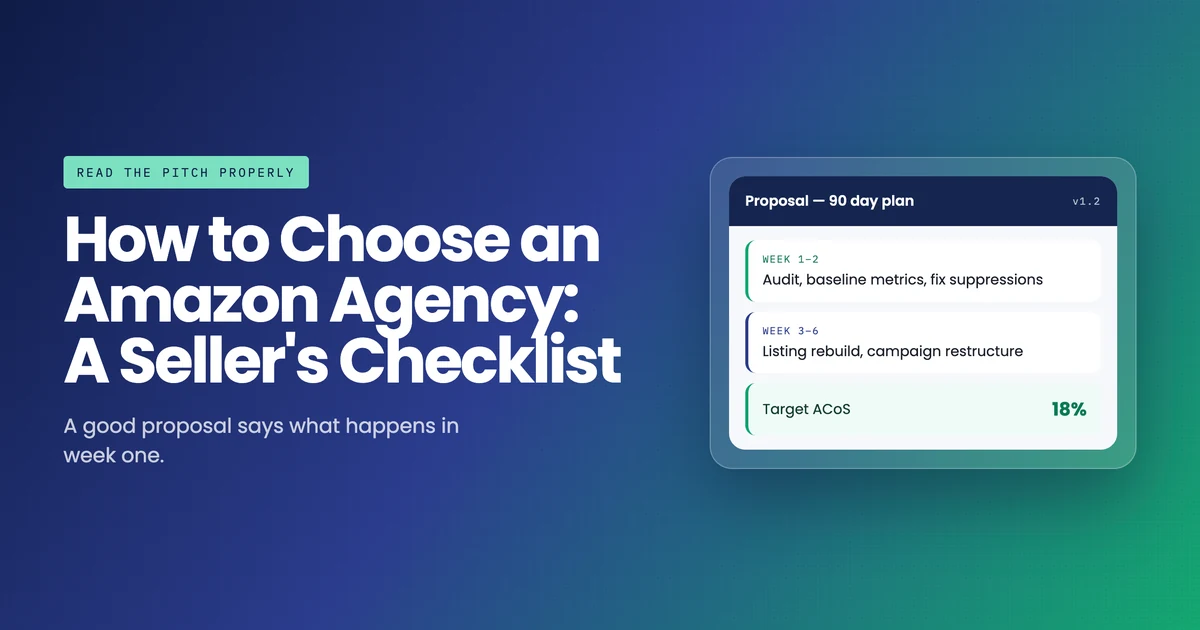
Here is how to choose an Amazon agency: write down the one problem you are paying to fix, then shortlist three from Amazon's Service Provider Network or the Amazon Ads partner directory. Score each on diagnosis, evidence, status claims, contract terms and references. Call two current clients, and agree 30, 60 and 90-day checkpoints before you sign.
Before you talk to anyone: what are you actually buying?
Most bad agency engagements start before the first call, because the seller has not decided what problem they are paying to solve. "Grow our Amazon business" is not a brief, and an agency will happily sell you a retainer against it.
There are really only four problems, and they need different suppliers.
- Nobody finds us. A visibility problem. You need keyword and listing work, then advertising.
- People find us and do not buy. A conversion problem. You need listing, imagery and pricing work, and advertising will make it worse until that is fixed.
- We sell fine but make nothing. A margin problem. You need ad efficiency, fee recovery and often a hard look at which ASINs deserve to exist.
- Something is broken. Suppression, suspension, a hijacked listing, a stuck case. You need a specialist for a defined piece of work, not a monthly retainer.
Write down which of those you have, in one sentence, before the first call. If an agency cannot tell you which one they think you have after twenty minutes of looking, they are selling capacity rather than judgement.
Two things worth settling at the same time, because they change who you should even be talking to. First, what would success look like in ninety days, expressed as a number you would recognise — organic rank on six terms, a total advertising cost of sale below a figure, a conversion rate on your top three ASINs. Vague goals produce vague retainers.
Second, what you are not willing to do: some brands will not discount, some will not run coupons, some have a price floor set by their wholesale channel. Say so early, because half of the standard Amazon playbook assumes otherwise, and an agency that only discovers your constraints in month two will have spent month one planning around them.
The twelve questions, and what a bad answer sounds like
In rough priority order. If you only get through the first five, you will still learn most of what you need.
1. How many accounts does the person doing my work carry?
The single most predictive question in the list, and the one most likely to be deflected. You want a number and a name. Somewhere between four and eight accounts is a person who can think about yours; fifteen is a person processing a queue.
A bad answer: "We work as a pod" or "it varies by client". Both are true statements that avoid the number. Ask again.
2. Who will actually be in the account, and are they employed by you?
Plenty of agencies sell a senior strategist and staff the work elsewhere. That is not automatically wrong — it is wrong when it is concealed. Ask where the team sits, what hours they work relative to yours, and whether you will speak to them or only to an account manager who relays.
A bad answer: any answer that describes the team as "our global delivery network" without naming a country or an employment relationship.
3. Show me a month where it went badly.
Every account has one. An agency that cannot produce one is either new, or curating. What you are listening for is whether they noticed it before the client did, what they changed, and whether they say what it cost. This question is worth more than any case study.
A bad answer: a reframed win. "We had a slow month while we rebuilt the campaigns, and then sales tripled."
4. What happens if we miss the agreed benchmark?
Not "do you guarantee results" — nobody credible does, because the platform is outside their control. The question is whether missing a target triggers anything at all: a review, a fee adjustment, an exit without penalty. If the answer is nothing, the benchmark is decoration.
A bad answer: "We're confident that won't happen."
5. Who owns the listings, creative and ad account if I leave?
This has to be in writing. Some agencies build A+ content and imagery in their own accounts and take it with them. Some run advertising through their own ad console rather than yours. Both are recoverable and both are miserable to discover in month thirteen.
A bad answer: "That's never been an issue."
6. What is your notice period, and does the contract auto-renew?
An initial term is reasonable — Amazon work takes a quarter to show. A twelve-month auto-renewing term with ninety days' notice is a different proposition, and it is usually buried rather than pitched.
7. What is the pricing model, and what changes it?
Flat retainer, percentage of ad spend, percentage of revenue, or a hybrid. Percentage of ad spend rewards an agency for spending more of your money, which is not a reason to reject it but is a reason to cap it. Percentage of revenue can be very expensive on a brand that was already growing.
A bad answer: a price that appears only after a discovery call. You are allowed to know the range before you invest an hour.
8. What do you do that risks my account?
Ask it exactly that way and watch the pause. You are checking for incentivised reviews, review gating, giveaway-driven rank manipulation, and any "guaranteed ranking" mechanism. All of these work briefly and all of them put the account at risk, and the person who loses the account is you, not them.
A bad answer: "We use proprietary ranking methods."
9. What are you going to do in the first thirty days?
A good answer is boring and specific: audit, catalogue clean-up, campaign restructure, listing priority order, baseline metrics agreed. A vague answer here usually means the first month will be spent deciding what to do, at your expense.
10. How do you report, and will I understand it?
Ask for a real, redacted report from an existing client. If it is forty slides of platform screenshots with no argument in it, that is what you will get monthly. The useful report is short, says what changed and why, and names what did not work.
11. What do you need from me?
Agencies that have done this before will have a clear answer — margin data, stock visibility, a named decision-maker, turnaround on creative approvals. An agency that says "nothing, we handle everything" is either overselling or about to make pricing decisions without knowing your cost of goods.
12. Why would you turn this account down?
The best closing question. Anyone with real experience has a list: no stock, no margin, no brand registry, a category they do not know, a founder who wants daily calls. An agency that cannot name a single reason it would decline work is telling you how it selects clients.
Free Amazon audit
Get a second opinion on your account
Before you weigh anyone's case studies, it helps to know what your own account needs. We'll send you a written audit you can hold every pitch against, whether or not you hire us.
Get my free written auditHow to read the evidence they give you
Every agency arrives with proof. Most of it is constructed to be unfalsifiable, and knowing how tells you what to ask next.
Case studies
Look for three things: a named client or a named category, a date range, and a starting point. "Grew revenue 340%" from a base of $4,000 a month is a different achievement to the same percentage from $400,000, and case studies that omit the base are omitting it deliberately. A dated engagement you can place in time also tells you whether the tactics still apply — a 2023 result predates several material Amazon changes, including the July 2026 title limit.
The most useful follow-up is: "what was the second-best month on that account, and what happened in it?" Anyone can produce one extraordinary month. The shape of the ordinary ones is the actual service.
Review scores
Clutch, DesignRush, Trustpilot and G2 all carry agency profiles, and the number beside the star rating matters more than the rating. A 4.9 from four reviews and a 4.9 from forty are not comparable claims. Check the service mix on the profile too: several agencies rank well on directories under categories that have little to do with Amazon, so the reviews you are reading may be for different work entirely.
Partner badges
Amazon publishes only two advertising partner statuses, verified and advanced, awarded on product adoption, certification and partner-led investment. Amazon does not publish a spend or client-count threshold for either. Anything described as "certified", "elite", "top 5%" or "premier" is either a different programme or the agency’s own framing — worth asking which, without treating it as a disqualification.
Client lists
A logo wall proves an account existed, not that it still does or that the agency did the work that made it notable. Ask when each engagement started and whether it is current. Two current clients you can call beats twenty logos.
The contract clauses nobody reads
The pitch is the marketing. The contract is the product. Five clauses do most of the damage.
| Clause | What to look for | Why it bites |
|---|---|---|
| Initial term and auto-renew | Length of the first term, whether it renews automatically, and the notice window | Ninety days' notice on an auto-renewing annual term can mean fifteen months from a decision to leave |
| Intellectual property | Explicit assignment of listings, copy, images, A+ modules and video to you | Silence usually means the agency keeps it, and rebuilding a full catalogue of creative is a real cost |
| Data and account access after exit | Who keeps admin rights, what reporting you receive, how long historical data is retained | An agency running ads from its own console can leave you with no campaign history at all |
| Exclusivity | Whether you are barred from engaging anyone else, and whether they are barred from your direct competitors | Both directions matter. Ask who else in your category they work with |
| Minimum ad spend | Whether a spend floor is a condition of the fee | A fee that assumes $20k a month of spend is a different price to the one on the proposal |
None of these need a lawyer to spot. They need you to ask for the contract before the call where you are expected to sign, and to read the five clauses above first.
Amazon agency pricing
See our prices before any call
We publish our fees tier by tier, so you can compare us without booking a discovery call first. No surprises later.
View our pricingWhat should this cost?
Published pricing in this industry is rare, which is itself informative. Of the agencies we checked while researching this, only two publish figures at all on their own sites: eStore Factory runs a full rate card with PPC packages from $499 to $1,833 a month on three-month terms, and SellerPlex publishes "starting at $2,500 a month plus 5% of incremental sales above baseline". Everyone else quotes after a call.
That makes benchmarking hard, so use structure rather than a number. Ask which of these you are being sold:
- Flat retainer. Predictable, easiest to budget, and the model where you most need to check what hours or deliverables it actually buys.
- Percentage of ad spend. Typically the cheapest headline and the one with the worst incentive alignment. Cap it, or agree the fee against a spend band rather than a raw percentage.
- Percentage of revenue. Aligns interests in principle. In practice it charges you for growth that would have happened anyway, so agree a baseline and pay on the increment.
- Project fee. The right model for a fix — a listing rebuild, a reinstatement, a catalogue migration. If your problem has an end state, do not buy a retainer.
Our own pricing is published, tier by tier, for the same reason we are telling you to ask for it: an agency that will not name a range before a call has made the first hour of your evaluation expensive on purpose.
Red flags
Ranked by how much damage they do rather than how bad they sound.
Guaranteed rankings or guaranteed sales. Nobody controls Amazon’s results. A guarantee means either a meaningless definition of the promise, or a mechanism that puts your account at risk. Ask which.
Reviews as a service. Any offer to supply reviews, source reviewers, or incentivise positive feedback. Amazon suspends sellers for this, not the agency, and in the US the Federal Trade Commission’s rule on consumer reviews makes buying and selling reviews a civil-penalty matter. This is the fastest way to lose an account you spent years building.
No named person on the account. If nobody’s name is attached, nobody is accountable, and your work will be whatever is left after the accounts with named owners are served.
Reporting that only goes up. Every account has bad months. A supplier whose reporting never shows one is either selecting metrics or not looking.
Pressure to sign inside the call. Discounts that expire at the end of a meeting are a sales technique, not a commercial reality. A good agency is comfortable with you reading the contract.
They never say no. If every idea you float is a good idea, you are buying agreement. You can get that cheaper.
Should you hire an agency at all?
Three alternatives, and the honest case for each.
A freelancer costs less and can be excellent, particularly for one discipline — a PPC specialist, a copywriter, a designer. The risks are bus factor and breadth: one person on holiday is your whole Amazon function on holiday, and few freelancers cover advertising, listings, catalogue and account health at once. Good fit under roughly $50k a month of revenue, or for a single well-defined discipline.
In-house is the right end state for most brands that get big enough. A competent Amazon manager costs more in salary than most retainers, plus tooling, plus the months before they are effective, plus the risk that they leave and take the institutional knowledge with them. The usual sequence is agency first, in-house once the playbook is stable, agency retained for specialist work.
Nothing is a real option more often than agencies admit. If your listings have not been rewritten since the 75-character title change in July 2026, if your images are phone photographs, or if you have no Brand Registry, a month of your own attention will beat a month of anyone’s retainer. Fix the free things first.
If you do go to market, brief three agencies on the same one-sentence problem and compare the answers, not the decks. The one that tells you something uncomfortable about your account in the first call is usually the one that will be useful in month six.
Ours is a written audit back within 48 hours, and it is deliberately the same document whether or not you hire us — partly because it is the fairest way to be compared, and partly because it is the only way to answer question three in this checklist about ourselves.
Not sure how to choose an Amazon agency from your shortlist?
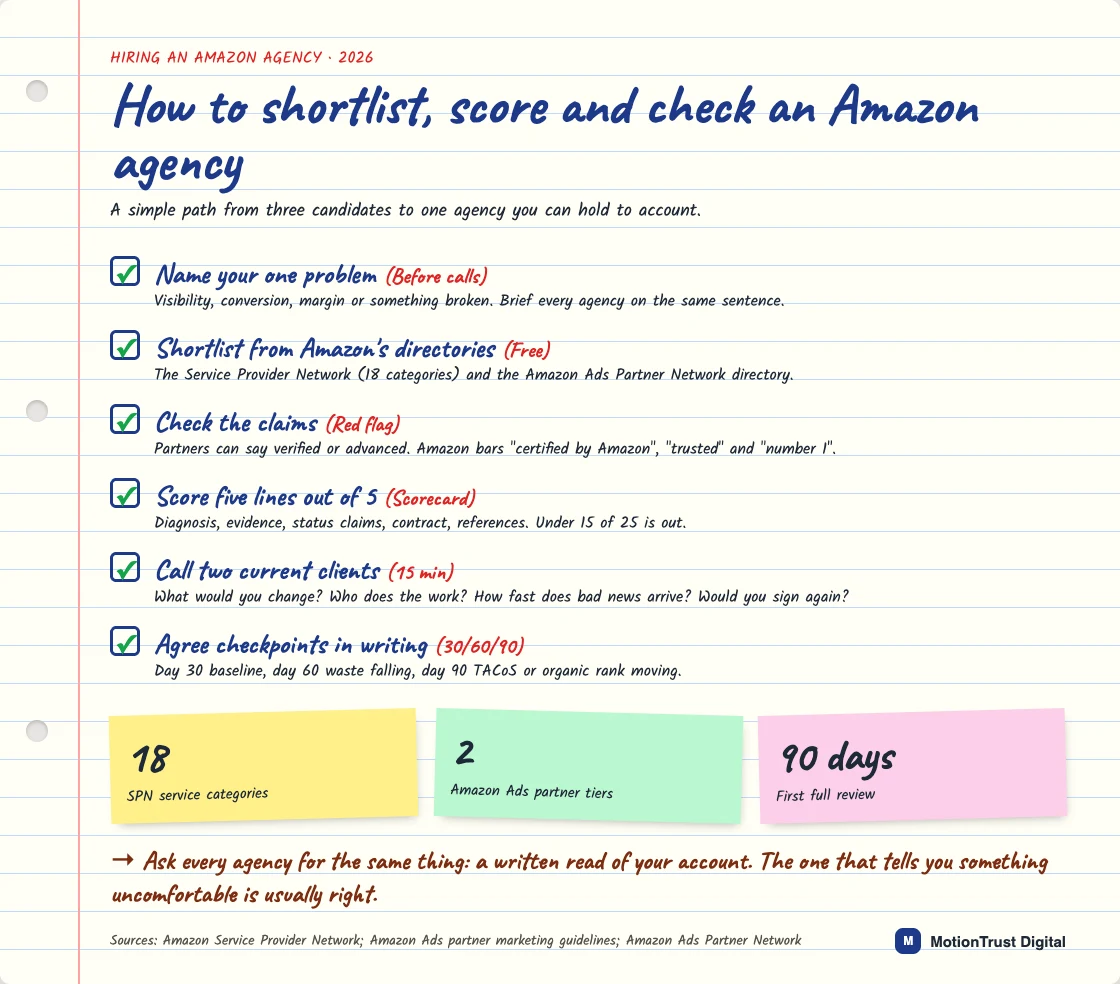
Most advice on how to choose an Amazon agency starts at the pitch call. The useful work happens earlier: finding candidates someone has already checked, then scoring them the same way. Here is the process we'd use if we were hiring one ourselves.
Where to find agencies worth calling
Start with Amazon's own directories. The Service Provider Network lists vetted providers across 18 service categories, including account management and advertising optimization. You can filter by marketplace, language and average rating, and read verified reviews. It is free with a selling account. Amazon is also clear that it "does not endorse any service provider."
For advertising, check the Amazon Ads Partner Network directory. It shows two statuses. An Amazon Ads verified partner has finished setup, linked advertisers and published a directory listing. An advanced partner has shown expertise and measurable results over time.
Amazon's marketing rules bar partners from claiming to be "certified by Amazon", "trusted" or the "number 1" agency. If a pitch deck uses those words, ask where the claim comes from.
A five-line scorecard for three agencies
This is how to choose an Amazon agency on evidence rather than charm. Score each one from 1 to 5 on every line, straight after the call.
| Line | Scores 5 when | Scores 1 when |
|---|---|---|
| Diagnosis | They name your main problem after looking at your account | They only describe their own process |
| Evidence | Case studies are dated and show the starting point | Percentages with no base |
| Status claims | A directory listing you can check yourself | "Certified" or "trusted" language |
| Contract | Short notice period, and you own every asset | A 12-month term that auto-renews |
| References | Two current clients who will take your call | A logo wall only |
Anything under 15 out of 25 should not make the final round, however good the deck looked.
How to run a reference call
Ask for two current clients, ideally at your size. Then ask each one four things. What would you change about them? Who actually does the work? How fast does bad news reach you? Would you sign again?
Fifteen minutes is plenty. Listen for hesitation more than praise.
How to measure the agency after you sign
Agree the checkpoints in writing before work starts. We use three.
- Day 30: audit delivered, with a written baseline for TACoS, organic rank on six to ten terms and contribution margin.
- Day 60: campaigns rebuilt and wasted spend falling, even if sales are flat.
- Day 90: TACoS lower or organic rank higher on the agreed terms. If neither moved, use the review clause.
If you'd like a benchmark to compare pitches against, our free Amazon audit gives you one in writing. You can also see our published agency pricing, or how our Amazon PPC agency team reports.
Amazon PPC management
Want a team that shows its working?
If you'd rather not manage ads yourself, we'll agree your 30, 60 and 90-day targets in writing first, then report plainly on what moved and what didn't.
See how we manage PPCQuestions people also ask
How do I choose the right Amazon agency?
Define your problem in one sentence first — visibility, conversion, margin or something broken — then brief three agencies on the same sentence and compare their answers rather than their decks. Ask how many accounts your named person carries, who owns the creative if you leave, what happens if a benchmark is missed, and to see a month that went badly.
What should a full-service Amazon agency cost?
Published pricing is rare, which tells you something. Of the agencies we checked, only two publish figures at all: eStore Factory’s PPC packages run $499 to $1,833 a month on three-month terms, and SellerPlex publishes $2,500 a month plus 5% of incremental sales. Compare the model — flat retainer, percentage of ad spend, percentage of revenue, or project fee — rather than the headline number.
What are red flags when hiring an Amazon agency?
Guaranteed rankings or sales, any offer involving reviews, no named person on the account, reporting that never shows a bad month, pressure to sign inside the call, and an agency that agrees with every idea you float. The reviews one is the most dangerous: Amazon suspends the seller, not the agency.
How many clients should an Amazon account manager handle?
Roughly four to eight accounts is a person who can think about yours. Fifteen is a person processing a queue. Ask for a number and a name, and treat "we work as a pod" as a deflection rather than an answer.
What should happen in the first 90 days with a new Amazon agency?
Month one: audit, catalogue clean-up, baseline metrics agreed in writing, campaign restructure started. Month two: listing work in priority order, advertising rebuilt and learning. Month three: the first honest read on whether it is working. If nobody has agreed what success looks like by the end of month one, that is the problem to fix.
Should I hire an Amazon agency to boost my sales?
Only if your problem needs skills you do not have. If your listings predate the 75-character title change, your images are phone photographs, or you have no Brand Registry, a month of your own attention beats a month of anyone’s retainer. Fix the free things first, then buy expertise for what is left.
What is the biggest red flag when talking to an Amazon agency?
A guarantee. Nobody controls Amazon’s search results, so a guaranteed ranking is either defined so loosely it means nothing or backed by a mechanism that risks your account. The second biggest is any agency that cannot name a reason it would turn work down.
How much does an Amazon agency cost per month?
The published examples run from about $500 a month for a narrow PPC package to $2,500 and up for full-service management, often plus a percentage. Most agencies quote only after a discovery call. You are entitled to a range before you spend an hour on a call, and a refusal to give one is information.
Is it worth hiring an Amazon agency?
It is worth it when the fee is smaller than the value of the judgement you are buying, which usually means once the account is complex enough that mistakes are expensive. Below roughly $50k a month, a specialist freelancer for one discipline is often the better trade.
What is included in Amazon agency fees?
Ask, because it varies enormously. Typical inclusions are advertising management, listing optimisation, catalogue and case work, and reporting. Commonly excluded and separately billed: photography and video, A+ module design, translation for other marketplaces, and ad spend itself. Get the exclusions in writing.
Amazon agency vs in-house team: which costs more?
In-house costs more in year one and usually less by year three, once you account for salary, tooling, recruitment and the ramp before a new hire is effective. The common sequence is agency first to build the playbook, in-house once it is stable, with the agency retained for specialist work like launches or reinstatements.
Should I sign a 12-month Amazon agency contract?
An initial term is reasonable because Amazon work takes a quarter to show. A twelve-month term that auto-renews with ninety days’ notice is a different thing: from the moment you decide to leave, you could owe fifteen months. Negotiate the renewal clause, not the headline term.
Who owns my listings and creative if I leave the agency?
Whatever the contract says, and if it says nothing, usually not you. Get explicit assignment of listings, copy, images, A+ modules and video in writing before signing, along with who retains admin access to the advertising account and how long historical campaign data is kept.
What is the difference between an Amazon PPC agency and a full-service Amazon agency?
An Amazon PPC agency runs your advertising only: campaigns, bids, keywords and reporting. A full-service agency also handles listings, images, catalogue problems, account health and sometimes logistics. If your listings convert well and the issue is ad efficiency, a specialist is usually cheaper and sharper. If traffic arrives and doesn't buy, you need someone who can fix the listing too.
Where can I find a vetted Amazon agency?
Start with Amazon's Service Provider Network, which lists providers across 18 categories with verified reviews and ratings, and the Amazon Ads Partner Network directory, which shows verified and advanced partner status. Amazon vets SPN providers but does not endorse any of them, so still check references, read the contract and score each agency the same way.
Written by Monjur Hossain, Founder & Amazon Strategy Lead at MotionTrust Digital, from the agency’s day-to-day work on client Amazon accounts and checked against the primary documentation listed under Sources below. Primary sources for this guide: eStore Factory, SellerPlex, US Federal Trade Commission, Amazon Ads and Amazon Seller Central.
Every figure attributed to Amazon or to another named organisation links to that organisation’s own page, with the month it was accessed. Anything drawn from our own client accounts is labelled as ours rather than presented as an industry figure, and where no primary source publishes a number this guide says so instead of estimating one. Last reviewed .
- eStore Factory — PPC packages, accessed September 2026.
- eStore Factory — Rate chart, accessed September 2026.
- SellerPlex — Pricing on the homepage, accessed September 2026.
- US Federal Trade Commission — Rule banning fake reviews and testimonials, accessed September 2026.
- Amazon Ads — Partner Network overview, accessed September 2026.
- Amazon Seller Central — Product title updates from 27 July 2026, accessed September 2026.
- Amazon (Sell on Amazon) — Service Provider Network, accessed October 2026.
- Amazon Ads — Marketing guidelines for Amazon Ads partners, accessed October 2026.
- Amazon Ads — Partner Network, accessed October 2026.
Monjur Hossain
Founder & Amazon Strategy Lead, MotionTrust Digital
Monjur incorporated MotionTrust Digital in September 2022 and leads Amazon strategy across the client base. Eight years in e-commerce and marketplace marketing, now on Amazon only — keyword strategy, listing architecture and advertising structure for growing brands.
MonjurAgency