
Amazon UK VAT for sellers: what you actually owe
 By Monjur HossainFounder & Amazon Strategy Lead
·
Published
·
Last reviewed
·12 min read
By Monjur HossainFounder & Amazon Strategy Lead
·
Published
·
Last reviewed
·12 min read
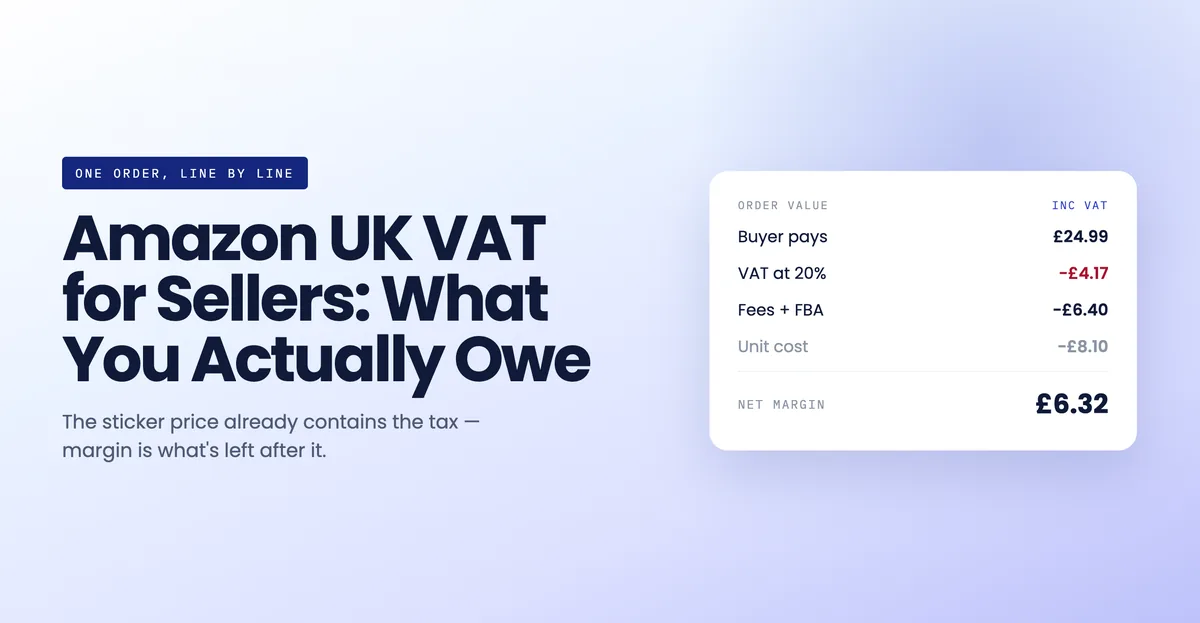
Amazon UK VAT applies to UK-established sellers once taxable turnover passes £90,000 in a rolling 12 months; overseas sellers storing stock in the UK must register from the first sale. Most goods carry 20% VAT inside the price. Amazon collects it for some overseas sellers, and since August 2024 also adds 20% VAT to its own fees.
When do you have to register for VAT?
It depends entirely on whether your business is established in the UK, and this is where most guidance written for Amazon.com is simply wrong.
| Your situation | Registration |
|---|---|
| UK-established business | Register once taxable turnover passes the VAT registration threshold in a rolling 12 months, or if you expect to pass it in the next 30 days. Check the current threshold on GOV.UK. |
| Overseas seller storing goods in the UK | No threshold. Register before the first sale. |
| Overseas seller, goods shipped from abroad | Rules differ by consignment value; Amazon collects and remits on many of these sales. See the GOV.UK guidance for overseas sellers. |
When does Amazon collect VAT for you?
Since the 2021 changes, Amazon is deemed the supplier for certain sales and collects the VAT itself rather than passing it to you. Broadly, this applies to goods sold by overseas sellers to UK consumers below the consignment threshold, and to goods already in the UK sold by an overseas seller.
Where Amazon collects, the money never reaches your account, so your disbursement is net of it. Sellers who do not realise this often think their margin has collapsed when in fact the VAT simply never arrived.
Where you remain the supplier — most UK-established sellers — Amazon pays you the gross amount and you account for the VAT yourself. Either way the referral fee is calculated on the gross figure, which is one of the fee lines set out in what it costs to sell on Amazon UK.
Amazon profit calculator
See your margin with VAT taken out first
Our calculator strips VAT before it does anything else, so the margin and break-even ACoS you see are the ones you actually keep. It takes about a minute.
Work out my real marginHow does VAT change your real margin?
This is the part that has practical consequences every day, not just at quarter end.
On a standard-rated product at £24.99, the VAT element is roughly £4.16, leaving £20.83 of net revenue. Amazon's referral fee is charged on the gross selling price, not the net — so you pay the fee on money you do not keep.
Calculating margin on the gross price overstates it by a sixth on a standard-rated product, which is enough to turn a profitable ACoS target into a loss-making one. Our profit calculator strips VAT before doing anything else, for exactly this reason.
The same error carries straight into advertising. A break-even ACoS calculated on the gross price is too generous, so the target you set is one the product cannot support — what is a good ACoS works through the arithmetic, and what it costs to sell on Amazon UK sets out the fee lines that sit above it.
Which VAT rate applies to your products?
Most goods are standard-rated, but the exceptions matter and several are common Amazon categories.
- Standard rate — most goods.
- Reduced rate — children's car seats, some energy-saving materials, certain mobility aids.
- Zero rate — most food, children's clothing and footwear, books, and some printed matter.
Getting this wrong in either direction is expensive: charge too much and you are uncompetitive, too little and you owe the difference. Check your specific goods against the GOV.UK rate list rather than assuming by category.
Should you use the Flat Rate Scheme?
The Flat Rate Scheme lets smaller businesses pay a fixed percentage of gross turnover instead of accounting for VAT on every transaction, in exchange for not reclaiming input VAT on most purchases.
For Amazon sellers importing goods and paying import VAT, it is frequently the wrong choice, because the input VAT you give up often exceeds the administrative saving. For a service business with few purchases it can work well.
This is a question for an accountant who has seen your numbers, not for a marketing agency. We flag it because sellers regularly join the scheme on general advice and discover the problem a year later. If you want the marketing side of the same picture, our free Amazon audit covers fees, margin and advertising, and stops short of anything that belongs to your accountant.
What records and invoices do you have to keep?
A VAT-registered seller must keep records that support every figure on the return, keep them for six years, and — under Making Tax Digital — keep them digitally and file through compatible software. Amazon's reports are the raw material for that, but they are not themselves a VAT record.
What to keep, and where it comes from:
| Record | Where it comes from | Why it matters |
|---|---|---|
| Sales by VAT rate and by country | Amazon VAT transactions report or the settlement reports | The return needs output tax split by rate, which a single sales total cannot give you |
| Amazon fee invoices | Seller Central, monthly | Fees carry input tax you may be able to reclaim |
| Import VAT evidence | Your C79 or postponed VAT accounting statement | Import VAT is reclaimed on the statement, not on the freight agent's invoice |
| Supplier purchase invoices | Your suppliers | Needed both for input tax and, separately, for any Amazon authenticity complaint |
| Marketplace-collected VAT | Amazon's reports, flagged as deemed supplier | These sales are not your output tax, and including them overstates what you owe |
The mistake worth naming: treating your Amazon disbursement as turnover. A disbursement is net of fees, refunds, and in some cases VAT Amazon has already collected as deemed supplier. Building a return from disbursements rather than from transaction-level reports produces the wrong number in both directions. HMRC's VAT guide (Notice 700) is the reference for what a valid record looks like, and the rules for marketplace-facilitated sales are in HMRC's online marketplace guidance.
None of this is advice on your own position — we are an Amazon agency, not accountants. What we can tell you is which report each figure comes out of, which is usually where sellers get stuck.
Amazon keyword research
Planning EU stores? Start with the words buyers use
A translated UK listing rarely ranks in Germany or France. We research each marketplace separately, so your listings match how local shoppers actually search.
See our keyword researchWhat about selling into the EU after Brexit?
Cross-border sales into the EU are a separate regime. You will generally need a GB EORI number to export, and often an EU EORI to import. The Import One Stop Shop simplifies VAT on low-value consignments to EU consumers, and above those thresholds you may need registration in the destination country or an intermediary.
If you store stock in an EU fulfilment centre, you almost certainly need a VAT registration in that country regardless of turnover. That is the detail that catches out UK sellers enabling Pan-European FBA without reading what it does.
There is a marketing dimension to this that is easy to miss while sorting out the tax. An EU listing is not a translated UK listing: search volume, vocabulary and category conventions all differ, in the same way Amazon.co.uk differs from Amazon.com. If EU expansion is on the plan, budget for keyword research in each marketplace rather than for translation alone — the reasoning is the same one set out in Amazon SEO vs Google SEO.
Amazon UK VAT vs US sales tax: what changes on Amazon.com?
If you also sell on Amazon.com, or you are a US brand opening on Amazon.co.uk, the two systems work very differently. The UK charges one national VAT; the US has no VAT at all, only state sales tax.
| Question | Amazon.co.uk (UK VAT) | Amazon.com (US sales tax) |
|---|---|---|
| What is charged | VAT at 20% standard rate, one national system | State and local sales tax, rates differ by state |
| Who collects it | You, unless Amazon is the deemed supplier for the sale | Amazon, under marketplace facilitator laws in every state with a sales tax |
| When you must register | UK businesses above the £90,000 threshold; overseas sellers with stock in the UK from the first sale | Usually no sales tax registration just for Amazon sales, but check nexus rules for your other channels |
| Effect on your price | VAT sits inside the shelf price, so it comes out of your margin | Tax is added at checkout, so your listed price is your price |
The practical difference for margin: a £24.99 UK price carries £4.17 of VAT, so you keep £20.83 before fees. A $24.99 US price is $24.99 before fees, because the buyer pays the sales tax on top. That is why the same product often needs a higher UK price to earn the same margin.
A US seller sending stock to a UK fulfilment centre needs a UK VAT number before the first sale — there is no threshold for overseas businesses. The rules are on GOV.UK. For the fee side of selling on both sites, see what it costs to sell on Amazon UK and Amazon.com.
How does Amazon UK VAT work on your seller fees, and can you reclaim it?
Most Amazon UK VAT guides cover the VAT on your sales. Far fewer cover the VAT on what Amazon charges you, and that changed in 2024. It is now a real line in every UK seller's costs, whether you are registered or not.
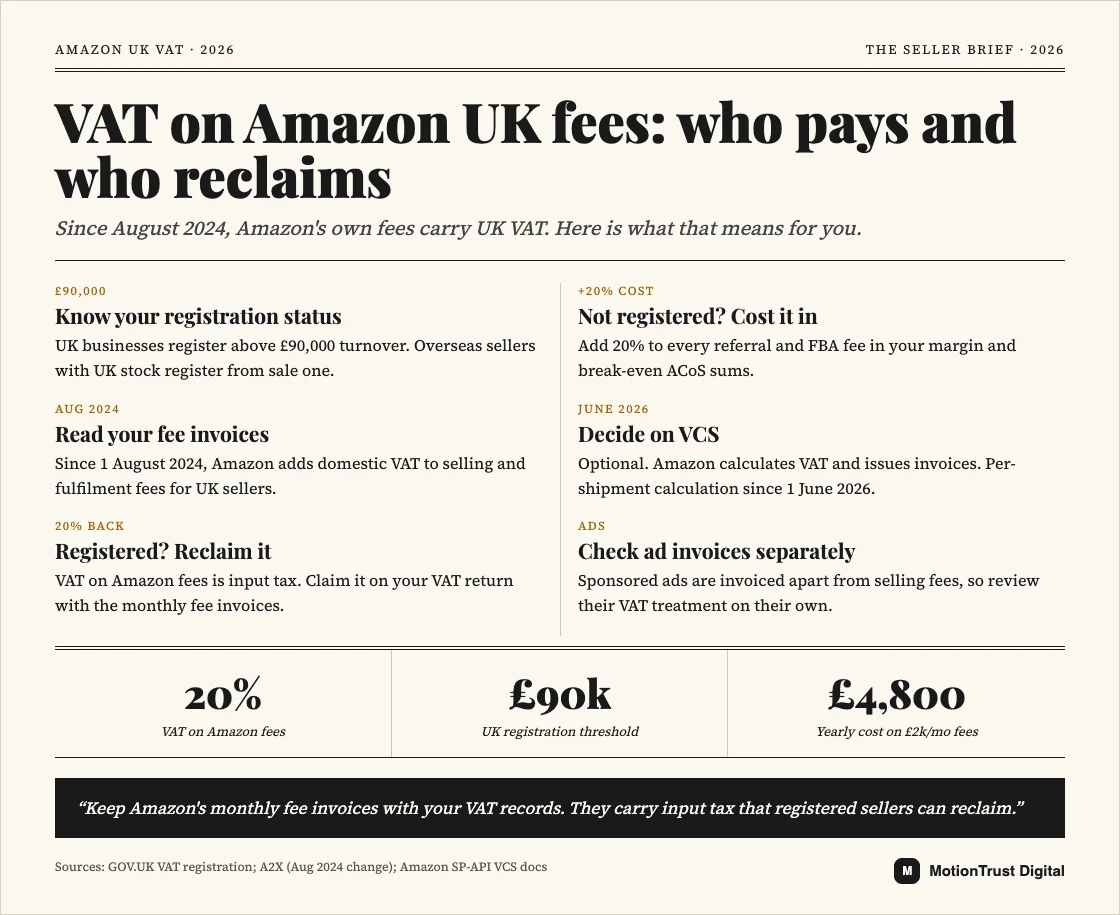
What changed on Amazon fee invoices in August 2024
Before 1 August 2024, Amazon billed most UK sellers' fees from Luxembourg under the reverse charge. No VAT showed on the invoice. Since then, Amazon charges domestic VAT on selling and fulfilment fees based on where you are established. For a UK seller, that usually means 20% on top.
Advertising sat outside this change. Sponsored ads are invoiced separately, so check those invoices on their own.
Who can reclaim VAT on Amazon fees?
| Your position | What the 20% on fees means |
|---|---|
| VAT registered, standard accounting | Reclaim it as input tax on your VAT return |
| Not registered, under the £90,000 threshold | A straight cost you cannot reclaim |
| Flat Rate Scheme | Usually not reclaimable, like most purchases under the scheme |
A quick example. If your Amazon fees come to £2,000 a month, the VAT on them is £400. A registered seller gets that back each quarter. An unregistered seller pays £4,800 a year that never comes back.
That is one reason some smaller sellers register for Amazon UK VAT voluntarily. Speak to your accountant first, though. Once registered, you charge VAT on your sales too, which can cost more than you save.
Should you switch on the Amazon VAT Calculation Service?
The VAT Calculation Service, or VCS, is optional. Once you enrol, Amazon works out the VAT on each order and can issue VAT invoices to buyers for you. That matters most on Amazon Business, where buyers expect a proper invoice.
To enrol, you need your VAT number, a default product tax code and a ship-from address. You keep sending VAT-inclusive prices. One 2026 change is worth knowing. From 1 June 2026, VCS calculates tax per shipment by rate, not per unit. If your bookkeeping matches invoices line by line, check it still reconciles.
Putting fee VAT into your margin
If you are not registered, Amazon UK VAT on fees belongs in your cost per unit. Add 20% to each referral and FBA fee before you set a break-even ACoS. Our Amazon profit calculator with UK VAT handles the sales side for you. For a second pair of eyes on fees and margin together, our free Amazon account audit covers both.
Free Amazon account audit
Not sure your fees and margin add up?
We will go through your fees, VAT treatment on the sales side, ads and listings, then send a plain written summary. We are not your accountant, but we know which report each number comes from.
Get my free auditQuestions people also ask
Do I need to register for VAT to sell on Amazon UK?
If your business is established in the UK, you must register once taxable turnover passes the VAT registration threshold in a rolling 12-month period. If your business is overseas and you store goods in the UK, there is no threshold and you must register before your first sale.
Does Amazon collect VAT on my behalf?
For some sales, yes. Since 2021 Amazon is treated as the supplier for certain transactions — mainly goods sold by overseas sellers to UK consumers — and collects and remits the VAT itself. Where that applies the money never reaches your account, so your disbursement is net of it.
Is Amazon's referral fee charged before or after VAT?
Amazon charges the referral fee on the gross selling price including VAT, which means you pay a fee on money you do not keep. This is why margin must always be calculated on the VAT-exclusive price.
What VAT rate applies to Amazon sales in the UK?
Most goods are standard-rated, but reduced and zero rates apply to specific categories including most food, children's clothing and books. Check your goods against the GOV.UK rate list rather than assuming by Amazon category.
Do I need an EORI number to sell on Amazon UK?
You need a GB EORI number to move goods in or out of the UK, and often an EU EORI as well if you export to the EU. If you store stock in an EU fulfilment centre you will generally also need a VAT registration in that country.
How long do I have to keep Amazon VAT records?
Six years, kept digitally and filed through compatible software under Making Tax Digital. Keep sales split by VAT rate and country, Amazon's monthly fee invoices, import VAT evidence (your C79 or postponed VAT accounting statement), supplier purchase invoices, and a clear record of which sales Amazon collected VAT on as deemed supplier.
Can I use my Amazon disbursement as my sales figure for VAT?
No. A disbursement is net of fees, refunds and any VAT Amazon has already collected as deemed supplier, so it is neither your turnover nor your output tax. Build the return from the transaction-level VAT or settlement reports instead, which split sales by rate and country.
Can I reclaim the VAT Amazon charges on my seller fees?
Yes, if you are VAT registered under standard accounting. Since 1 August 2024, Amazon adds 20% UK VAT to selling and fulfilment fees for UK-established sellers, and you reclaim it as input tax on your return. If you are not registered, or you use the Flat Rate Scheme, that VAT is usually a cost you cannot recover.
Is the Amazon VAT Calculation Service mandatory?
No. VCS is optional. If you enrol, Amazon calculates VAT on each order and can issue VAT invoices for you, which helps on Amazon Business sales. You need a VAT number, a default product tax code and a ship-from address. Since 1 June 2026, VCS calculates tax per shipment by rate rather than per unit.
Written by Monjur Hossain, Founder & Amazon Strategy Lead at MotionTrust Digital, from the agency’s day-to-day work on client Amazon accounts and checked against the primary documentation listed under Sources below. Primary sources for this guide: GOV.UK, HM Revenue & Customs and Amazon Seller Central UK.
Every figure attributed to Amazon or to another named organisation links to that organisation’s own page, with the month it was accessed. Anything drawn from our own client accounts is labelled as ours rather than presented as an industry figure, and where no primary source publishes a number this guide says so instead of estimating one. Last reviewed .
- GOV.UK — VAT registration: when to register, accessed August 2026.
- GOV.UK — Rates of VAT on different goods and services, accessed August 2026.
- HM Revenue & Customs — VAT guide (Notice 700), accessed August 2026.
- HM Revenue & Customs — VAT and overseas goods sold to customers in the UK using online marketplaces, accessed August 2026.
- Amazon Seller Central UK — UK VAT on e-commerce legislation, accessed August 2026.
- A2X — UK seller alert: Amazon VAT changes from 1 August 2024, accessed October 2026.
- Amazon Selling Partner API — VAT Calculation Service guide, accessed October 2026.
- Amazon Selling Partner API — VAT Calculation Service updates (changelog), accessed October 2026.
Monjur Hossain
Founder & Amazon Strategy Lead, MotionTrust Digital
Monjur incorporated MotionTrust Digital in September 2022 and leads Amazon strategy across the client base. Eight years in e-commerce and marketplace marketing, now on Amazon only — keyword strategy, listing architecture and advertising structure for growing brands.
MonjurAgencyGet a free Amazon audit
Send your storefront and we will send back a written audit of your listings, keywords, advertising and account health. Back within 48 hours, and yours to keep.
Get Your Free Amazon AuditLast reviewed . We update articles in place rather than republishing at a new URL, so the link you have keeps working.
Keep your margins right as the numbers move
VAT, fees and ACoS all feed the same margin. One email a week with our newest articles on PPC and listings, written for UK sellers. Email us to join.