
How does the Amazon ranking algorithm actually work?
 By Monjur HossainFounder & Amazon Strategy Lead
·
Published
·
Last reviewed
·11 min read
By Monjur HossainFounder & Amazon Strategy Lead
·
Published
·
Last reviewed
·11 min read
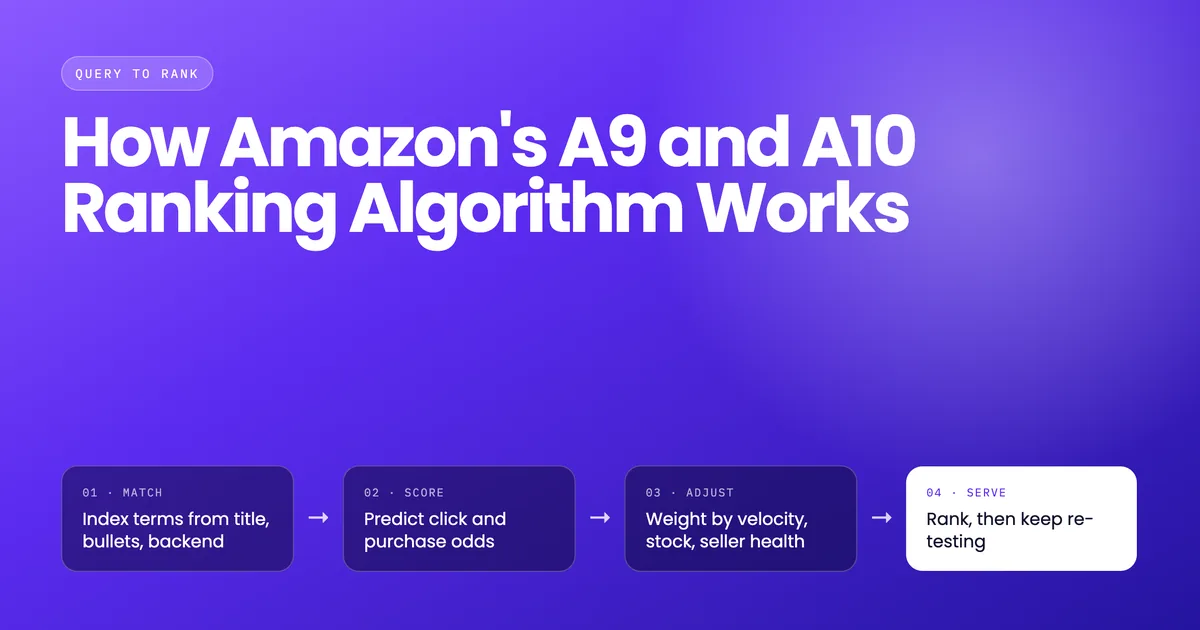
The Amazon ranking algorithm orders products on relevance and performance. Relevance comes from your title, bullets, backend terms and attributes, and in 2026 also from intent matching by Amazon's COSMO system. Performance comes from conversion rate, sales velocity, price and stock. Backlinks and domain authority play no part at all.
What is the A9 algorithm, and what is A10?
A9 is the name of the search system Amazon built for product search, named after the subsidiary that developed it. "A10" is not an official Amazon term. It is shorthand the seller community adopted to describe the observation that Amazon's ranking has shifted over time toward external traffic, organic sales and seller authority, and away from pure keyword matching and paid velocity.
Amazon does not publish the algorithm and has never confirmed an "A10". Treat both names as labels for the same thing: a system that tries to put the product most likely to sell at the top of the page.
- Google ranks pages to answer a question. Amazon ranks products to make a sale. Every practical difference follows from that.
Which ranking factors actually matter?
They divide cleanly into two groups: whether you are eligible to rank for a term at all, and how well you perform once you are.
| Factor | Group | Where you control it |
|---|---|---|
| Keyword indexing | Relevance | Title, bullets, backend search terms, structured attributes |
| Conversion rate | Performance | Images, price, reviews, first bullet, A+ Content |
| Sales velocity | Performance | Recent units sold for that term, not lifetime sales |
| Click-through rate | Performance | Main image, title, price and review count in the results grid |
| Stock availability | Eligibility | Going out of stock removes you from rank entirely |
| Listing health | Eligibility | Suppressed or policy-flagged listings do not rank at all |
Relevance gets you into the auction. Performance decides where you finish. Most sellers work exclusively on the first and wonder why position does not move.
Amazon listing optimisation
Want a listing that converts, not just ranks?
If your conversion rate is lagging, we can rework the images, price position and first bullet with you. It is the part of ranking you can actually control.
See how we optimise listingsWhy does conversion rate matter more than keywords?
Because Amazon is paid on sales. A listing that converts at 18% earns Amazon more per impression than one converting at 6%, so the system has a direct commercial reason to show it more often.
This is the part that surprises people arriving from Google SEO. You can be perfectly indexed for a term and still sink, because every impression Amazon gives you is being measured. Ranking is not awarded and then held; it is continuously re-earned.
The practical consequence: if your conversion rate is below your category norm, keyword work is the wrong first job. Fix the images, the price position and the first bullet, then chase rank. We set out the order in how to optimise an Amazon listing.
What does not affect Amazon ranking?
Four things sold as ranking services do nothing on Amazon:
- Backlinks and domain authority. There is no link graph inside Amazon search. Anyone selling DA or DR packages for Amazon rank is selling a Google product for an Amazon problem.
- Keyword density and repetition. Amazon indexes a term once. Repeating it in the title, the bullets and the backend field wastes the backend field.
- Meta descriptions and page titles in the Google sense. Your listing has no meta description.
- Sales velocity you did not earn. Manipulated velocity is detected and reversed, and the account is at risk under Amazon's Community Guidelines.
External traffic does have some effect, but as a source of real sales rather than as a signal in itself.
One eligibility point is worth separating from the rest, because it is often mistaken for a ranking factor: Brand Registry does not rank you higher. What it does is unlock A+ Content, Sponsored Brands and Vine — all of which act on conversion rate and sales velocity, which are ranking factors. The lift is real; it simply arrives through performance rather than through any status Amazon assigns your brand.
How do you check whether you are indexed for a keyword?
The reliable manual method takes about a minute per term:
- Search Amazon for your exact keyword plus your ASIN, separated by a space.
- If your listing appears, you are indexed for that term.
- If nothing appears, you are not — and no amount of bidding will produce organic rank for it.
Indexing usually follows a listing change within 48 hours to two weeks. Rank movement takes longer, because it depends on conversion and sales history accumulating behind the new terms.
Our keyword mapper will show you which of your terms are competing with each other across fields, which is the most common cause of a term never indexing at all.
How does the Buy Box affect ranking?
Losing the Buy Box effectively removes you from organic ranking, because a listing without it has no “Add to Basket” button to convert against. Rank is earned through conversion, so a listing that cannot be bought in one click stops earning it.
The Buy Box is awarded per offer, not per listing, and the inputs are largely operational rather than editorial:
- Landed price. Item price plus delivery, compared against other offers on the same ASIN.
- Fulfilment method and speed. FBA and Prime-eligible offers are advantaged on delivery promise.
- Stock. An out-of-stock offer cannot hold the Buy Box, and rank decays while you are away.
- Seller performance. Late dispatch, defect rate and cancellation rate all feed in.
Two practical consequences follow. First, a stock-out is a ranking event, not just a sales event — the position you regain after a fortnight out of stock is usually below the one you left. Second, if you sell on a shared ASIN, a competitor undercutting you on landed price takes both the sale and, over time, the organic position.
Amazon calls it the Featured Offer in its own documentation; the qualifying conditions are set out in Seller Central under Featured Offer eligibility, and they are worth reading in the version current for your account rather than a third-party summary.
Check the Buy Box percentage in your business reports before you diagnose a rank drop as a keyword problem. If it fell first, the ranking did not cause the sales drop — the lost Buy Box caused both.
How long does it take to move Amazon rank?
Three separate clocks run, and conflating them is why sellers panic in week two.
| What changes | Typical timescale |
|---|---|
| Indexing for new terms | 48 hours to 2 weeks |
| First meaningful position movement | 4 to 8 weeks |
| A settled, readable picture | One full sales cycle, commonly 60 to 90 days |
Anyone promising ranked keywords in days is describing manipulation rather than optimisation.
Amazon SEO
Rank slipped and you can't see why?
We run this exact checklist on client accounts every week. If you'd rather not dig through reports alone, we're happy to take a look with you.
See how our Amazon SEO worksYour rank dropped — how do you find out why?
Work through the eligibility questions before the optimisation ones. Most sudden rank drops are caused by something that removed the listing from competition, not by a competitor out-optimising you overnight.
In order, because each step is cheaper than the one after it:
- Is the listing live and unsuppressed? A missing required attribute takes an ASIN out of search without taking it off the site. There is a full account of this in why Amazon suppresses a listing.
- Did you go out of stock? Check the date against the drop. Rank decays during a stock-out and returns lower than it left.
- Did you lose the Buy Box? Compare Buy Box percentage week on week in your business reports.
- Did the price move? Yours or a competitor's. Conversion rate follows price position closely, and rank follows conversion.
- Did conversion fall without a price change? Look for a new review below three stars, a changed main image, or a competitor's new A+ Content.
- Only then, is it indexing? Re-run the ASIN-plus-keyword check above on your priority terms, and cross-check the search term report in Amazon Ads to see whether the term still triggers your listing at all.
Log the date of every listing change you make. Without a change log you cannot tell a rank drop caused by your own edit from one caused by the market, and the two need opposite responses. Our listing checker will flag the eligibility problems in the first three steps, and the Amazon SEO service page sets out how we run the same sequence on a client account.
One caution on tooling: third-party rank trackers sample a keyword from one location at one moment, so small daily movements are usually noise. Compare weekly averages, not daily positions.
How are COSMO and Alexa for Shopping changing the Amazon ranking algorithm?
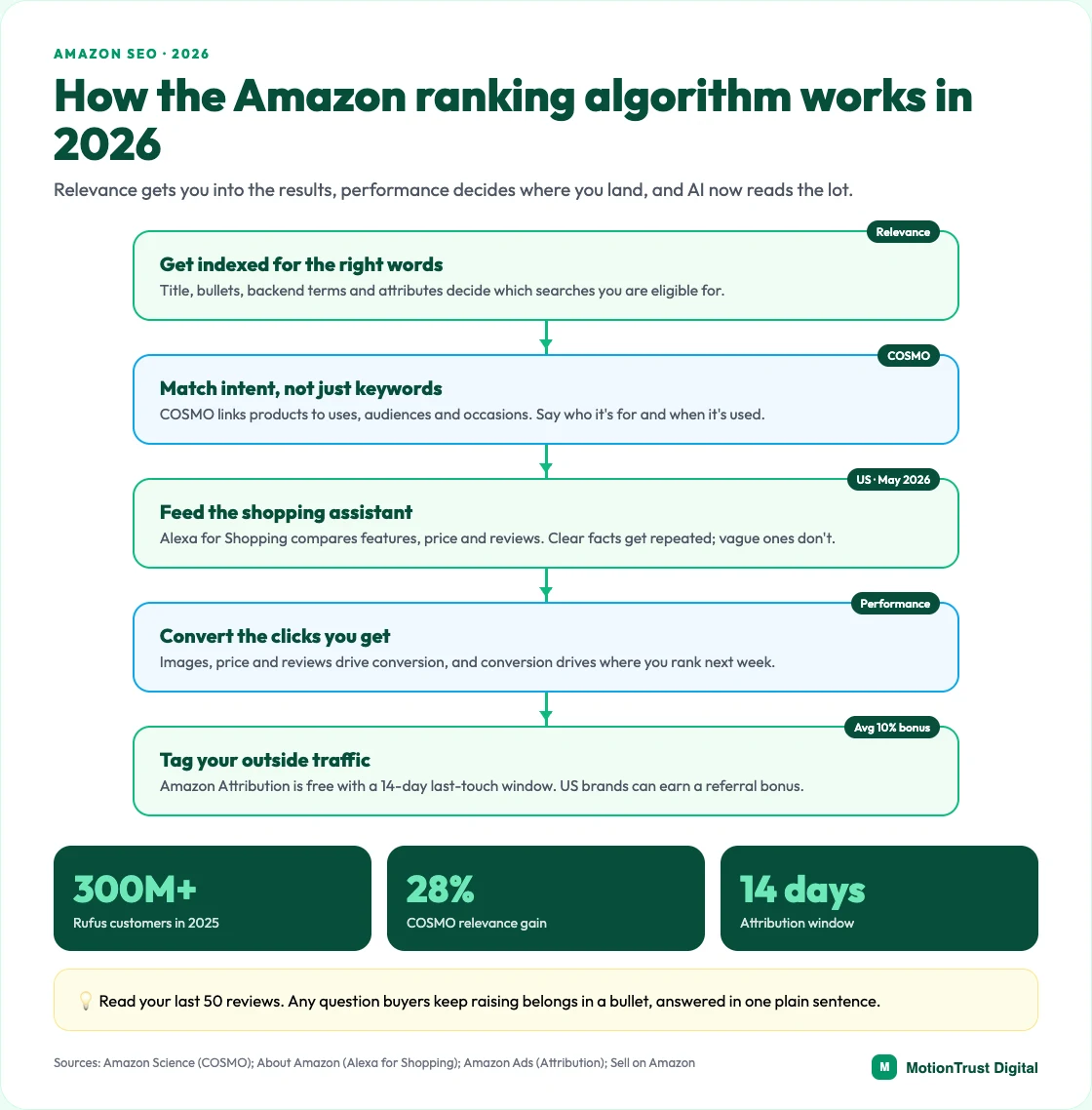
The core of the Amazon ranking algorithm has not changed. Be relevant, then convert. What has changed is how Amazon works out relevance. Two systems matter in 2026, and most guides still skip both.
COSMO: matching intent, not just words
COSMO is Amazon's commonsense knowledge system. Amazon Science describes it as linking products to the jobs, people and occasions they serve. Think "shoes for standing all day" or "a gift for a new runner". It covers 18 major product categories. Amazon says it is deployed in search features such as search navigation.
In Amazon's published tests, the fine-tuned COSMO model beat the best baseline by 28% on a relevance score (macro F1). That is a research result, not a ranking boost you can claim. But the direction is clear. A listing that says who it is for and when it gets used gives Amazon far more to match.
Alexa for Shopping reads more than your keywords
In May 2026 Amazon merged Rufus and Alexa+ into Alexa for Shopping, for US customers. Shoppers now ask questions straight from the search bar. Amazon says Rufus helped over 300 million customers in 2025.
The assistant compares products on features, price and reviews. It also pulls in information from across the web. So your reviews and product details now speak for you in answers you never see. Vague bullets give it nothing useful to repeat.
Do reviews and external traffic affect ranking?
Amazon publishes no weights for either inside the Amazon ranking algorithm. It does confirm that listing quality, account health and competitive pricing feed search rank. Reviews work mainly through conversion, and now through what the assistant says about you.
External traffic is at least measurable. Amazon Attribution is free and uses a 14-day, last-touch window. US brand owners also earn a Brand Referral Bonus averaging 10% of qualifying sales, credited after about two months. That is real money, not a ranking signal.
What to change in your listing this quarter
These fixes help both halves of the Amazon ranking algorithm: relevance and conversion.
- Name the use case. Say who it is for and where it is used, in plain sentences.
- Fill every attribute. Structured fields hand Amazon clean facts to match and quote.
- Answer what reviews keep asking. If buyers mention fit or size, settle it in a bullet.
- Tag outside traffic. Put Attribution tags on social, email and Google links.
Not sure where you stand? Start with our free Amazon listing check. If you would rather hand it over, our Amazon listing optimisation service rewrites copy and attributes for intent-led search. For rank work across a whole catalogue, our Amazon SEO agency team can help.
Free Amazon audit
Get a second pair of eyes on your listing
Send us an ASIN and we'll write back with what is holding its rank, from indexing gaps to conversion leaks. No obligation, just a clear list you can act on.
Request my free auditQuestions people also ask
What is Amazon's A9 algorithm?
A9 is the product search system Amazon built, named after the subsidiary that developed it. It ranks listings on relevance — keywords in the title, bullets and backend terms — and on performance, chiefly conversion rate and recent sales velocity. Amazon does not publish its details.
Is A10 a real Amazon algorithm?
No. A10 is a term the seller community adopted, not an Amazon one. It describes an observed shift toward organic sales, external traffic and seller authority over pure keyword matching. Amazon has never confirmed it exists as a separate system.
Do backlinks help Amazon rankings?
No. There is no link graph inside Amazon search, so domain authority and backlinks have no direct effect on where a listing ranks. External traffic can help indirectly, but only because it produces real sales, which do count.
How long does it take to rank on Amazon?
Indexing for new keywords usually happens within 48 hours to two weeks. Meaningful position movement takes four to eight weeks, and a settled picture takes one full sales cycle — commonly 60 to 90 days — because rank follows accumulated conversion and sales history.
Does Amazon PPC improve organic ranking?
Indirectly. Advertising produces sales, and sales velocity is a ranking input, so a campaign that converts well can lift organic position for the same terms. Advertising that generates clicks without conversions does not help and can hurt, because conversion rate is itself a factor.
What is Amazon COSMO and does it replace the A9 algorithm?
No. COSMO is a commonsense knowledge system from Amazon Science that links products to uses, audiences and occasions. Amazon says it is deployed in search features such as search navigation. It adds intent understanding on top of keyword relevance rather than replacing it, so your title, bullets and backend terms still need the right words.
Does Alexa for Shopping use my product reviews?
Yes. Amazon says the assistant compares products on features, price and reviews, and also draws on information from across the web. That means recurring themes in your reviews, good or bad, can shape how it describes your product. Fixing the issues reviewers mention helps both conversion and what the assistant says.
Written by Monjur Hossain, Founder & Amazon Strategy Lead at MotionTrust Digital, from the agency’s day-to-day work on client Amazon accounts and checked against the primary documentation listed under Sources below. Primary sources for this guide: Amazon Seller Central UK and Amazon.
Every figure attributed to Amazon or to another named organisation links to that organisation’s own page, with the month it was accessed. Anything drawn from our own client accounts is labelled as ours rather than presented as an industry figure, and where no primary source publishes a number this guide says so instead of estimating one. Last reviewed .
- Amazon Seller Central UK — Improve your product listing search relevance, accessed August 2026.
- Amazon Seller Central UK — Product listing requirements and style guides, accessed August 2026.
- Amazon — Community Guidelines, accessed August 2026.
- Amazon — Brand Registry (Amazon UK), accessed August 2026.
- Amazon Science — COSMO: A large-scale e-commerce common sense knowledge generation and serving system at Amazon (SIGMOD 2024), accessed October 2026.
- Amazon Science — Building commonsense knowledge graphs to aid product recommendation, accessed October 2026.
- About Amazon — Meet Alexa for Shopping, your personalized, agentic AI assistant on Amazon, accessed October 2026.
- Amazon Ads — Basics of Amazon Attribution, accessed October 2026.
Monjur Hossain
Founder & Amazon Strategy Lead, MotionTrust Digital
Monjur incorporated MotionTrust Digital in September 2022 and leads Amazon strategy across the client base. Eight years in e-commerce and marketplace marketing, now on Amazon only — keyword strategy, listing architecture and advertising structure for growing brands.
MonjurAgencyTry the free tools
Seven Amazon tools that run in your browser — profit and ACoS calculator, PPC auditor, listing checker and more. No account, nothing uploaded.
Try the free toolsLast reviewed . We update articles in place rather than republishing at a new URL, so the link you have keeps working.
Stay current on how Amazon ranks products
Ranking signals change quietly. One email a week with our newest articles on Amazon SEO and listings, written for sellers rather than for other marketers. Email us to join.