
The Amazon product launch playbook for sellers
 By Monjur HossainFounder & Amazon Strategy Lead
·
Published
·
Last reviewed
·18 min read
By Monjur HossainFounder & Amazon Strategy Lead
·
Published
·
Last reviewed
·18 min read
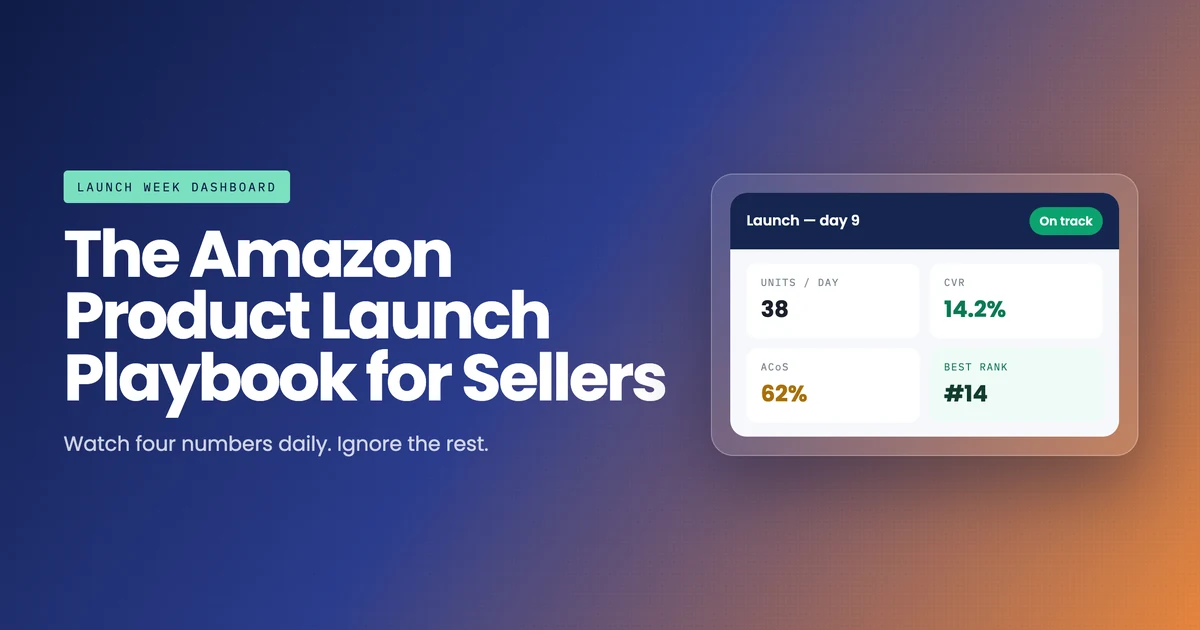
An Amazon product launch is ninety days of buying rank you intend to keep. Days 1–30 collect data: advertise hard on tightly matched terms and expect a loss. Days 31–60 put budget behind what converted. Days 61–90 lock in organic position as ad dependence falls. Most of the outcome is decided before day one, including Amazon's launch incentives.
Before day one: the checklist that decides the launch
Launches are lost in the fortnight before they start, usually because something on this list was left until "after we go live". Work through it in order.
Stock, and the arithmetic behind it. Nothing kills a launch faster than going out of stock in week three, because the sales velocity you paid for evaporates and the rank goes with it. Plan inventory against your ambition, not your forecast: if you intend to sell thirty units a day by week six, you need cover for that plus lead time, and running out is more expensive than overstocking by a wide margin.
Brand Registry, finished. Without it you cannot run Sponsored Brands, cannot use A+ content, cannot see Brand Analytics, and have no protection against hijackers. All four matter during a launch more than at any other time. If it is not done, delay the launch rather than launch without it.
The listing, written for the 2026 fields. This is the step most published playbooks have not updated. Amazon announced that "Starting July 27, 2026, titles in all categories except for media will need to be 75 characters or less including spaces", with a new 125-character Item Highlights field that began displaying beneath the title on 10 August. Amazon states both are search inputs and neither is prioritised.
So a new listing has 75 characters for brand plus the one or two terms that say what the product fundamentally is, and 125 for the attributes a buyer filters on. If you write the title the old way it will be rejected or rewritten for you — Amazon gave brand owners 14 days to review AI-generated recommendations and updated non-compliant titles gradually afterwards.
Photography, treated as the main budget line. The main image decides click-through rate on a results page, which decides what every advertising dollar buys. Seven images minimum: hero on white, in-use, scale reference, feature callouts, what is in the box, a comparison against the obvious alternative, and one addressing the most common objection in your category’s reviews.
A keyword set, tiered. Fifteen to twenty terms per ASIN, sorted by relevance before volume, with the placement decided in advance. Our keyword research guide covers the method; the important part for a launch is that the list is short enough to act on.
Price, set against the page rather than the spreadsheet. Look at what the page-one results charge and what review counts they carry. A new listing at the top of the price band with no reviews is asking shoppers to take a risk they have no reason to take.
Free listing check
Before you spend on ads, check the page
A quick check of your title, bullets and images against Amazon's current rules, so launch traffic lands on a listing that's ready for it.
Check my listingThe honeymoon period, and what it really is
New listings frequently see an early surge of impressions that is hard to explain from sales alone. Sellers call it the honeymoon period. Amazon has never confirmed it exists, publishes no duration, and anyone quoting you an exact window is repeating folklore.
What is observable, and what actually matters, is simpler: a new listing has no conversion history, so Amazon has to test it to learn anything. That testing produces impressions. What you do with them decides whether the listing keeps them.
Which reframes the whole question. The point of the first few weeks is not to exploit a bonus before it expires. It is that you are being assessed on a small sample, and a listing that converts poorly during that sample takes longer to recover than one that never had the impressions in the first place.
Three consequences worth planning around:
- Do not launch before the listing is finished. Traffic against a half-built page spends your one cheap sample proving you do not convert.
- Do not launch into an out-of-stock risk. The assessment does not pause while you restock.
- Do not launch on a Friday. Something will need fixing in the first 48 hours, and Seller Support is slower at the weekend.
Treat the early window as an audition rather than a gift and you will make better decisions than any theory about its length would produce.
The corollary is worth stating plainly, because it is the most expensive mistake in this article: a soft launch is usually a wasted launch. Going live quietly to "see how it does" before the photography is finished, before the keyword set is placed, or before stock has landed in full, spends the one period when Amazon is actively looking at you on a version of the listing you would not choose to be judged on. If you are not ready to support it with budget and attention, leave it unpublished.
Days 1–30: buy data, expect to lose money
The first month has one job: find out which keywords convert for this product. Sales are the mechanism, not the target.
Campaign structure, day one. Three campaigns and no more:
- Auto, modest budget, running permanently. This is a research instrument that happens to make sales. It will find phrasing you did not think of.
- Exact match, your fifteen to twenty researched terms. One ad group, generous bids. You are buying placement to generate conversion history on terms you intend to own.
- Product targeting against three to five competitor ASINs. Specifically the ones a shopper would buy instead of you. Expensive, and it puts you in front of exactly the right person.
Resist adding broad match, Sponsored Brands, Sponsored Display or anything else in month one. You cannot read the results of five variables changed at once, and the simplicity is the point.
Bid higher than feels comfortable. A launch bid is not a profit calculation, it is a purchase of placement. Our own working range at this stage is 50–80% ACoS, which is deliberately unprofitable, and the discipline is that it has an end date rather than that it is low.
Harvest weekly, without exception. Every week: pull the search term report, move converting terms into their own exact-match ad groups, add non-converting spenders as negatives. Four cycles of this during month one is most of the value the month produces.
Reviews, inside the rules. Enrol in Vine if you are eligible — it is Amazon’s own programme and the only sanctioned way to get early reviews. Turn on Request a Review automation. Put a well-designed product insert in the box that asks for honest feedback without conditioning anything on a rating.
What not to do, at any price: buying reviews, incentivising positive reviews, review gating, or giveaway schemes designed to manufacture rank. Amazon suspends the seller for these, not the supplier, and in the US the Federal Trade Commission’s rule on consumer reviews makes buying and selling them a civil-penalty matter. Our review work is built entirely inside the permitted mechanisms for this reason.
Days 31–90: concentrate, then consolidate
The second and third months are where a launch either compounds or stalls, and the difference is almost always whether anyone acted on month one’s data.
Days 31–60: concentrate
You now have four weeks of real conversion data. Use it to make the budget narrower rather than larger.
Rank your terms by conversion rate, not by volume. The top five to eight get most of the budget. Terms that took clicks and never converted get paused or negated, however good they looked in research.
Promote the winners into the listing. Terms that converted consistently for four weeks have earned a place in the title, Item Highlights or bullets. This is the moment advertising data becomes SEO work, and it is the step most launches skip entirely.
Add Sponsored Brands if you have two or more products worth showing together, and defend your own brand term, which will be cheap and convert well.
Start reading organic rank on your main terms weekly. This is the number that tells you whether the money did anything durable.
Days 61–90: consolidate
Reduce bids on terms where organic rank has arrived — one at a time, watching position for a fortnight after each. Reduce rather than pause: total sales velocity on a term includes the paid sales, so switching off abruptly can cost the organic position you just bought.
Watch TACoS rather than ACoS. A falling total advertising cost of sale at steady spend means organic revenue is growing underneath the advertising, which is the entire point of the ninety days. There is more on the distinction in our piece on ACoS and TACoS benchmarks.
Decide what this product is. By day 90 you should know whether it is a winner worth further investment, a steady contributor to run at target ACoS, or a mistake to clear and stop funding. Making that call on schedule is worth more than any tactic in this article.
Amazon PPC management
Want a hand with the first 90 days of ads?
We set up tightly matched campaigns, move budget each week to what converts, and step spend down as organic rank arrives.
See how we run launch PPCExternal traffic, and whether it is worth it
Sending traffic to Amazon from somewhere else — an email list, paid social, a creator, your own site — comes up in every launch conversation, and the honest answer is that it is useful in a narrower set of cases than it is recommended in.
Use Amazon Attribution or do not bother. It is free, it gives every external source a tagged link, and without it you are sending traffic you cannot measure and will never know whether it worked. An untagged Instagram campaign that coincides with a launch is indistinguishable from the launch.
The quality problem is real. Amazon shoppers arrive ready to buy. Someone clicking from a social feed is browsing, and browsing traffic converts worse. Because conversion rate on a term feeds ranking, a burst of poorly-converting external traffic can be actively unhelpful during exactly the weeks you are being assessed.
Where it genuinely helps. An existing email list of people who already want the product, because they convert like Amazon traffic rather than like social traffic. A creator whose audience matches the product closely. And a category so thin that Amazon’s own search volume cannot produce the velocity you need, where you have no alternative.
Where it usually does not. Cold paid social to a brand nobody knows, on a product that competes on price, during a launch that also needs its advertising budget. That combination spends money in two places to achieve what one would have done better.
Send them to the right place
If you do run external traffic, send it to a search results page for your brand plus product rather than straight to the detail page. Amazon reads a search-then-purchase sequence as demand for those terms, which is worth more than the same sale arriving cold. And keep the landing consistent with the ad — external traffic that bounces immediately is worse than no external traffic at all.
The four numbers to watch daily
Launch dashboards fail by showing forty metrics nobody reads. Four numbers, checked each morning for the first month, catch almost everything that goes wrong.
| Number | What it tells you | Act when |
|---|---|---|
| Units per day | Whether velocity is building | Flat for five days at steady spend |
| Conversion rate | Whether the page is doing its job | Below category norm, or falling |
| ACoS | What the velocity is costing | Rising while units stay flat |
| Best organic rank | Whether any of it is durable | Not improving by week three |
The pairs matter more than the individual figures. Units flat and ACoS rising means you are paying more for the same sales, which is usually a conversion problem rather than a bidding one. Units rising and organic rank static means you are renting the position and will keep renting it. Conversion falling with everything else steady usually means a competitor changed price or image, or your reviews took a hit.
Why launches stall after a strong start
Four causes, in order of how often we see them.
Stock ran out. The most common and the least recoverable. Velocity stops, rank decays, and restarting costs more than the original launch.
The budget was cut too early. Someone saw a 70% ACoS in week two, panicked, and halved the bids. The launch then fails to reach the velocity it needed, which is read as the launch failing.
Nobody promoted the winning terms. Month one produced the data and nothing was done with it, so the listing never earned the organic position the advertising was buying.
Reviews did not arrive. Conversion plateaus around the point where shoppers start comparing review counts, and a listing with four reviews against competitors with four hundred converts worse every week as the traffic gets less forgiving.
What does an Amazon product launch cost?
No honest answer is a single number, because it scales with your category’s cost per click and your price point. But the shape is consistent, and thinking in shape rather than total is more useful.
Work backwards from units. Decide how many units a day you need to reach the organic position you want, then work out how many clicks that takes at your conversion rate, then what those clicks cost at your category’s going rate. That is your launch budget, and it will be a larger number than you expected in a competitive category and a smaller one than you feared in a thin one.
Budget the loss, not the spend. If break-even ACoS is 40% and you plan to run at 70% for thirty days, you are choosing to lose roughly 30% of advertised revenue. Write that figure down before you start. It converts an anxious daily decision into a plan you already agreed to.
Do not forget the non-advertising line. Photography, copy, A+ modules and Vine units are real launch costs, and they are the ones that make every advertising dollar go further. A launch that spends everything on clicks and nothing on the page is the most expensive way to run one.
Keep a reserve for month two. Launches that spend their whole budget in the first thirty days cannot act on what they learned, which wastes the thirty days. A reasonable split is half the advertising budget in month one, a third in month two, and the remainder held for whichever terms turn out to be worth defending.
Account for the fee floor. Amazon raised FBA fees by an average of $0.08 per unit from 15 January 2026, and referral fees range from 5% to 45% by category with a $0.30 minimum. On a thin-margin product that is the difference between a launch that reaches break-even in month four and one that never does, so calculate with your own category rate rather than a rule of thumb.
Launching in more than one marketplace
Do not run a second marketplace at the same time as the first. Each one has its own search behaviour, competitive set, fee structure and, increasingly, its own listing requirements. Land one, learn it, then take the proven keyword set and re-research it locally rather than translating it — US and UK English diverge in ways that cost real money.
If you would like a second read on a launch before you commit the budget, our launch process is published in full, and a free written audit comes back within 48 hours with the listing and keyword gaps named before you spend anything on clicks.
Which Amazon product launch incentives and promotions are worth using in 2026?
The playbook above is about rank. This part is about money, because an Amazon product launch in the UK can now be partly paid for by Amazon itself, and the promotions you pick change what each extra sale costs.
New Seller Incentives: what Amazon UK gives new brands
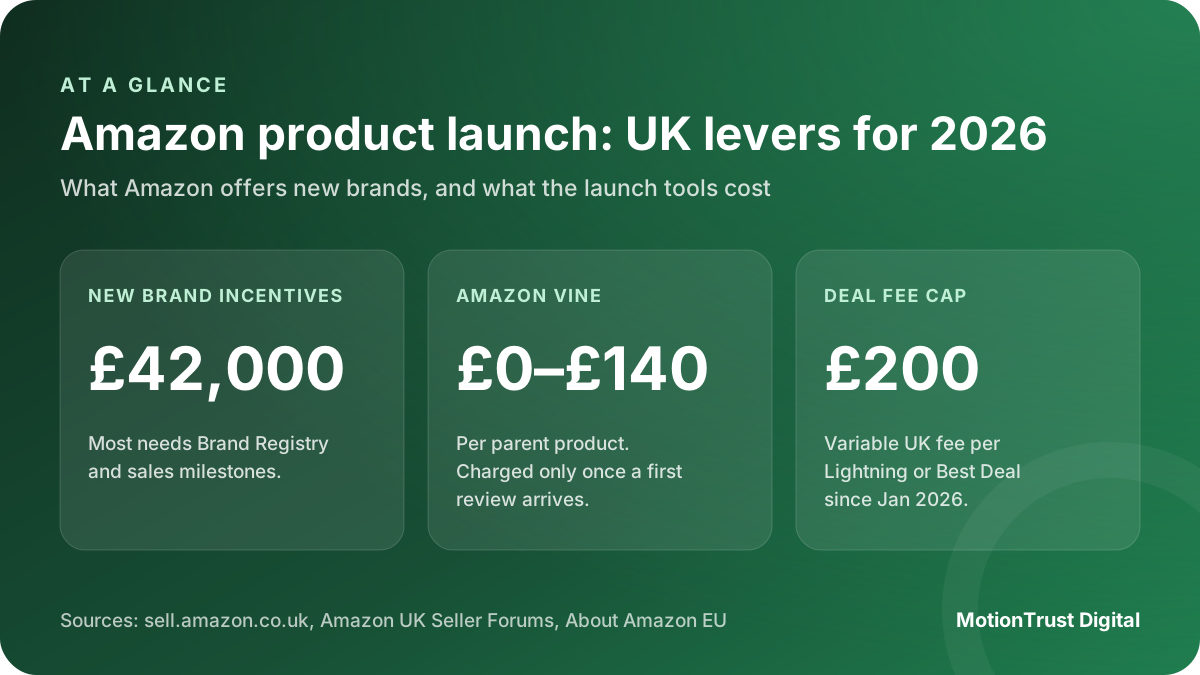
Amazon’s UK “launch your brand” page advertises up to £42,000 in incentives for 2026. The package mixes referral fee discounts, Sponsored Ads credits, FBA inbound shipping credits, Vine credits and voucher credits. Most of it depends on joining Brand Registry and reaching sales milestones within set windows, so read the eligibility terms before you plan around the headline figure. If you qualify, claim it before launch day, because some credits only apply to sales in your first months.
Amazon Vine: what it costs and when to enrol
Vine sends free units to trusted reviewers for honest reviews. In Amazon’s October 2023 UK announcement the fee tiers per parent product are £0 for up to 2 units, £60 for up to 10 and £140 for up to 30. The fee is only charged if a first review arrives within 90 days. Check the current figures in Seller Central before enrolling, and enrol about three weeks before launch so reviews start arriving as traffic does.
Vouchers, deals and Prime Exclusive Discounts in an Amazon product launch
- Vouchers are the cheapest lever. The badge lifts click-through in search and you only pay when one is redeemed.
- Lightning and Best Deals suit day 31 onwards, once reviews are in. Since January 2026 the UK variable deal fee is capped at £200 per deal.
- Prime Exclusive Discounts help around Prime events, but they stack with vouchers. Do the margin arithmetic first.
Use one lever at a time in the first month so you can tell which one moved sales, and launch at your real price with a voucher rather than a low price you later have to raise.
UK review rules: what the fake-reviews ban means for your launch
Since 6 April 2025 the Digital Markets, Competition and Consumers Act makes fake reviews, and incentivised reviews that are not disclosed, a banned practice in the UK. Vine, Request a Review and neutral follow-up emails are fine. Rebates in return for a review, review groups and asking only happy buyers are not. The CMA’s guidance (CMA208) sets out what counts. Our review compliance checker flags risky wording in your inserts and messages.
If you would rather hand the whole launch over, our Amazon product launch service covers incentives, Vine timing and the first 90 days of PPC management, with review management that stays inside the rules.
Product launch
Launching something this quarter?
Tell us about the product and we'll plan the incentives, Vine timing, promotions and ads with you, then help run them.
Talk to us about your launchQuestions people also ask
How long is the Amazon honeymoon period in 2026?
Amazon has never confirmed a honeymoon period exists and publishes no duration, so any specific window you are quoted is folklore. What is observable is that a new listing has no conversion history, so Amazon tests it to learn — and a listing that converts poorly during that sample takes longer to recover than one that never got the impressions.
How much should I budget for an Amazon launch?
Work backwards rather than picking a number: how many units a day you need for the rank you want, how many clicks that takes at your conversion rate, what those clicks cost in your category. Then budget the loss separately — running at 70% ACoS against a 40% break-even means choosing to lose about 30% of advertised revenue for thirty days.
Should I launch with a low price and raise it later?
A launch price below your intended price is a legitimate tactic, but raise it gradually and watch conversion at each step. The risk is that your early reviews and conversion history are earned at a price point you do not intend to keep, so the listing converts worse the moment it reaches its real price.
Is Amazon Vine still worth it for launches in 2026?
For most launches yes, because it is Amazon’s own programme and the only sanctioned way to get reviews before you have sales. Treat the units you give away as a launch cost like photography. It is not a substitute for organic review velocity, and Vine reviewers are not obliged to be kind.
Why did my launch stall after a strong start?
Most often stock ran out, which stops velocity and decays rank. After that: the budget was cut in week two when ACoS looked alarming, nobody promoted the converting terms into the listing, or reviews never arrived and conversion plateaued against competitors with hundreds.
Why do Amazon product launches fail?
Usually because the listing was not finished before traffic arrived, so the first weeks of impressions proved the product does not convert. After that: insufficient stock cover, a budget that ended before the data was acted on, and launching without Brand Registry, which removes Sponsored Brands, A+ content and Brand Analytics at the moment they matter most.
What is a good TACoS for an Amazon product launch?
High and falling. Our own working range during launch is 25 to 40%, which reflects that most revenue is bought rather than earned at that stage. What matters is the direction across months two and three — if TACoS is not coming down by day 90, the advertising bought sales rather than position.
How many units should I order for my first launch?
Enough to cover the velocity you are aiming for plus your supplier and inbound lead time, not the velocity you forecast conservatively. Running out in week three is more expensive than overstocking, because it stops the sales velocity you paid for and the rank decays with it.
Do Amazon PPC ads directly improve organic ranking?
Not directly. Ads produce sales, and sales velocity and conversion history on a keyword are ranking inputs regardless of where the sale came from. The distinction matters: ads pointed at a listing that converts poorly will not build rank, because poor conversion is also a signal.
Should I use FBA or FBM for my launch?
FBA for most launches, because Prime eligibility materially affects conversion and Featured Offer share, and your ads will not serve when you are not winning the Featured Offer. FBM makes sense for oversized, hazardous or very low-volume items where fulfilment fees would eat the margin.
When should I start PPC?
Day one, but only after the listing is finished. Three campaigns: an auto campaign as a research instrument, exact match on your fifteen to twenty researched terms, and product targeting against three to five true competitor ASINs. Nothing else until month two.
How many reviews do I need to be competitive?
There is no threshold, only a comparison — what matters is your count against the products beside you on the results page. Check page one for your main term and aim to close the gap rather than reach a number. Conversion typically plateaus at the point where shoppers start comparing review counts.
What incentives does Amazon give new brands launching in the UK?
Amazon UK advertises up to £42,000 in 2026 incentives for new brands: referral fee discounts, Sponsored Ads credits, FBA shipping credits, Vine credits and voucher credits. Most depend on Brand Registry and on hitting sales milestones in set windows, so read the terms on Amazon's launch-your-brand page.
How much does Amazon Vine cost in the UK?
Amazon's October 2023 UK announcement set three tiers per parent product: £0 for up to 2 units, £60 for up to 10 and £140 for up to 30. You pay only if a first review arrives within 90 days. Confirm current fees in Seller Central before enrolling, as they can change.
Written by Monjur Hossain, Founder & Amazon Strategy Lead at MotionTrust Digital, from the agency’s day-to-day work on client Amazon accounts and checked against the primary documentation listed under Sources below. Primary sources for this guide: Amazon Seller Central, Amazon, Amazon Ads and US Federal Trade Commission.
Every figure attributed to Amazon or to another named organisation links to that organisation’s own page, with the month it was accessed. Anything drawn from our own client accounts is labelled as ours rather than presented as an industry figure, and where no primary source publishes a number this guide says so instead of estimating one. Last reviewed .
- Amazon Seller Central — Updates to improve your product titles, from 27 July 2026, accessed September 2026.
- Amazon — Product launch guidance, accessed September 2026.
- Amazon Ads — Sponsored Products, accessed September 2026.
- US Federal Trade Commission — Rule banning fake reviews and testimonials, accessed September 2026.
- Amazon UK — Launch your brand on Amazon (2026 incentives), accessed October 2026.
- Amazon Seller Forums UK — Lower-priced fee tiers for Amazon Vine (announcement), accessed October 2026.
- About Amazon EU — Update to European referral and FBA fees for 2026, accessed October 2026.
- CMA — Fake reviews guidance (CMA208), accessed October 2026.
Monjur Hossain
Founder & Amazon Strategy Lead, MotionTrust Digital
Monjur incorporated MotionTrust Digital in September 2022 and leads Amazon strategy across the client base. Eight years in e-commerce and marketplace marketing, now on Amazon only — keyword strategy, listing architecture and advertising structure for growing brands.
MonjurAgency