
How much does it cost to sell on Amazon UK?
 By Monjur HossainFounder & Amazon Strategy Lead
·
Published
·
Last reviewed
·11 min read
By Monjur HossainFounder & Amazon Strategy Lead
·
Published
·
Last reviewed
·11 min read
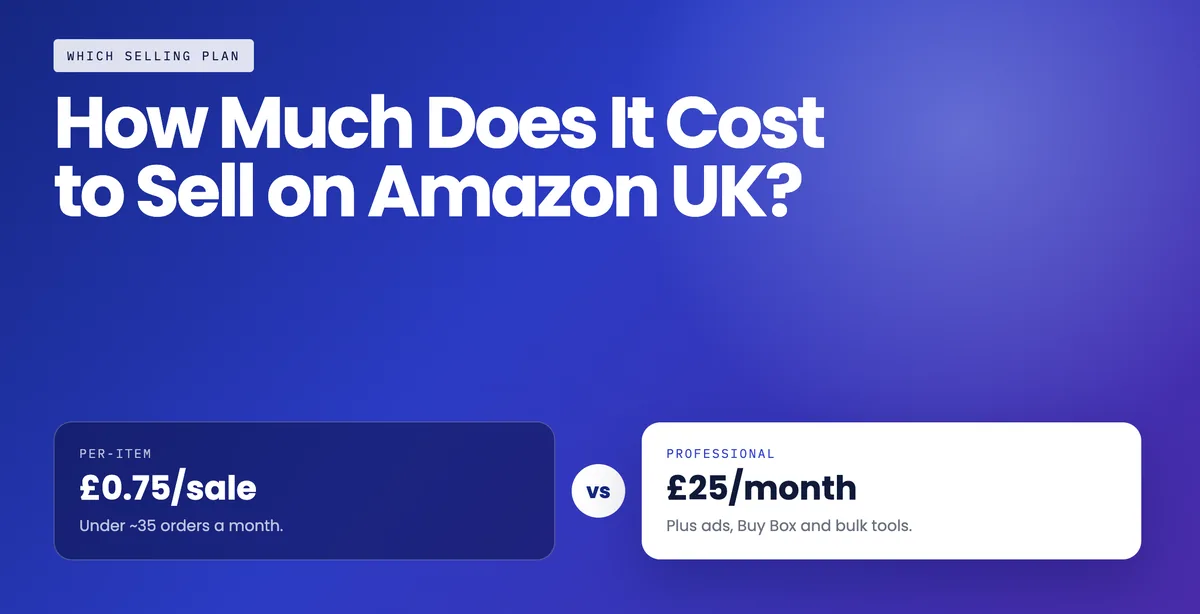
The cost to sell on Amazon UK is £25 a month plus VAT for a Professional plan, a referral fee of mostly 8% to 15% per sale, and FBA fulfilment and storage fees if Amazon ships for you. In 2026, fees fell on many items under £20, while a 1.5% surcharge now applies to FBA fulfilment.
What are all the costs, in one list?
| Cost | When it applies | Typical scale |
|---|---|---|
| Selling plan | Monthly, Professional account | £25 a month excluding VAT, or £0.75 per item sold on the Individual plan |
| Referral fee | Every sale | Commonly 8–15% of the total price, by category |
| FBA fulfilment fee | Per unit shipped by Amazon | By size and weight band |
| Monthly storage | Per cubic foot held in FBA | Higher October to December |
| Aged inventory surcharge | Stock held beyond the threshold | Rises with age |
| Returns processing | Some categories | Per returned unit |
| Advertising | Optional, but competitive in most categories | Cost per click, set by auction |
| VAT | On most sales | See Amazon UK VAT for sellers |
Amazon publishes the two selling-plan figures on its own UK pricing page: £25 a month excluding VAT for the Professional plan, or £0.75 excluding VAT per item sold on the Individual plan, in both cases before referral and fulfilment fees. Fulfilment and storage rates are set by size and weight band and change more often, so take those from the fee schedule in your own account rather than from any article, this one included.
Amazon FBA profit calculator
Run your own product through the numbers
The example below is a sketch. If you plug in your own price, size and category, we will show you the real margin and break-even ACoS in about a minute.
Open the free calculatorWhat does that look like on a real product?
A worked example on a standard-rated product at £24.99, standard size, sold via FBA:
| Line | Amount |
|---|---|
| Selling price (inc VAT) | £24.99 |
| Less VAT at the standard rate | −£4.16 |
| Net revenue | £20.83 |
| Referral fee at 15% of gross | −£3.75 |
| FBA fulfilment (standard size) | −£2.95 |
| Cost of goods | −£6.20 |
| Inbound shipping and duty | −£1.10 |
| Contribution per unit | £6.83 |
That is roughly a 33% contribution margin, which sets a break-even ACoS of about 33%. Run your own numbers in the profit calculator — the figures above are illustrative and your referral and FBA rates will differ by category and size band.
How does the referral fee actually work?
The referral fee is a percentage of the total price, which includes the item price, any delivery charge and gift wrap. Critically, Amazon calculates it on the VAT-inclusive figure, so you pay a fee on money you are holding for HMRC rather than keeping.
Rates vary by category — most sit between 8% and 15%, with some higher. Check your specific category on the Seller Central fee schedule rather than assuming, because a five-point difference changes the whole margin picture.
Is FBA worth the fee?
Usually, and the reason is Prime eligibility rather than the logistics. FBA units are Prime-eligible by default, which affects both conversion rate and Buy Box competitiveness.
FBA is the wrong choice for slow-moving stock, very large or heavy items, and products with high return rates where the returns processing cost compounds. There is a fuller comparison in our services page.
Amazon PPC management
Advertising is where the plan pays for itself
Once you are on Professional, ads decide whether the account works. If you would rather not learn bid management the hard way, we are happy to run it with you.
See how we manage PPCIndividual or Professional — which plan is cheaper?
The crossover is arithmetic: at £25 a month against £0.75 per item, the Professional plan is cheaper once you sell about 34 units a month. Below that the Individual plan costs less on paper — but the comparison is misleading, because the two plans do not give you the same account.
| Individual | Professional | |
|---|---|---|
| Cost | £0.75 per item sold, excl VAT | £25 a month, excl VAT |
| Referral fee | Still charged | Still charged |
| Advertising | Not available | Available |
| Brand Registry, A+ Content | Not available | Available |
| Bulk listing and reports | Limited | Available |
The rows that matter are the last three. Without a Professional plan there is no advertising, no Brand Registry and therefore no A+ Content, so a brand testing the marketplace on the Individual plan is testing it without the tools that make it work. That is a fair way to validate demand for a handful of units; it is not a fair test of whether Amazon is viable for your brand.
The honest version of the decision: use the Individual plan to check that anyone buys the product at all, then move to Professional before you draw any conclusion about the channel. Once you are advertising, the £25 is a rounding error next to the referral and fulfilment fees — and it is the advertising, not the subscription, that decides whether the account works. What is a good ACoS covers how to set that budget from your own margin.
What costs do sellers forget?
- Returns. A 10% return rate on a £24.99 product is a real reduction in contribution, and it does not appear on any fee schedule.
- Aged inventory. Stock that does not move accrues surcharges that can exceed its value.
- Q4 storage. Storage rates rise materially October to December, exactly when you hold the most stock.
- Advertising as a floor, not an option. In competitive categories, zero advertising means near-zero visibility for a new product.
- Removal or disposal fees when you pull stock back out.
Returns deserve a line of their own, because they are the only item here that is both large and partly within your control. A return usually costs you the fulfilment fee, the return processing where it applies, and often the unit itself if it comes back unsellable.
Where returns cluster on one ASIN, the cause is nearly always a listing that promised something the product does not deliver — a size, a material, a capacity — which makes it a listing accuracy problem rather than a logistics one. Reading the return reasons alongside the one and two-star reviews will usually name the culprit in an afternoon.
Put the whole picture through the profit calculator before setting a price, and remember that the fee you pay Amazon is calculated on the VAT-inclusive figure while your margin is not — the mechanics are in Amazon UK VAT for sellers. If you want someone to check the arithmetic against your live account, the free audit covers fees and margin as well as listings.
Cost to sell on Amazon UK vs Amazon.com (US)
Most of the cost structure is the same on both sites — a monthly plan, a referral fee on each sale, and FBA fees if Amazon ships for you. The numbers and the tax treatment are what change.
| Cost | Amazon.co.uk | Amazon.com |
|---|---|---|
| Professional plan | £25 a month, plus VAT | $39.99 a month |
| Individual plan | 75p per item sold | $0.99 per item sold |
| Referral fee | Mostly 7–15% of the sale price, by category | Mostly 8–15% of the sale price, by category |
| Tax in the price | 20% VAT inside the shelf price | Sales tax added at checkout |
| FBA fees | Per unit, by size and weight, in £ | Per unit, by size and weight, in $ |
The biggest difference is VAT. On a £20 product, about £3.33 is VAT before Amazon takes a single fee. On a $20 product on Amazon.com, the full $20 is yours to split between fees and margin. If you are choosing which marketplace to launch on first, run the same product through both columns — the US often wins on margin per unit, and the UK on lower advertising costs.
Check the current rates on sell.amazon.com/pricing for the US and Seller Central UK for the UK, because both change once or twice a year. Our profit and break-even ACoS calculator works in either currency.
What changed in the cost to sell on Amazon UK in 2026?
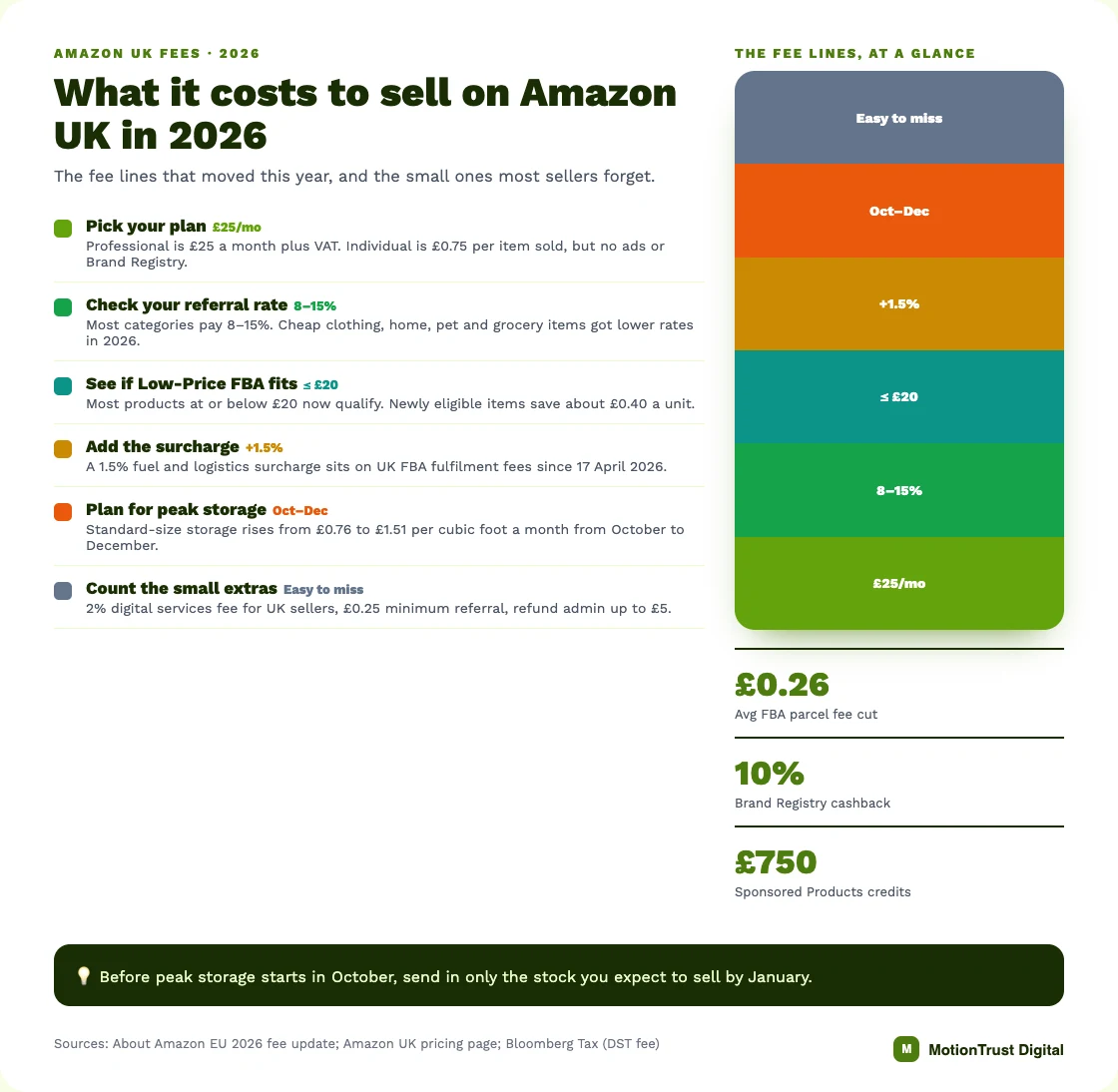
The fee list above still holds, but the numbers under it moved this year. Some lines got cheaper, a couple got dearer, and a few small charges rarely make it into fee guides at all. Here is what changed, using Amazon's own figures, so you can update your spreadsheet instead of guessing.
Where fees came down
Amazon cut UK FBA parcel fees by an average of £0.26 per unit from 15 December 2025. From 5 January 2026, Low-Price FBA covers most products priced at or below £20. Amazon says newly eligible items save about £0.40 per unit.
Referral fees also dropped on cheaper items in several categories:
| Category | Price band | Old rate | New rate |
|---|---|---|---|
| Clothing and accessories | Up to £15 | 8% | 5% |
| Clothing and accessories | £15 to £20 | 15% | 10% |
| Home products | Up to £20 | 15% | 8% |
| Pet clothing and food | Up to £10 | 15% | 5% |
| Grocery, vitamins and supplements | Up to £10 | 8% | 5% |
If most of your range sells under £20, the cost to sell on Amazon UK may now be lower than your last margin check showed. Above £20, these cuts change nothing.
Where fees went up
From 17 April 2026, Amazon adds a 1.5% fuel and logistics surcharge to UK FBA fulfilment fees. On a £3.00 fulfilment fee, that is under 5p a unit. Small, but it lands on every order.
Storage is the bigger swing right now. Standard-size stock in most categories costs £0.76 per cubic foot a month from January to September. From October to December it jumps to £1.51, roughly double. That is the rate you are paying today, so clear slow sellers before peak stock arrives.
The small charges most fee guides miss
- Digital services fee. Since September 2020, Amazon has added 2% to fees such as referral and FBA for UK-established sellers. A 15% referral fee becomes 15.3%.
- Minimum referral fee. Most categories charge at least £0.25 per item, which hurts on very cheap products.
- Refund administration fee. When you refund a buyer, Amazon keeps the lower of £5 or 20% of the referral fee.
First-year credits that soften the bill
New sellers can win some of this back. With Brand Registry, Amazon pays 10% back on your first £40,000 of branded sales, then 5% for the rest of the first year. There are also up to £750 in Sponsored Products credits. Put those credits into a tight, well-structured campaign, which is exactly where our Amazon PPC management UK work usually begins.
The quickest way to see the real cost to sell on Amazon UK for your own product is to run it through our Amazon FBA profit calculator with the 2026 rates.
Free Amazon account audit
Want us to check your fees against your margin?
Send us your account and we will look at fees, storage, ads and listings together, then tell you plainly where the money is leaking. No obligation, just a written review.
Request my free auditQuestions people also ask
How much does it cost to sell on Amazon UK?
A Professional selling plan costs a fixed monthly fee, plus a referral fee on every sale of typically 8% to 15% of the total price. FBA adds a fulfilment fee per unit and monthly storage. On a £24.99 product, total Amazon fees commonly land between £6 and £8.
Is the Amazon referral fee charged on the price including VAT?
Yes. Amazon calculates the referral fee on the total price including VAT and any delivery charge, which means you pay a fee on money you are holding for HMRC rather than keeping. Always calculate margin on the VAT-exclusive price.
Do I need a Professional selling account?
If you sell more than a handful of items a month, yes — the per-item fee on the Individual plan overtakes the monthly subscription quickly. The Professional plan is also required for advertising, Brand Registry and A+ Content.
At how many sales does the Professional plan become cheaper?
At around 34 units a month, comparing £25 a month excluding VAT against £0.75 excluding VAT per item sold. The arithmetic understates the case, though: advertising, Brand Registry and A+ Content are only available on the Professional plan, so a brand on the Individual plan is testing Amazon without the tools that make it work.
Is FBA cheaper than fulfilling myself?
Not usually on cost alone, but FBA units are Prime-eligible, which affects conversion and Buy Box competitiveness. FBA is generally the wrong choice for slow-moving stock, very large items, and products with high return rates.
How much do returns cost an Amazon seller?
More than the fee schedule shows. A return typically costs you the fulfilment fee, return processing where the category applies it, and often the unit itself if it comes back unsellable. Where returns cluster on one ASIN the cause is usually a listing that overstates a size, material or capacity — which makes it a listing accuracy problem rather than a logistics one.
Did Amazon UK seller fees go down in 2026?
For cheaper products, yes. FBA parcel fees fell by an average of £0.26 per unit in December 2025, Low-Price FBA now covers most items at or below £20, and referral fees dropped on low-priced clothing, home, pet, grocery and supplement items. Against that, a 1.5% fuel and logistics surcharge has applied to FBA fulfilment fees since 17 April 2026.
Why are my Amazon UK storage fees higher in October?
Amazon charges a peak rate from October to December. For standard-size items in most categories, monthly storage rises from £0.76 to £1.51 per cubic foot, roughly double. Clothing and footwear rise less, from £0.62 to £0.82. Sending only the stock you expect to sell before January keeps this under control.
Written by Monjur Hossain, Founder & Amazon Strategy Lead at MotionTrust Digital, from the agency’s day-to-day work on client Amazon accounts and checked against the primary documentation listed under Sources below. Primary sources for this guide: Amazon Seller Central UK, Amazon and GOV.UK.
Every figure attributed to Amazon or to another named organisation links to that organisation’s own page, with the month it was accessed. Anything drawn from our own client accounts is labelled as ours rather than presented as an industry figure, and where no primary source publishes a number this guide says so instead of estimating one. Last reviewed .
- Amazon Seller Central UK — Selling on Amazon fee schedule, accessed August 2026.
- Amazon — Amazon UK selling plan pricing, accessed 22 August 2026.
- Amazon Seller Central UK — FBA fulfilment fees, accessed August 2026.
- GOV.UK — VAT rates, accessed August 2026.
- Amazon (About Amazon EU) — Update to European referral and Fulfilment by Amazon fees for 2026, accessed October 2026.
- Bloomberg Tax — Amazon passes cost of U.K. digital services tax to sellers, accessed October 2026.
Monjur Hossain
Founder & Amazon Strategy Lead, MotionTrust Digital
Monjur incorporated MotionTrust Digital in September 2022 and leads Amazon strategy across the client base. Eight years in e-commerce and marketplace marketing, now on Amazon only — keyword strategy, listing architecture and advertising structure for growing brands.
MonjurAgencyTry the free tools
Seven Amazon tools that run in your browser — profit and ACoS calculator, PPC auditor, listing checker and more. No account, nothing uploaded.
Try the free toolsLast reviewed . We update articles in place rather than republishing at a new URL, so the link you have keeps working.
Fees are half the picture. Get the other half weekly
Advertising and conversion decide the rest of your margin. One email a week with our newest articles on PPC, listings and SEO for UK sellers. Email us to join.