
Amazon SEO vs Google SEO: why the same tactics fail
 By Monjur HossainFounder & Amazon Strategy Lead
·
Published
·
Last reviewed
·10 min read
By Monjur HossainFounder & Amazon Strategy Lead
·
Published
·
Last reviewed
·10 min read
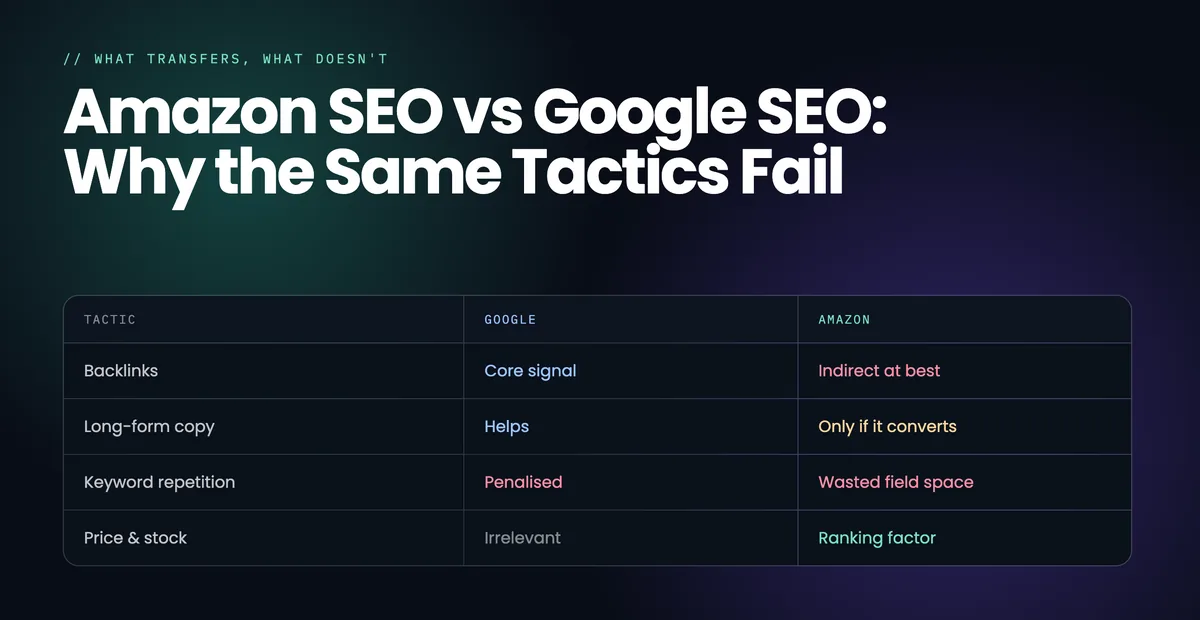
Amazon SEO vs Google SEO comes down to what each engine wants. Google ranks pages that answer a question, weighing links, authority and helpful content. Amazon ranks products that sell, weighing keyword placement, conversion rate and sales velocity. Backlinks and long-form copy do nothing on Amazon, while both reward clear, specific buyer language.
How do the two actually differ, factor by factor?
| Factor | Amazon | |
|---|---|---|
| Goal of the system | Answer a question | Complete a sale |
| Backlinks | Major factor | No effect |
| Domain authority | Meaningful | Does not exist |
| Conversion rate | Indirect at best | Primary factor |
| Sales velocity | Not applicable | Primary factor |
| Content length | Longer often helps | Field limits; longer does not help |
| Keyword repetition | Mildly negative | Wasted — indexed once |
| Freshness | Matters for many queries | Matters only via recent sales |
| Price | Not a ranking factor | Affects conversion, so affects rank |
Amazon keyword research
Want the phrases your buyers actually type?
We build keyword maps from Amazon's own search term data, not Google volumes. If you'd rather skip the spreadsheet work, we're glad to do it with you.
See how we research keywordsHow does keyword strategy differ?
On Google you write for a topic and let the engine infer relevance from context, synonyms and entities. On Amazon you place terms in specific fields, and a term that is not in a field is not indexed.
The practical difference is placement over prose. Amazon gives you a title of up to 200 characters, five bullets of up to 500 characters each, and roughly 250 bytes of backend search terms. Each term should appear once, in the highest-value field it fits, because repeating it elsewhere buys nothing.
Amazon buyers also search differently. They use attribute-heavy phrases — size, colour, quantity, compatibility — because they are filtering a shelf rather than asking a question. Those phrases rarely register in Google keyword tools at all, which is why Google volume data misleads on Amazon.
Does long-form content help on Amazon?
No. There is no equivalent of a 2,000-word guide inside a listing. You have the title, the bullets, the backend terms, the description or A+ Content, and the images.
A+ Content is worth building where you have Brand Registry, but treat it as conversion work rather than ranking work — its text is not indexed the way bullets are. The reason to build it is that it lifts conversion rate, and conversion rate is a ranking factor. The effect is real but it arrives by the side door.
Amazon SEO
Not sure your agency is doing Amazon work?
We only do Amazon, so every hour goes on listings, indexing and conversion. Happy to show you what a month of real Amazon SEO looks like.
See our Amazon SEO approachWhat does transfer between the two disciplines?
Three habits carry over cleanly, and they are worth naming because the rest does not.
- Search intent. Understanding what someone means by a query, and matching the offer to it, works identically in both.
- Competitor analysis. Reading what already ranks and asking why is the same skill.
- Measurement discipline. Tracking positions against a defined term set, and attributing change to a specific action, transfers directly.
What does not transfer: link building, technical SEO, content depth, internal linking, schema markup and domain-level authority. If an agency is selling you those for Amazon, it is selling a Google service — a distinction worth checking against what an Amazon SEO engagement should actually contain.
How do you measure each one, and why do the numbers disagree?
The two disciplines measure different things, so a single dashboard cannot report both honestly. Google SEO is measured in impressions, clicks and average position for a query. Amazon SEO is measured in sessions, unit session percentage and organic rank for a term — and Amazon does not publish query-level impressions the way Search Console does.
| Question | Where you answer it for Google | Where you answer it for Amazon |
|---|---|---|
| Am I visible for this term? | Search Console performance report | Manual ASIN-plus-keyword search, or a rank tracker |
| Is traffic converting? | Analytics goal or e-commerce tracking | Business reports: unit session percentage |
| What did people actually type? | Search Console queries | Advertising search term report |
| Is the page eligible at all? | Indexing report | Listing status and suppression alerts |
Two mismatches cause most of the confusion. Google keyword tools report volume for questions people ask the web, not for the attribute-heavy phrases people type into a shop — so a term with no Google volume can be a strong Amazon term, and vice versa. And Amazon's advertising search term report is the closest thing you have to Search Console queries, which is why it is worth reading even in months when you are not changing bids: it is the only place your buyers' real vocabulary is written down.
Our keyword research service is built around that report rather than around third-party volume estimates, and the keyword mapper will show you where those terms currently sit.
Google's own guidance on creating helpful, people-first content is a fair summary of what the web side rewards. Nothing in it applies to a listing — which is the clearest demonstration of how far apart the two systems are.
Do you need both if you sell on Amazon and your own site?
Usually yes, and they serve different jobs. Your own site captures the branded and research queries that happen before someone reaches Amazon, and it is the asset you own. Amazon captures the transactional query at the point of purchase.
Where they connect is external traffic: a Google-ranking article that sends genuine buyers to your Amazon listing produces sales, and sales are an Amazon ranking factor. That is a real effect, but it works through conversions rather than through any link signal.
Split the work rather than the budget. The site earns the research and comparison queries and keeps the customer relationship; the listing earns the transactional query and the repeat purchase. Where a brand has both, the useful question each month is not “which channel won” but which stage each one is carrying. There is a fuller account of the listing side in how to optimise an Amazon listing and of the ranking mechanics in how Amazon's ranking algorithm works.
The website side of that split is work we do too, though it is not what this site is mostly about: Clenviro's website SEO engagement is the published example, and it is search work with no Amazon listing in it at all.
How does AI search change Amazon SEO vs Google SEO in 2026?
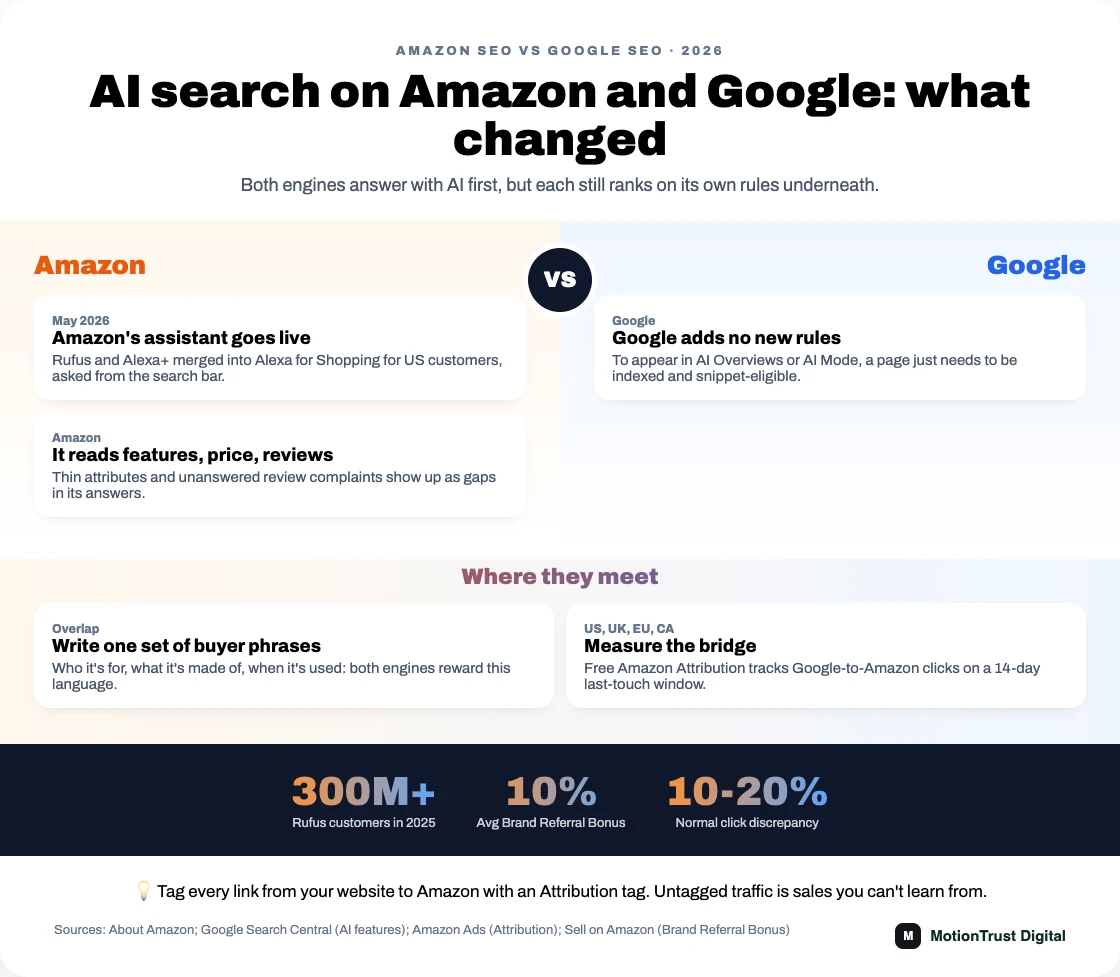
Both engines now answer shoppers with AI before showing a list of results. That changes the Amazon SEO vs Google SEO comparison a little, but not in the way most people expect. The ranking basics underneath each one still hold.
Amazon's assistant reads your listing and your reviews
In May 2026 Amazon merged Rufus and Alexa+ into Alexa for Shopping, for US customers. Shoppers ask questions from the search bar and get comparisons back. Amazon says Rufus helped over 300 million customers in 2025.
The assistant weighs features, price and reviews. It also draws on information from across the web and on the shopper's own history. In practice, your attributes, bullets and review themes now get summarised for you. Gaps in your listing become gaps in the answer.
Google's AI Overviews are still ordinary SEO underneath
Google is unusually direct here. It says there are no additional requirements to appear in AI Overviews or AI Mode. A page must simply be indexed and eligible to show with a snippet. Both features may run several related searches, which Google calls query fan-out, to build an answer.
| Amazon: Alexa for Shopping | Google: AI Overviews | |
|---|---|---|
| Job | Help choose a product | Answer a question |
| Reads | Catalogue data, reviews, web info, shopper history | Indexed pages eligible for a snippet |
| Extra setup | None published | None, per Google |
| Best lever | Complete attributes and clear use cases | Helpful, people-first pages |
Where the two now overlap
The overlap is plain, specific language. Who the product is for, what it is made of and when it gets used. Google rewards pages that answer that well. Amazon's assistant can only repeat what your listing and reviews actually say. One well-researched set of buyer phrases can now serve both. That is where Amazon SEO vs Google SEO work finally meets.
Measuring the bridge between Google and Amazon
Amazon Attribution is free and tracks clicks from Google, social and email to your listing. It runs in the US, Canada, UK, Germany, France, Italy and Spain. It credits a sale to the last click within 14 days. Amazon warns clicks may differ by 10–20% from your ad platform's numbers.
US brand owners can also earn a Brand Referral Bonus averaging 10% of qualifying sales. UK sellers get the reporting but not the bonus.
If you want the buyer phrases mapped properly, our Amazon keyword research service starts from real search term data. For ongoing work, our Amazon SEO agency team handles the listing side, and a free Amazon listing audit shows where to start.
Free Amazon audit
See where your listing stands today
Send us an ASIN and we'll look at it the way Amazon's search and its assistant do. You'll get a short, honest list of what to fix first.
Request my free auditQuestions people also ask
Is Amazon SEO the same as Google SEO?
No. Google ranks pages to answer a question and weighs links, domain authority and content depth. Amazon ranks products to make a sale and weighs conversion rate, sales velocity and keyword placement inside the listing fields. Backlinks and domain authority have no effect on Amazon.
Do backlinks help my Amazon listing rank?
Not directly. There is no link graph inside Amazon search. External links can help indirectly if they send buyers who convert, because sales velocity is a ranking input — but the benefit comes from the sale, not from the link.
Should I write long descriptions for Amazon listings?
No. Amazon has hard field limits and longer copy does not improve ranking. Use the title for the primary terms, the five bullets for attribute and use-case terms, and the backend field for synonyms and misspellings that read badly on the page.
Can a Google SEO agency do Amazon SEO?
Some can, but the disciplines share very little. Link building, technical SEO, content depth and schema markup — the core of most Google SEO offers — have no equivalent on Amazon. Ask specifically what an agency would do in month one and check whether it is Amazon work.
Why does a keyword with no Google search volume sell well on Amazon?
Because the two audiences phrase things differently. People ask Google questions and type attributes into Amazon — size, quantity, compatibility, material. Those attribute phrases often register as near-zero volume in Google keyword tools while converting strongly on Amazon. Use Amazon's own advertising search term report as your volume source rather than a Google tool.
Where do I find what customers actually search on Amazon?
The advertising search term report in your campaign manager. It lists the real phrases that triggered your ads and whether each one converted, which makes it the closest Amazon equivalent to Search Console's query report. It is worth reading monthly even when you are not changing bids, because it is the only place your buyers' own vocabulary is written down.
Do I need to optimise my Amazon listing separately for Rufus or Alexa for Shopping?
Not as a separate project. Amazon has published no special requirements for its assistant. It compares products on features, price and reviews, so the work is the same listing work done more thoroughly: complete every attribute, state the use cases plainly, and fix the problems your reviews keep mentioning.
Can my Amazon product listing rank on Google?
It can, but you have little control over it, because Amazon owns the page and its technical SEO. A better route is ranking your own site or content on Google and linking to the listing with Amazon Attribution tags. That way you see the clicks and sales, and US brand owners can earn the Brand Referral Bonus.
Written by Monjur Hossain, Founder & Amazon Strategy Lead at MotionTrust Digital, from the agency’s day-to-day work on client Amazon accounts and checked against the primary documentation listed under Sources below. Primary sources for this guide: Amazon Seller Central UK and Google Search Central.
Every figure attributed to Amazon or to another named organisation links to that organisation’s own page, with the month it was accessed. Anything drawn from our own client accounts is labelled as ours rather than presented as an industry figure, and where no primary source publishes a number this guide says so instead of estimating one. Last reviewed .
- Amazon Seller Central UK — Search relevance guidance, accessed August 2026.
- Amazon Seller Central UK — A+ Content guidelines, accessed August 2026.
- Google Search Central — Creating helpful, reliable, people-first content, accessed August 2026.
- About Amazon — Meet Alexa for Shopping, your personalized, agentic AI assistant on Amazon, accessed October 2026.
- Google Search Central — AI features and your website, accessed October 2026.
- Amazon Ads — Basics of Amazon Attribution, accessed October 2026.
- Sell on Amazon — Brand Referral Bonus, accessed October 2026.
Monjur Hossain
Founder & Amazon Strategy Lead, MotionTrust Digital
Monjur incorporated MotionTrust Digital in September 2022 and leads Amazon strategy across the client base. Eight years in e-commerce and marketplace marketing, now on Amazon only — keyword strategy, listing architecture and advertising structure for growing brands.
MonjurAgencyTry the free tools
Seven Amazon tools that run in your browser — profit and ACoS calculator, PPC auditor, listing checker and more. No account, nothing uploaded.
Try the free toolsLast reviewed . We update articles in place rather than republishing at a new URL, so the link you have keeps working.
Amazon SEO, one clear article at a time
If this cleared up what carries over from Google and what does not, get our newest Amazon SEO and listing articles in the same plain style, once a week. Email us to join.