
Amazon keyword tools compared — and when you still need a human
 By Monjur HossainFounder & Amazon Strategy Lead
·
Published
·
Last reviewed
·19 min read
By Monjur HossainFounder & Amazon Strategy Lead
·
Published
·
Last reviewed
·19 min read
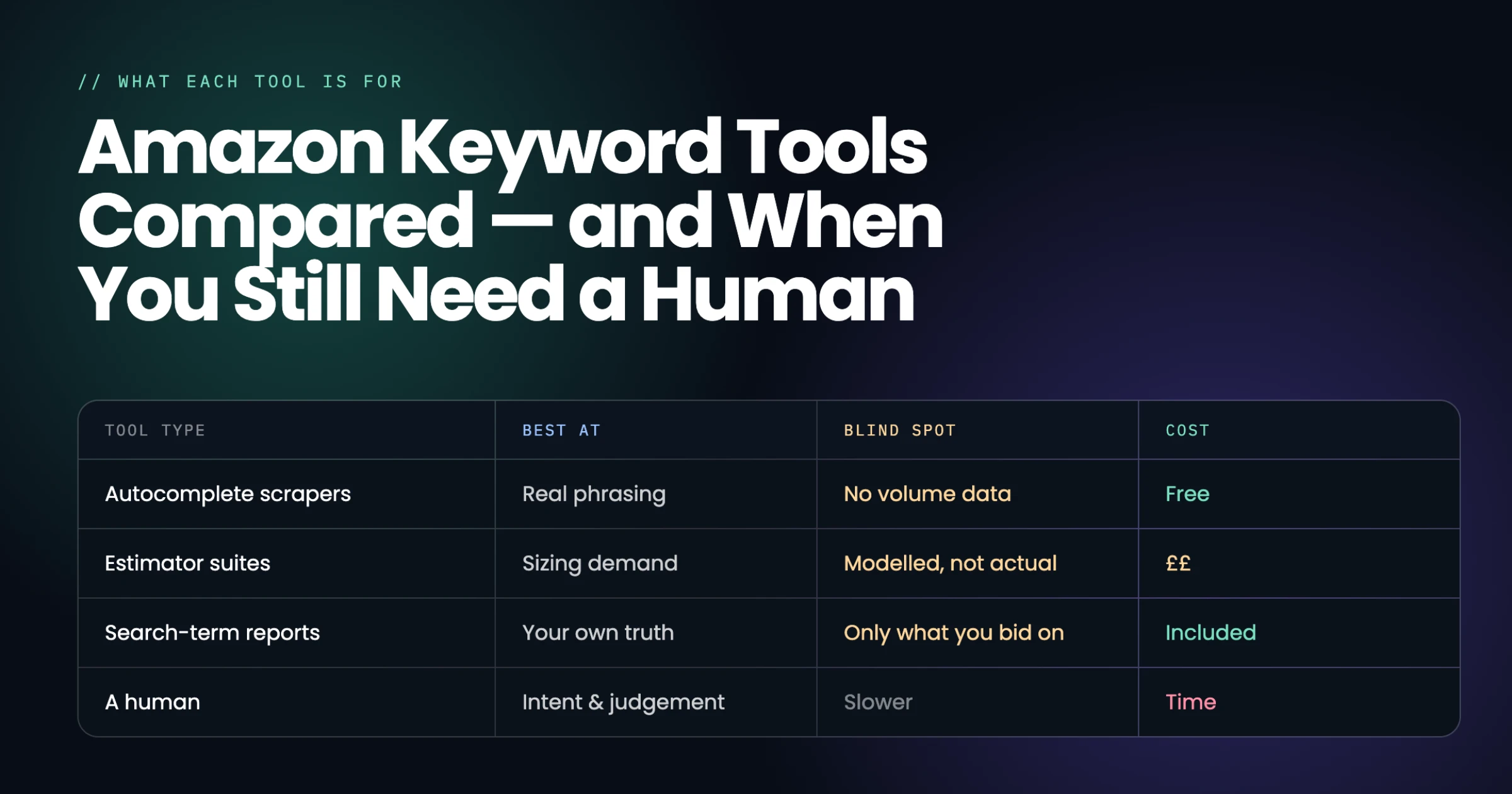
Most sellers only need two Amazon keyword tools: Amazon's own free reports and one paid tool with reverse ASIN. Helium 10 Platinum is $129 a month ($99 billed yearly). Jungle Scout Starter is $49 monthly or $29 a month billed yearly. Pick the one that fully supports your marketplace, then check its numbers against your own Search Query Performance data.
Amazon keyword tools compared: prices and reverse ASIN
Almost every comparison you will read says pricing "varies by plan". Here are the actual numbers, each read off the vendor's own pricing page in September 2026. Where a vendor does not publish a figure, this says so rather than guessing.
| Tool | Published price | Reverse ASIN | Best for |
|---|---|---|---|
| Helium 10 | Platinum $129/mo, Diamond $359/mo billed monthly ($99 and $279 billed yearly). Enterprise from $1,499/mo, billed annually. Free tier | Yes — Cerebro | The default. Deepest keyword tooling of the set |
| Jungle Scout | Catalyst: Starter $29, Growth Accelerator $49, Brand Owner + CI $129/mo billed yearly ($49, $79 and $149 billed monthly). Cobalt not published | Yes — Keyword Scout | Sellers under $1M who want research and product data together |
| Data Dive | Starter $39/mo, Standard $149/mo, Enterprise $490/mo | Functionally yes — ASIN-driven "Dives" | Agencies and analysts who want the raw matrix |
| SmartScout | Basic $49, Essentials $119, Business $299/mo | Partial — vendor pages do not confirm | Brand and seller-level data the keyword tools lack |
| SellerApp | Free tier, Pro $99/mo, Smart $149/mo | Yes — free standalone tool | Sellers who want ads automation in the same place |
| Perpetua | Essentials $695/mo up to $10k ad spend, then % of spend | No | Ad management, not keyword research — see below |
| DataHawk | Not published — custom, annual, demo-gated | No — rank tracking, not extraction | Reporting into BI tools |
| Keepa | Not published in readable form | No | Price and sales-rank history |
| Sonar | — | — | Discontinued |
Two things in that table are worth more than the rest of this article.
The first is Sonar. It was the free keyword tool everybody recommended, it came from Sellics, and after Perpetua absorbed Sellics the page now carries a live notice reading "We’re sorry, but this feature is no longer available". It is still on page one of several "best free Amazon keyword tool" listicles. If a guide is recommending it in 2026, that guide has not been checked since it was written.
The second is Perpetua, which most comparisons still file under keyword tools. It is now an ad management platform starting at $695 a month with automated keyword harvesting as a feature of that. Useful, but not comparable to a $39 research tool, and putting the two side by side without saying so misleads people about what they are choosing between.
The free tools, including the one you are already paying for
Before you buy anything, use what Amazon gives you. Three data sources sit inside Seller Central and are better than most paid estimates, because they are not estimates.
Brand Analytics Top Search Terms gives you the actual search frequency rank for a term, plus the three most-clicked ASINs and their share of clicks and conversions. That last part is the bit no third-party tool can replicate: it tells you not just that a term has volume, but whether that volume converts and to whom. It requires Brand Registry.
Search Query Performance shows, for your own ASINs, the queries that produced impressions, clicks, adds to basket and purchases, with your share of each. This is the report that tells you whether a keyword change worked, and it is the single most underused thing in Seller Central.
The advertising search term report shows exactly what shoppers typed before clicking your ad. It is the only source in the list that reflects real spoken demand rather than a normalised index. Every Sponsored Products account generates it, and most sellers never open it.
Between them these cover most of what a paid keyword tool sells you. What they do not do is show you someone else’s keywords, which is the one job that genuinely requires a third-party tool and the reason Cerebro and its equivalents sell.
There is a fourth free source most people forget: Amazon’s own search bar. Type the first two words of your category and read what autocomplete suggests, then repeat with each letter of the alphabet appended. It is tedious and it is real demand data straight from the shopping interface, unmodelled and current. The paid tools scrape exactly this and sell it back to you in a table. For a single product launch, twenty minutes of this beats a month of subscription.
The same goes for the related searches strip and the "customers frequently viewed" carousels on a competitor’s detail page. Both are Amazon telling you, in public, which products it considers substitutes for each other — which is the substitution set your keyword list has to cover.
The genuinely free third-party options
Helium 10 has a free tier and a free keyword tool page. SellerApp publishes a free reverse ASIN tool with no price on the page. Beyond that, "free" usually means a capped trial. That is fine for a one-off check and useless for ongoing work, which is the honest reason most sellers end up paying for something.
Helium 10 or Jungle Scout?
This is the actual decision most people are making, and the answer depends less on features than on what you are for.
Helium 10 is the deeper keyword instrument. Cerebro separates organic rank from sponsored rank on the same keyword, shows title density, and compares up to ten ASINs at once. Those three things together are why agencies default to it: the organic-versus-sponsored split tells you whether a competitor earned a position or bought it, which changes whether the keyword is worth chasing at all.
Platinum is $129 a month billed monthly, or $99 billed yearly. Note that Helium 10's own Cerebro page and its pricing page currently show different figures for the same plans — check which you are being charged before you assume.
Jungle Scout is broader and cheaper at the entry point. It reorganised in 2025–26 into Catalyst for sellers under roughly $1M and Cobalt for enterprise, and Keyword Scout is gated by plan: 50 searches a month on Starter, 250 on Growth Accelerator, unlimited on Brand Owner. If you are still choosing products as well as keywords, Jungle Scout does both jobs in one subscription and Helium 10 does not do the first one as well.
Both now ship an MCP integration that exposes account data to AI assistants, which is a real convenience and not a reason to pick either.
The two specialists worth knowing
Data Dive at $39 is the tool agencies use when they want the full keyword matrix across a set of competitor ASINs rather than a pretty report. It calls the operation a "Dive" rather than a reverse ASIN lookup, which is why it is missed in comparisons, but ASINs go in and a master keyword list comes out.
SmartScout at $49 is not really a keyword tool. It is brand and seller-level data — who owns what, which brands are growing, where the category's revenue actually sits. If your question is "which competitor should I be studying", it answers that better than any keyword tool, and then you take those ASINs to Cerebro.
Free Amazon keyword mapper
Turn a keyword export into a plan
A spreadsheet of 1,000 terms is hard to act on. Our free mapper helps you decide which terms belong in your title, bullets and backend, so you are not guessing.
Map my keywords for freeWhat these tools actually measure
Every one of them shows you five or six columns, most sellers sort by the first one, and the first one is usually the least useful. It is worth knowing what each column is claiming.
Search volume. An estimate of how many times a phrase was searched in a period. Modelled, not measured — see the next section. Useful for ranking candidates against each other, dangerous as an absolute.
Organic rank versus sponsored rank. Where a given ASIN sits in results for that keyword, separated into the position it earned and the position it bought. This is the most decision-relevant column in any keyword tool and the one sellers ignore most often. A competitor sitting at organic position 3 has a listing and a sales history you would have to out-compete. A competitor at sponsored position 1 and organic position 40 is renting the spot, and the keyword is more open than it looks.
Title density. How many of the products on page one carry that exact phrase in their title. Low title density on a term with real volume is the clearest opportunity signal in the whole discipline: demand exists and nobody has claimed the words. High density means you are late, and winning the term will take more than a listing edit.
Competing products. How many listings return for the phrase. On its own it is close to meaningless — a term with 40,000 competing products and no title density is easier than a term with 800 and full density. Read it against the other two columns or not at all.
Relevancy or opportunity scores. Each vendor has one, each calculates it differently, and none will tell you how. They are reasonable first-pass sorts and a poor basis for a decision you have to defend to a client or a finance director. Treat a proprietary score as the tool’s opinion, not as data.
Indexed or not indexed. Whether a given ASIN currently appears in results for the phrase at all. This is the fastest way to check whether a backend keyword change took, and it is the column to reach for after you edit a listing rather than before.
If you read only two of these, read organic-versus-sponsored rank and title density together. They answer the only question that matters at the research stage: is this term winnable by someone with my resources, or am I about to spend three months losing to a brand that got there first.
How accurate is any of this?
Less than the interface implies, and the direction of error matters more than the size.
Amazon does not publish keyword search volume to third parties. Every number you see in Helium 10, Jungle Scout or anywhere else is modelled — inferred from sales rank movement, clickstream panels, advertising data and sampling. Different vendors model it differently, which is why the same keyword can show materially different volumes in two tools open side by side on the same screen.
The practical consequences:
- Relative volume is reliable, absolute volume is not. If tool A says a term gets four times the searches of another term, trust the ratio and ignore the raw figures.
- Accuracy degrades outside the US. Panels are thinner in smaller marketplaces, so a term with a confident-looking number on amazon.com may be close to guesswork on amazon.co.uk or amazon.de.
- Long-tail estimates are the least trustworthy and, awkwardly, the most commercially interesting. A term modelled at 200 searches a month might be 40 or 600.
- Brand Analytics beats all of it for terms it covers, because search frequency rank is Amazon's own measurement rather than somebody's model of it.
The right use of a keyword tool is to build a candidate list and rank it. The right use of Amazon's own reports is to decide which candidates were correct. Sellers who skip the second step end up with beautifully researched listings optimised for demand that does not exist in their category.
A cheap way to sanity-check any tool
Pick three keywords you already rank well for and already have data on from Search Query Performance. Look them up in whichever tool you are evaluating and compare. You are not checking whether the numbers match — they will not.
You are checking whether the tool puts them in the same order as your real impressions data, and whether it gets the gaps roughly right. A tool that inverts the order of three terms you already understand will do the same on the terms you do not, and no amount of feature list makes up for that.
Run the same three through a second tool before you commit to an annual plan. Where two independent models agree, you can act with reasonable confidence. Where they disagree by a factor of five, treat the term as unknown and let advertising settle it — a fortnight of exact-match spend on an uncertain keyword costs less than a year of the wrong subscription and produces better data than either vendor.
Amazon keyword research service
Want someone to make the calls for you?
If you would rather not spend evenings in Cerebro, we do the research, check relevance against your actual product and hand you a mapped set for every ASIN.
See how we research keywordsWhen you still need a human
Four judgements sit outside every tool in the table, and all four decide whether the research was worth doing.
Relevance, which is not the same as volume
A tool will hand you "waterproof phone case" for a rugged tablet sleeve because competitors rank for it and the string overlaps. Index for it and you buy clicks from people who wanted something else, which depresses your conversion rate on that term and, because conversion rate is a ranking input, quietly damages your position on the terms you do want. Irrelevant traffic is not free. Nothing in any tool flags this, because relevance is a claim about the product, and the tool has never seen the product.
What the words actually mean to a buyer
"Heavy duty" and "industrial" can be near-identical in a keyword export and describe two different shoppers with different price expectations. So can "organic" and "natural", which are also a compliance question rather than a copy question in several categories. A tool sorts by volume. A person asks which word the person with the credit card would use.
Where the keyword goes, now that titles are 75 characters
This is newly hard. Amazon cut product titles to 75 characters in all categories except media on 27 July 2026, and introduced a 125-character Item Highlights field that began displaying beneath the title on 10 August. Amazon states both are inputs for search and neither is prioritised over the other.
That turns keyword placement from a listing exercise into a genuine allocation problem: you now have far less prime real estate and a second field whose weighting nobody outside Amazon can measure. No tool has an opinion on which of your twelve priority terms earns one of the 75 characters. That is a judgement about your category, your brand, and what a shopper scanning a results page needs to see in the first four words.
Knowing when to stop
Keyword research has a point of diminishing return that arrives much earlier than the tool's export suggests. A thousand-row keyword list is a research artefact, not a plan. Most listings are carried by between eight and twenty terms, and the work that matters is deciding which, then measuring whether you were right. Our keyword research service ends with a mapped set per ASIN rather than an export, for exactly this reason.
Which one should you actually buy?
| If you are | Buy | Because |
|---|---|---|
| Brand registered, one to ten ASINs | Nothing yet | Brand Analytics and Search Query Performance cover you. Spend the money on photography |
| Still choosing what to sell | Jungle Scout Catalyst, $29–$49 | Product research and keyword research in one subscription |
| Established and competing hard | Helium 10 Platinum, $129 | Cerebro's organic-versus-sponsored split is the thing you cannot get elsewhere |
| Running an agency or many brands | Helium 10 Diamond plus Data Dive | Depth plus the raw matrix, at a cost that spreads across clients |
| Trying to understand the category, not the keyword | SmartScout, $49 | Brand and seller-level data no keyword tool holds |
| Spending five figures a month on ads | Your search term report | Real queries that converted, for free, updated daily |
If you want an outside read on which of those rows you are actually in, our free listing checker scores a live ASIN in about a minute, and a written audit comes back within 48 hours with the keyword gaps named rather than scored.
How do you choose Amazon keyword tools that fit your marketplace in 2026?
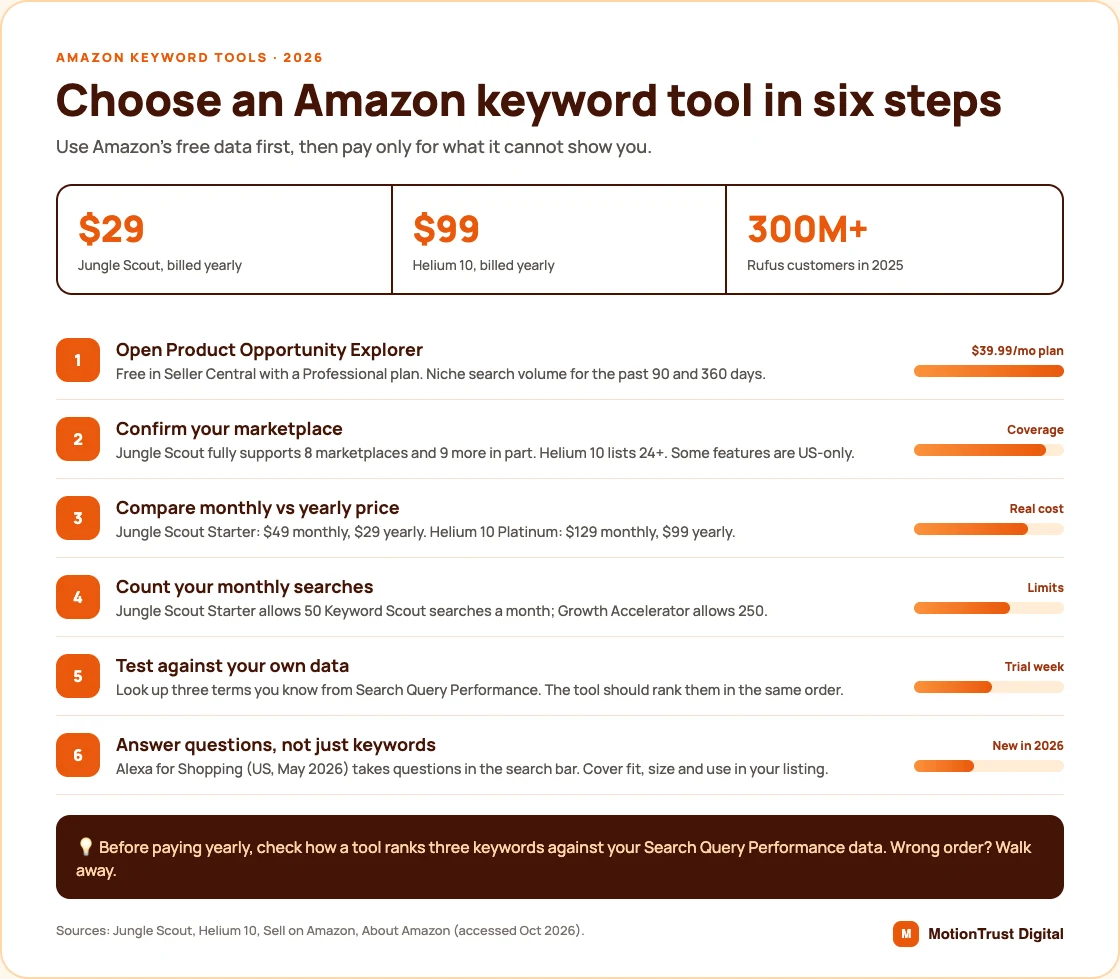
Most lists rank Amazon keyword tools by feature count. In practice, three things decide whether a subscription earns its keep. Does it cover the marketplace you sell in? Is the price you see the price you will pay? And does it see the searches your buyers actually make? Start with the free data Amazon already gives you.
Start with Product Opportunity Explorer, not a subscription
Of all the Amazon keyword tools, Product Opportunity Explorer is the free one. It sits under the Growth menu in Seller Central. It comes with a Professional selling plan, which costs $39.99 a month. It groups search terms into niches and shows search volume for the past 90 and 360 days, with growth against the period before.
Amazon says products launched from niches viewed in the tool had 2.5x higher sales potential in their first three months. That figure comes from its own 2025 data for the US, EU and Japan. Treat it as a reason to look, not a promise.
Check marketplace coverage and the real monthly price
| Tool | Marketplace coverage | Paid monthly | Paid yearly |
|---|---|---|---|
| Helium 10 Platinum | 24+ marketplaces | $129/mo | $99/mo |
| Jungle Scout Starter | Full in 8, partial in 9 more | $49/mo | $29/mo |
| Jungle Scout Growth Accelerator | Same as above | $79/mo | $49/mo |
Jungle Scout's headline $29 is the annual price. Full coverage means the US, Canada, Mexico, the UK, France, Germany, Italy and Spain. Even there, some features are US-only. If you sell on amazon.co.uk, test the exact report you need during a trial.
A five-question checklist before you pay
- Where do you sell? Confirm full support for that marketplace, not just a flag on the pricing page.
- How many searches a month? Jungle Scout Starter allows 50 Keyword Scout searches. Growth Accelerator allows 250.
- Do you need reverse ASIN? If not, a free Amazon keyword tool and Brand Analytics may be enough.
- Can you pay yearly? It cuts Helium 10 Platinum by $30 a month.
- Does it match your own data? Check its ranking of three terms against Search Query Performance.
What no keyword tool can see: questions typed into search
In May 2026 Amazon launched Alexa for Shopping in the US. The search bar in the app now recognises when a shopper asks a question. Amazon says Rufus, its earlier assistant, helped over 300 million customers in 2025.
Questions like "will this fit a 2019 RAV4?" never appear as tidy keywords with a volume, and none of the Amazon keyword tools above can model them. So answer them in your bullets and images: sizes, compatibility, materials and use cases.
If you would rather have a finished keyword plan than another login, our Amazon keyword research service maps terms to each ASIN. You can also start with the free Amazon keyword mapper, or check Amazon agency pricing first.
Free Amazon audit
Not sure which tool you actually need?
Send us your ASIN and we will tell you honestly where your keyword gaps are, and whether a paid tool would close them. It costs nothing and there is no follow-up pressure.
Get my free auditQuestions people also ask
What is the best Amazon SEO tool in 2026?
For most sellers, Helium 10 — Cerebro separates organic from sponsored rank on the same keyword, which is the one insight no free source provides. Platinum is $129 a month at list. If you are also still choosing products, Jungle Scout Catalyst at $29 to $49 covers both jobs in one subscription.
Which Amazon SEO tool works well for beginners?
Jungle Scout Catalyst Starter at $29 a month, which includes 50 Keyword Scout searches. Before buying anything, though, open Brand Analytics and Search Query Performance in Seller Central — both are free with Brand Registry and use Amazon’s own data rather than a model of it.
What is the strongest free Amazon SEO tool?
Amazon Brand Analytics, which you already have if you are brand registered. It gives search frequency rank, the three most-clicked ASINs per term and their click and conversion share — data no third-party tool can replicate because it is Amazon’s own measurement.
Is Helium 10 worth it for Amazon sellers?
If you are competing in a category where competitors advertise heavily, yes, because Cerebro shows whether a rival earned a keyword position organically or bought it. If you have a handful of ASINs in a thin category, Brand Analytics and your search term report will do most of the same work for nothing.
What Amazon SEO tools do agencies use?
Usually Helium 10 for keyword depth, Data Dive when they want the full keyword matrix across a set of competitor ASINs, and SmartScout for brand and seller-level context. The cost spreads across clients, which is why agency stacks look extravagant next to a single seller’s.
Do Amazon SEO tools improve product rankings?
No. They produce a candidate list. Rankings move when the right terms are placed in the listing, the listing converts, and sales velocity follows. A tool that hands you a thousand keywords has not made a single decision for you.
Do I need Amazon SEO tools or an Amazon SEO agency?
Different problems. A tool answers "which phrases exist and how big are they". An agency answers "which of them describe what you sell, which earn one of your 75 title characters, and did the change work". If you already know how to answer the second set, buy the tool.
What is the best free Amazon keyword research tool?
Of the third-party options, Helium 10’s free tier and SellerApp’s free reverse ASIN tool. Note that Sonar, which still appears on many "best free tool" lists, has been discontinued — its own page carries a notice saying the feature is no longer available.
Is Helium 10 or Jungle Scout better for keyword research?
Helium 10, on depth. Cerebro compares up to ten ASINs, splits organic from sponsored rank and reports title density. Jungle Scout is cheaper to start and better if you are researching products as well as keywords, but Keyword Scout searches are capped by plan.
How accurate is Amazon keyword search volume?
Directionally useful, not literally accurate. Amazon does not publish volume to third parties, so every figure is modelled from rank movement, clickstream panels and ad data. Trust the ratio between two terms rather than the raw number, and expect accuracy to fall outside the US marketplace and on long-tail phrases.
How many keywords should I target for one product?
Most listings are carried by eight to twenty terms. A thousand-row export is a research artefact, not a plan. Since titles were cut to 75 characters in July 2026, the scarce resource is placement rather than discovery, which argues for a shorter and better-argued list.
Do I still need a paid keyword tool if I have Brand Analytics?
Only for one job: seeing which keywords a competitor’s ASIN ranks for. Brand Analytics, Search Query Performance and your advertising search term report cover discovery, validation and measurement between them. Reverse ASIN lookup is the gap, and it is the reason most sellers subscribe.
Are free Amazon keyword tools good enough?
For a one-off check, yes. For ongoing work, the caps bite quickly and most "free" third-party tools are capped trials. Amazon’s own reports are the exception: genuinely free with Brand Registry, and more accurate than the paid estimates.
Can AI replace Amazon keyword research?
It can generate and cluster candidate phrases quickly, which is the cheap half. It cannot tell you whether a phrase describes your product, whether the words carry a compliance risk in your category, or which term earns one of your 75 title characters — and getting those wrong costs more than the research saved.
Which Amazon keyword tools support amazon.co.uk data?
Helium 10 says it supports 24+ marketplaces, and Jungle Scout lists the UK as fully compatible, alongside the US, Canada, Mexico, France, Germany, Italy and Spain. Full support does not mean every feature, though. Jungle Scout notes some features are US-only. Run the exact report you need on a UK keyword during a trial before you commit to a yearly plan.
Is Jungle Scout really $29 a month?
Only if you pay for a year up front. Jungle Scout's Catalyst Starter plan is $29 a month billed annually ($348 a year) or $49 billed monthly. Growth Accelerator is $49 yearly or $79 monthly, and Brand Owner + CI is $129 yearly or $149 monthly. Starter includes 50 Keyword Scout searches a month, so check that cap fits your workload.
Written by Monjur Hossain, Founder & Amazon Strategy Lead at MotionTrust Digital, from the agency’s day-to-day work on client Amazon accounts and checked against the primary documentation listed under Sources below. Primary sources for this guide: Helium 10, Jungle Scout, Data Dive, SmartScout, SellerApp, Perpetua and Amazon Seller Central.
Every figure attributed to Amazon or to another named organisation links to that organisation’s own page, with the month it was accessed. Anything drawn from our own client accounts is labelled as ours rather than presented as an industry figure, and where no primary source publishes a number this guide says so instead of estimating one. Last reviewed .
- Helium 10 — Pricing, accessed September 2026.
- Helium 10 — Cerebro, accessed September 2026.
- Jungle Scout — Catalyst plans, accessed September 2026.
- Data Dive — Pricing, accessed September 2026.
- SmartScout — Pricing, accessed September 2026.
- SellerApp — Pricing, accessed September 2026.
- Perpetua — Pricing, accessed September 2026.
- Perpetua — Sonar — feature no longer available, accessed September 2026.
- Amazon Seller Central — Product title updates from 27 July 2026, accessed September 2026.
- Sell on Amazon — Product Opportunity Explorer, accessed October 2026.
- About Amazon — Meet Alexa for Shopping, your personalized, agentic AI assistant on Amazon, accessed October 2026.
Monjur Hossain
Founder & Amazon Strategy Lead, MotionTrust Digital
Monjur incorporated MotionTrust Digital in September 2022 and leads Amazon strategy across the client base. Eight years in e-commerce and marketplace marketing, now on Amazon only — keyword strategy, listing architecture and advertising structure for growing brands.
MonjurAgency