
Amazon review rules: what you can and cannot legally do in the UK
 By Monjur HossainFounder & Amazon Strategy Lead
·
Published
·
Last reviewed
·12 min read
By Monjur HossainFounder & Amazon Strategy Lead
·
Published
·
Last reviewed
·12 min read
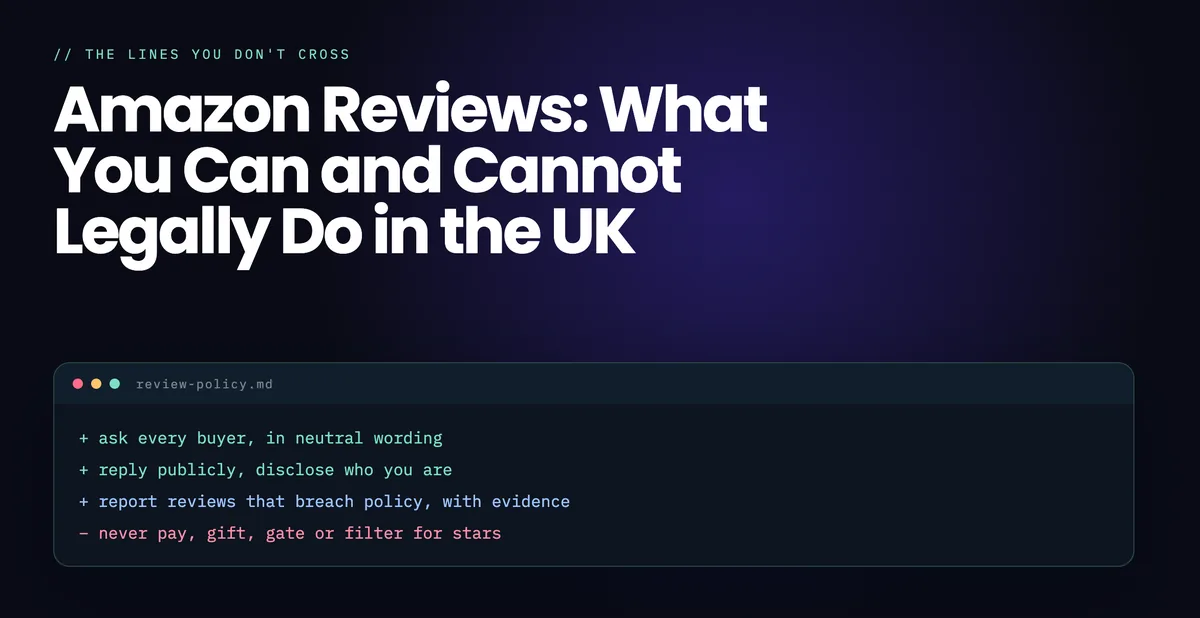
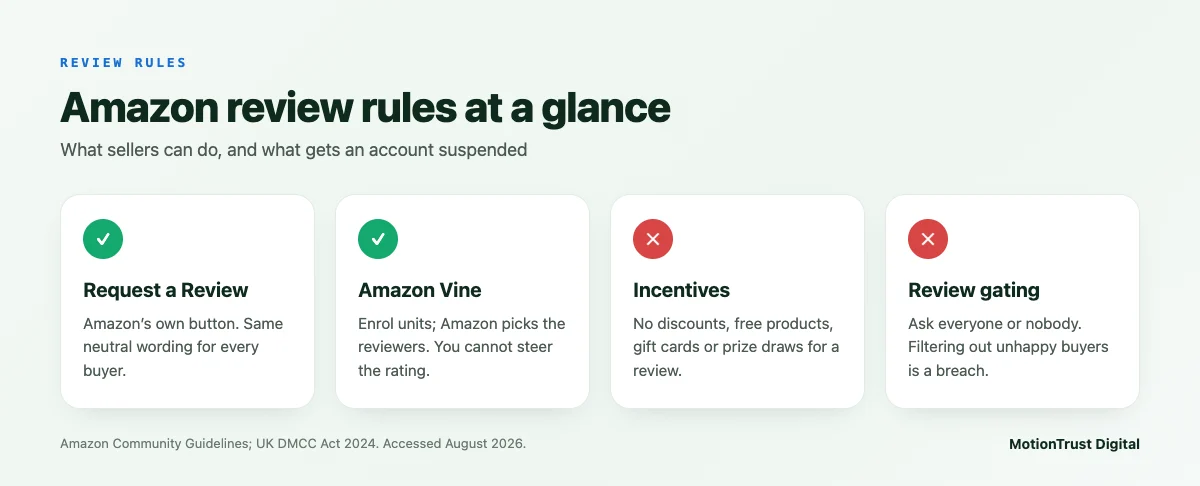
Amazon review rules let sellers ask every buyer, neutrally, for an honest review, use Request a Review and enrol in Vine. You cannot buy reviews, offer incentives, gate requests, merge unrelated variations or ask for reviews to be removed. UK fines reach 10% of global turnover; US penalties reach $53,088 per violation.
What are UK sellers actually allowed to do?
Four mechanisms are permitted without qualification, because Amazon provides them.
| Mechanism | What it is | Why it is safe |
|---|---|---|
| Request a Review | Amazon's own button, sending a standardised request inside the eligible window | The wording is Amazon's, not yours, and every buyer gets the same ask |
| Amazon Vine | Enrol units; Amazon distributes them to its own reviewers (what Vine costs) | You cannot choose the reviewer, influence the rating or remove a bad one |
| Neutral packaging insert | A card asking for an honest review, with no condition attached | Nothing is offered and no sentiment is steered |
| Responding publicly | Answering a review on the listing | Encouraged, and it is how you show other buyers the problem was handled |
Request a Review can be sent once per order, between 5 and 30 days after delivery. Outside that window the button simply does not appear.
Free review compliance checker
Not sure your wording is safe?
Paste your insert, email or message template into our free checker and we will flag anything that reads as an incentive or a gate. It runs in your browser, so nothing is uploaded.
Check my wordingWhat breaches Amazon review rules?
Six practices are prohibited under the Amazon Community Guidelines, and enforcement has moved from removing the review to suspending the account.
- Paying for reviews, through any network, agency or "verified buyer" service.
- Offering anything in exchange — free products, discounts, gift cards, prize draws, extended warranties.
- Review gating: asking only satisfied customers, or routing dissatisfied ones elsewhere first.
- Asking for a positive review rather than an honest one, including any mention of a star rating.
- Reviewing your own products, or having family, staff or connected businesses do it.
- Trading reviews with another seller.
- You may ask everyone the same neutral question. The moment the ask is conditional, selective, or steers the answer, it is a breach.
What does UK law add on top of Amazon's rules?
This is the part most guidance written for Amazon.com misses entirely.
The Digital Markets, Competition and Consumers Act 2024 brought fake reviews into UK consumer protection law, and the Competition and Markets Authority gained direct enforcement powers under it. Submitting fake reviews, commissioning them, or publishing consumer reviews without taking reasonable steps to check they are genuine are treated as banned practices.
The practical consequence for a UK seller: buying reviews is no longer only a platform policy problem that costs you a listing. It is a consumer protection matter with a regulator attached. The CMA has published its position in Unfair commercial practices (CMA207), which sets out what the Act's banned practices mean in operational terms.
Two duties in that guidance catch sellers who have never bought a review in their lives. The first is the duty on anyone publishing consumer reviews to take reasonable and proportionate steps to check they are genuine — which reaches your own website's testimonials, not only Amazon's review box.
The second is the rule on concealed incentives: a review obtained in exchange for anything must be disclosed as such, and burying that disclosure is treated as concealing it. If you run any kind of seeding, sampling or brand-ambassador programme off Amazon, that is the paragraph to read.
Enforcement detail under the Act has been phased in, so check the version of CMA207 current at the time you are reading rather than relying on a summary — including this one.
What makes a packaging insert compliant?
Inserts are where most sellers cross the line without meaning to, usually while trying to be helpful.
| Compliant | Breaches policy |
|---|---|
| "If anything is wrong, contact us through Amazon and we will put it right." | "Email us before leaving a negative review." |
| A neutral request for an honest review, with no condition. | "Leave a 5-star review and we will send a free gift." |
| Warranty registration available whatever the review says. | Extended warranty offered only in exchange for a review. |
| Support details alongside the Amazon route. | Directing customers off Amazon to resolve an order. |
You can check your own wording against these patterns with our free review compliance checker — it runs in your browser and nothing is uploaded.
Amazon reputation management
When bad reviews keep saying the same thing
If a run of low ratings is hurting sales, we can read through them with you, find the real cause and fix it the honest way. No removal tricks, just the work that changes what buyers write next.
See how we helpWhat can you do about a negative review?
Three legitimate responses, in order of how often they apply.
- Respond publicly. Useful, specific, unemotional. Other buyers read the response more than the review.
- Fix the underlying cause. Count the themes across your one and two-star reviews. If a third mention the same fault, that is a product or listing problem, not a review problem.
- Report genuine policy breaches. Profanity, reviews of the seller or delivery rather than the product, and obvious competitor sabotage can be reported for removal.
What you cannot do is get an honest negative review removed because you disagree with it, and no agency can do that for you either. Where a pattern of negative reviews is the real problem rather than a single one, that is reputation work — reading what the reviews have in common and fixing the cause — not review removal. There is a practical guide to building volume back up in how to get more reviews without breaking the rules.
If you are not sure whether an insert or a request flow you already use is compliant, our free Amazon audit checks it as part of the review.
Do these rules apply to reviews outside Amazon?
Amazon review rules, set out in the Community Guidelines, govern reviews on Amazon; UK consumer law governs reviews anywhere you publish them. If you show testimonials on your own website, run an ambassador programme, or send free product to creators, the second set applies to you whether or not a single Amazon review is involved.
Three rules travel with you off the platform:
- Incentives must be disclosed clearly. A gifted product, a discount or a payment behind a review has to be visible to the reader at the point they read it, not in a footer or a hashtag stack.
- You cannot publish reviews you have not checked. The duty is to take reasonable and proportionate steps to establish they are genuine before publishing.
- Selection is a form of misleading. Publishing only the positive responses from a set you collected is treated as an unfair practice, in the same way review gating is on Amazon.
For advertising claims specifically, the CAP Code's section on misleading advertising covers endorsements and testimonials, and the ASA applies it to a brand's own website and social posts as readily as to paid media. The practical upshot for most brands is unglamorous: keep a record of where each testimonial came from and what, if anything, was given for it.
The same logic applies to how you present aggregate ratings. If you quote an average, quote the number of reviews it is drawn from — a 5.0 from three reviews and a 4.6 from four hundred are not comparable, and presenting the first as if it were the second is exactly the kind of impression the rules are aimed at. Our review rating calculator shows how far an average moves with volume, which makes the point faster than an argument does.
What actually happens if you are caught?
Breaking Amazon review rules is handled in escalating steps, and the order is roughly:
- Reviews removed and the listing's rating recalculated.
- A policy warning on your account health dashboard.
- The listing suppressed.
- Selling privileges suspended, with funds held.
- Account deactivated under Section 3 of the Business Solutions Agreement.
The legal side now carries real money too. Under the DMCC Act 2024 the CMA can fine a business up to 10% of its global turnover, or £300,000 if that is higher, for breaches that include fake reviews.
Detection is not limited to the reviews themselves — Amazon correlates reviewer accounts, delivery addresses, insert designs and refund patterns. Enforcement often arrives months after the insert shipped, which is why "it has worked so far" is a poor test. If you are already at step three or beyond, the suspension guide is the next thing to read.
How have Amazon review rules changed since 2025, in the US and the UK?
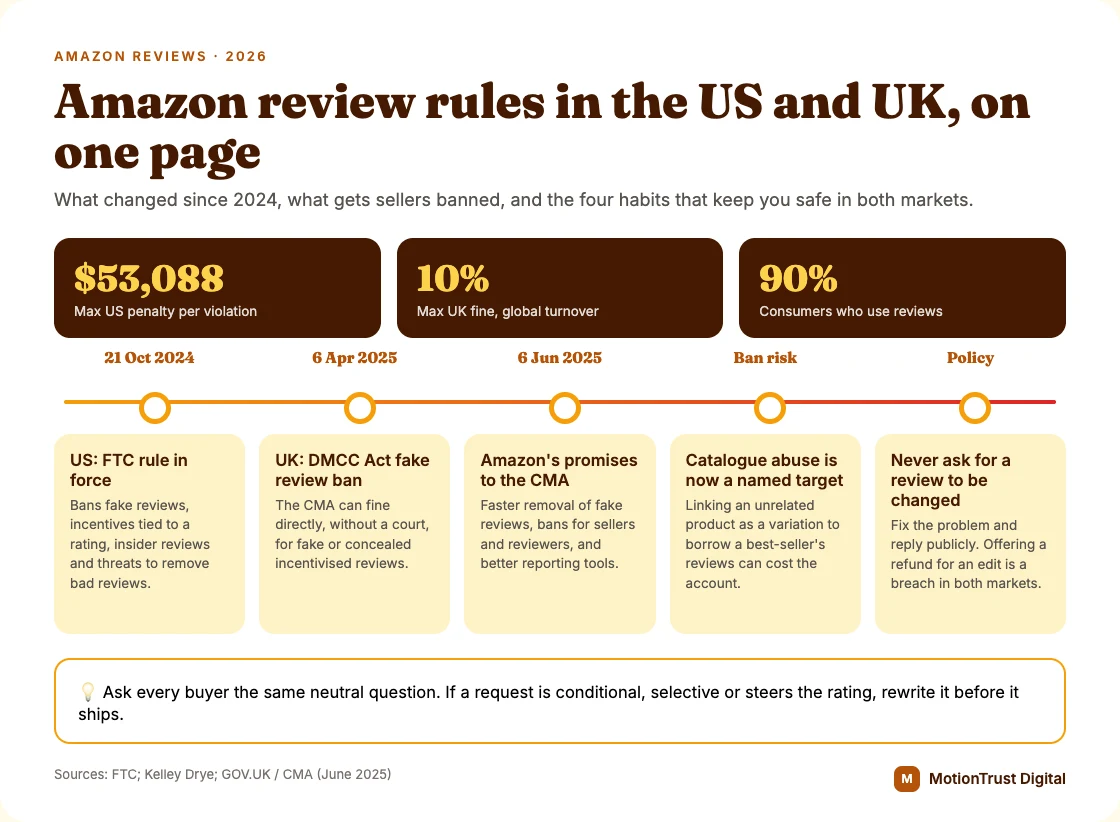
Two regulators have moved in the last two years. Both now treat review manipulation as a legal problem, not just a platform one. If you sell on amazon.com as well as amazon.co.uk, the Amazon review rules you follow are now backed by two separate sets of penalties.
| US (amazon.com) | UK (amazon.co.uk) | |
| Regulator | FTC, under its Consumer Review Rule | CMA, under the DMCC Act 2024 |
| In force since | 21 October 2024 | 6 April 2025 |
| Maximum penalty | Up to $53,088 per violation | Up to 10% of global turnover |
| Named practices | Fake reviews, sentiment-based incentives, insider reviews, review suppression | Fake reviews, hidden incentives, catalogue abuse |
The US layer: the FTC rule on fake reviews
The FTC's rule bans buying reviews, conditioning any incentive on a positive or negative rating, and using threats to get bad reviews taken down. In December 2025 it sent warning letters to ten companies. The letters cited penalties of up to $53,088 per violation, and each fake review can count separately.
What Amazon promised the CMA in June 2025
On 6 June 2025, Amazon gave formal undertakings to the UK Competition and Markets Authority. It agreed to find and remove fake reviews faster, ban sellers who use them to lift ratings, and ban reviewers who post them. It also promised clearer tools for reporting suspect reviews.
The CMA's reasoning is simple. Around 90% of consumers use reviews when they buy. Up to £23 billion of UK spending a year may be swayed by them.
Catalogue abuse: the variation trick that now gets sellers banned
Catalogue abuse means attaching a product to a strong listing so it borrows that listing's reviews. The usual version is adding an unrelated item as a "variation" of a best-seller. The CMA named it directly, and Amazon's policy already lists variation links made to combine reviews as prohibited.
The test is plain. Would a shopper see these as the same product in a different size, colour or pack? If not, split them. Our Amazon listing optimisation work checks variation families for exactly this.
Can you ask a buyer to change or remove a review?
No. Asking a customer to edit or delete a review breaks Amazon's policy. Offering a refund or replacement in return makes it worse, and in the US it also looks like a sentiment-based incentive. You can still fix the problem and reply publicly. If the buyer then updates the review on their own, that is their call.
Most sellers break Amazon review rules by accident, through an old insert or a template email. A quick Amazon review compliance check catches risky wording. If you want someone to own the whole process, a good Amazon review management agency starts with an audit, not a promise of more stars.
Amazon review management
Want reviews handled properly, in both markets?
We run compliant review programmes for sellers on amazon.com and amazon.co.uk: requests on every order, Vine timing and wording checked against both the FTC and CMA rules. If you would rather not track all this yourself, we are happy to take it on.
See our review management serviceQuestions people also ask
Can I ask customers for a review on Amazon?
Yes, if the request is neutral and goes to every customer equally. Ask for an honest review, offer nothing in return, and do not mention a star rating. Amazon's own Request a Review button is the safest route because the wording is Amazon's rather than yours.
Is it illegal to buy Amazon reviews in the UK?
It breaches Amazon's Community Guidelines and can suspend your account. Under the Digital Markets, Competition and Consumers Act 2024, fake reviews are also treated as a banned practice in UK consumer law, with the CMA holding direct enforcement powers.
Can I offer a discount in exchange for a review?
No. Offering anything in exchange for a review — a discount, a free product, a gift card, a prize draw entry or an extended warranty — is an incentivised review and is prohibited without exception.
What is review gating and why is it banned?
Review gating means asking only satisfied customers for a review, or routing unhappy customers somewhere else first. Sellers often see it as good service, but Amazon treats it as manipulating the review pool and enforces on it heavily.
Can I get a bad Amazon review removed?
Only where it genuinely breaches Amazon's guidelines — profanity, a review about delivery or the seller rather than the product, or obvious sabotage. An honest negative review about a real fault will not be removed, and should not be.
Do the UK fake review rules apply to testimonials on my own website?
Yes. The Digital Markets, Competition and Consumers Act 2024 applies to consumer reviews wherever you publish them, not only on a marketplace. If you display testimonials, you are expected to take reasonable and proportionate steps to check they are genuine, to disclose any incentive behind them, and not to publish only the favourable ones from a set you collected.
Do I have to disclose gifted products to reviewers and creators?
Yes, and the disclosure has to be clear at the point someone reads or watches the review — not in a footer, a bio or a block of hashtags. This is a UK consumer law and advertising standards requirement rather than an Amazon one, so it applies to your website, your social accounts and any creator you send product to.
Can I merge reviews from another product into my Amazon listing?
Only when the items are true variations of one product, such as sizes or colours of the same design. Linking an unrelated product so it shares a best-seller's reviews is catalogue abuse. Amazon prohibits it, and it was named directly in Amazon's June 2025 undertakings to the CMA. Sellers caught doing it risk losing reviews and their selling account.
Does the US FTC fake review rule matter for a UK seller on amazon.com?
Yes, treat it as applying. The rule covers reviews used to sell to US shoppers, wherever the business is based. It bans fake reviews, incentives tied to a positive or negative rating, undisclosed insider reviews and review suppression. The FTC's December 2025 warning letters cited penalties of up to $53,088 per violation, so one bad campaign can add up fast.
Written by Monjur Hossain, Founder & Amazon Strategy Lead at MotionTrust Digital, from the agency’s day-to-day work on client Amazon accounts and checked against the primary documentation listed under Sources below. Primary sources for this guide: Amazon, UK Government, Competition and Markets Authority and Advertising Standards Authority / CAP.
Every figure attributed to Amazon or to another named organisation links to that organisation’s own page, with the month it was accessed. Anything drawn from our own client accounts is labelled as ours rather than presented as an industry figure, and where no primary source publishes a number this guide says so instead of estimating one. Last reviewed .
- Amazon — Community Guidelines, accessed August 2026.
- UK Government — Digital Markets, Competition and Consumers Act 2024, accessed August 2026.
- Competition and Markets Authority — Unfair commercial practices (CMA207), accessed August 2026.
- Competition and Markets Authority — enforcement guidance, accessed August 2026.
- Advertising Standards Authority / CAP — CAP Code section 3: misleading advertising, accessed August 2026.
- GOV.UK / Competition and Markets Authority — Amazon gives undertakings to CMA to curb fake reviews (6 June 2025), accessed October 2026.
- Federal Trade Commission — Federal Trade Commission announces final rule banning fake reviews and testimonials, accessed October 2026.
- Kelley Drye (Ad Law Access) — FTC warns companies of potential violations of the Consumer Review Rule, accessed October 2026.
Monjur Hossain
Founder & Amazon Strategy Lead, MotionTrust Digital
Monjur incorporated MotionTrust Digital in September 2022 and leads Amazon strategy across the client base. Eight years in e-commerce and marketplace marketing, now on Amazon only — keyword strategy, listing architecture and advertising structure for growing brands.
MonjurAgencyGet a free Amazon audit
Send your storefront and we will send back a written audit of your listings, keywords, advertising and account health. Back within 48 hours, and yours to keep.
Get Your Free Amazon AuditLast reviewed . We update articles in place rather than republishing at a new URL, so the link you have keeps working.
Know when the review rules change
Review policy moves, and getting it wrong is expensive. Our newest articles on compliant reviews and account health, once a week, with PPC and SEO if you want them. Email us to join.