
Amazon SEO vs PPC: where sellers should spend first
 By Monjur HossainFounder & Amazon Strategy Lead
·
Published
·
Last reviewed
·18 min read
By Monjur HossainFounder & Amazon Strategy Lead
·
Published
·
Last reviewed
·18 min read
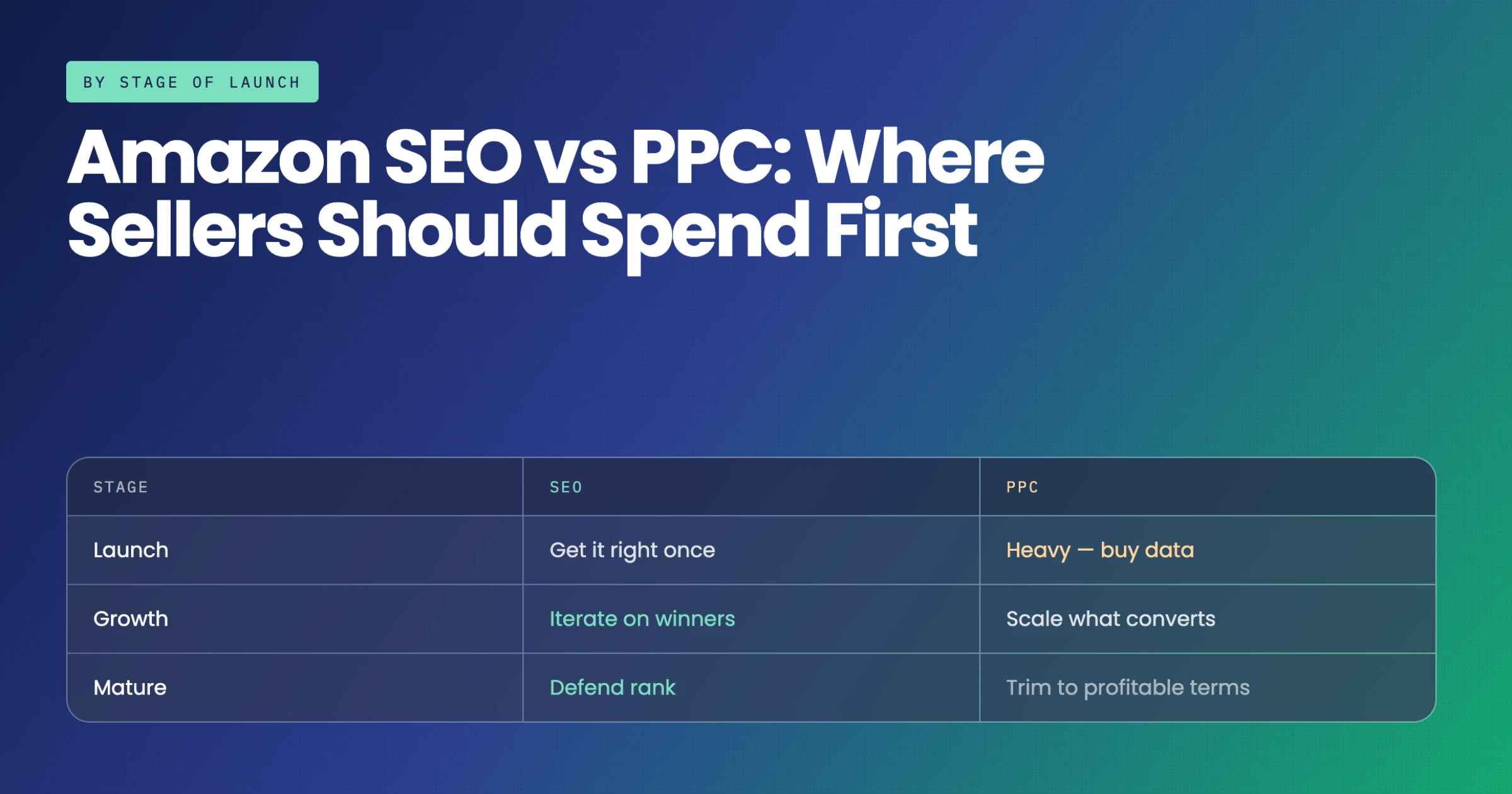
Amazon SEO vs PPC is not a choice between rival channels. The two are halves of one loop. Fix the listing first, because ads on a page that does not convert raise your cost per sale everywhere. Then use PPC to find the keywords that convert and feed them back into the listing. Splitting a first $1,000? Put roughly 60% into the listing, 40% into ads.
Why this is a loop, not a choice
On Google, organic and paid are genuinely separate systems. Ranking well brings traffic; what happens after the click is largely your problem, and your ad performance does not move your organic position.
Amazon does not work that way, and the difference is the whole article.
Conversion feeds ranking. Amazon's job is to show shoppers what they will buy, so a listing that converts well on a term climbs on that term. That is true whether the sale came from an ad or from organic placement. Advertising therefore does not just buy traffic, it buys ranking inputs.
Advertising produces the data SEO needs. The search term report tells you the literal strings shoppers typed before clicking. Not a model, not a panel estimate — the words, with spend and conversions attached. That is the single best keyword source available to any seller, and it only exists if you are running ads.
SEO reduces what advertising costs. Each term you hold organically is a term you stop paying for, or pay less to defend. A mature account funds a smaller share of its revenue through ads not because its bidding improved but because its listings earned position.
So the sequence runs: listing quality → ads find the converting terms → those terms go into the listing → organic rank rises → ad dependence falls → budget frees up for the next product. Starting anywhere other than listing quality breaks the loop at the first step.
Which is why the usual framing is wrong
Most comparisons present this as a trade-off: SEO is slow and cheap, PPC is fast and expensive, pick according to your patience and your bank balance. That framing is imported from Google, where the two systems really are independent, and on Amazon it produces bad decisions in both directions.
A seller who "chooses SEO" because the budget is tight ends up with an optimised listing nobody sees, because without early sales there is no rank and without rank there are no sales. A seller who "chooses PPC" because they want speed ends up renting a position indefinitely, paying the same acquisition cost in year three as in month one, with nothing accumulating underneath.
Neither is a strategy. They are the two failure modes of treating a loop as a fork.
What each one actually does
| Amazon SEO | Amazon PPC | |
|---|---|---|
| Main job | Earn position you do not pay per click for | Buy position immediately, and learn which terms convert |
| Speed | Weeks to months | Hours |
| Cost shape | Work now, compounding return | Pay per click, stops when you stop |
| What it needs | A product that converts and sells | Budget and Featured Offer eligibility |
| Main risk | Optimising for terms that never convert | Buying clicks to a page that does not convert |
| Metric that matters | Organic rank, and TACoS falling | ACoS against your break-even |
| Fails quietly when | Nobody checks whether rank moved | ACoS looks fine because branded traffic carries it |
The row worth staring at is the last one. Both disciplines have a characteristic way of looking healthy while doing nothing, and they are different failures. SEO work that nobody measures produces a nicer-reading listing and no rank movement. Advertising that nobody segments produces a respectable blended ACoS carried entirely by people searching your brand name, while the campaigns meant to acquire new customers quietly lose money underneath.
There is more on that second failure in our piece on ACoS, TACoS and what a good one looks like, and on the first in the keyword research guide.
Listing optimisation
Not sure your listing is pulling its weight?
We rewrite titles, bullets and images around the searches that actually convert, so the clicks you pay for have a better chance of selling.
See how we optimise listingsWhy the listing genuinely comes first
This is the part sellers most want to skip, because ads feel like action and listing work feels like admin. The arithmetic is unkind to that instinct.
Take a $30 product at a 10% conversion rate and a $1.20 cost per click. Ten clicks produce one sale, so you spent $12 to make $30. Now take the same product converting at 15% after the listing is fixed. Under seven clicks produce a sale, so you spent about $8. Nothing about the campaign changed. Your cost per sale fell by a third because the page got better at its job.
And that improvement does not stop at advertising. The same conversion rate feeds organic ranking, so the listing work pays twice: once in cheaper ads, once in position you stop paying for.
Run it the other way and the damage compounds the same way. Ads to a weak listing buy expensive bounces, and those bounces are a signal to Amazon that shoppers searching that term do not want your product — which suppresses the organic position you were trying to build.
What "fix the listing" means in 2026
Specifically, and in this order:
- Main image. The single biggest lever on click-through rate, and the cheapest to fix. It is what decides whether your ad spend buys a click at all.
- Title, under the new limit. Amazon cut titles to 75 characters in all categories except media on 27 July 2026, with a new 125-character Item Highlights field displaying beneath it from 10 August. If your title has not been rewritten since, Amazon may have rewritten it for you — brand owners had 14 days to review AI-generated recommendations. Check what yours says before you plan anything.
- Price against the page. Not against your costs. If you are the most expensive result with the fewest reviews, no amount of bidding fixes that.
- Bullets and Item Highlights. Objections answered in sentences, not keyword strings.
- A+ content. A conversion asset rather than a ranking one, and worth doing after the above.
Our listing work runs in that dependency order for this reason, and the free listing checker will score a live ASIN against most of it in about a minute.
The split, by stage
Concrete numbers, because "do both" is not a plan. These are allocation ratios rather than absolute budgets — scale them to what you have.
| Stage | Listing and SEO | PPC | Why |
|---|---|---|---|
| Pre-launch | 100% | 0% | Nothing to advertise to yet. Photography, copy, keyword set |
| Launch, first 30 days | 30% | 70% | Ads buy the velocity and the search term data. Listing is already built |
| Months 2–6 | 60% | 40% | Feed the converting terms back into the listing. This is the compounding phase |
| Mature | 40% | 60% | Organic carries volume. Ads defend and extend into adjacent terms |
| Stalled | 80% | 20% | If spend is up and sales are flat, the problem is almost never the bids |
Two notes on reading that table.
The launch row inverts on purpose. For thirty days you are buying sales velocity and relevance, not profit, and the listing work should already be done before you start — which is why pre-launch is 100% the other way. There is more on that sequence in our launch playbook.
The stalled row is the one most accounts are actually in, and the one most often handled by increasing ad spend. If your advertising is up and your total revenue is not, more bidding buys more of the same. Something on the page or in the price is the constraint.
Splitting a first $1,000
If you have one product and a thousand dollars, spend roughly $600 on getting the listing right — photography first, then copy under the 75-character limit, then a proper keyword set — and put $400 into exact-match Sponsored Products across fifteen to twenty terms you believe in. Three or four weeks later you will know which of those terms convert. That is worth more than either half alone, because the $400 has bought data as well as sales and the $600 has made the data cheaper to collect.
Amazon PPC management
This loop is what we run for clients every week
Search terms harvested, wasted spend cut and the winners moved into the listing, with paid and organic in one report.
See our PPC managementHow to actually run the loop
The handover between the two disciplines is where most accounts leak, so here is the mechanism in detail.
Weekly: harvest. Open the search term report. Any term with conversions at an acceptable cost moves into an exact-match campaign of its own, where you can bid it properly. Any term with meaningful spend and no conversions becomes a negative, in the campaign and at the ad group above it. Fifteen minutes, done properly, is worth more than most optimisation.
Monthly: promote. Terms that have converted consistently for four weeks have earned a place in the listing. This is the moment PPC data becomes SEO work, and it is the step almost nobody schedules. Put them in the right field — the one or two that describe what the product fundamentally is compete for title characters, attributes go to Item Highlights, synonyms and misspellings to the backend.
Monthly: check the rank you bought. For each term you promoted last month, check organic position. If organic rank is climbing on terms you advertise heavily, the loop is working and you can start reducing bids on those terms specifically. If it is not, the listing is not converting well enough on them and advertising harder will not fix it.
Quarterly: recalculate. Break-even moves as fees and cost of goods move, and the whole allocation above is downstream of it. Amazon raised FBA fees by an average of $0.08 per unit from 15 January 2026, which is small on a $40 product and material on a $9 one.
The three mistakes that break the loop
Pausing keywords you rank for organically. A term where you hold organic position and also advertise looks like paying for traffic you would have had anyway. Sometimes it is. But pausing it can cost the organic position too, because the total sales velocity on that term falls. Reduce the bid, watch rank for a fortnight, then decide.
Judging organic work on ACoS. ACoS cannot see organic sales at all — they are not in its denominator. Successful SEO work will often make ACoS look flat or worse while total revenue grows. Watch TACoS instead.
Running ads with no negatives. Automatic campaigns drift into adjacent, poorly-converting queries within weeks. An unattended auto campaign is the most reliable way to pay Amazon for traffic that damages your ranking.
Which one is your actual problem?
Before allocating anything, work out which half of the funnel is broken. The diagnosis takes ten minutes in Search Query Performance and it decides everything downstream.
That report shows, for each query your ASINs appeared on, the whole funnel: impressions, clicks, adds to cart, purchases, and your share at every step. Read it by looking for where the drop happens.
| What you see | The problem is | Spend on |
|---|---|---|
| Few impressions on terms you should own | Relevance — Amazon does not associate you with the term | SEO: keyword placement and indexing |
| Impressions fine, click share low | The results page — main image, title, price, review count | Listing: image first, then title and price |
| Click share fine, purchase share low | The detail page — the promise did not survive the click | Listing: bullets, A+ content, imagery below the fold |
| All three fine, revenue still flat | Reach — you are winning a small pond | PPC: new terms, then adjacent audiences |
Only the last row is an advertising problem. The first three are all listing or keyword work, and in every one of them extra ad spend makes the economics worse rather than better — you buy more impressions that do not click, or more clicks that do not convert, at exactly the point where conversion is already the constraint.
The pattern behind most stalled accounts
A seller notices flat revenue, increases the advertising budget, sees sales rise slightly and ACoS rise more, concludes the category has got harder, and increases the budget again. Three months later spend is up 40%, revenue is up 8%, and the conclusion is that Amazon is expensive.
Usually the second row of that table was true the whole time. Click share was low because a competitor refreshed their main image or dropped their price, and no amount of bidding changes what happens on a results page where your thumbnail is the least appealing option. The fix cost a photography day and would have improved the ad economics and the organic position simultaneously.
The general rule: advertising is a multiplier on the listing, not a substitute for it. Multiply a bad number by a bigger budget and you get a bigger bad number.
The straight answers
To the questions this actually comes down to.
Can you rank on Amazon without PPC? Yes, and it is slow. Products in thin categories with a strong differentiator and some external traffic do it. In any competitive category, launching without ads means waiting for organic sales that will not come, because you have no rank, and you have no rank because you have no sales. Advertising is how you break that circle.
Does PPC directly improve organic ranking? Not directly, and anyone who says otherwise is overclaiming. What happens is indirect and real: ads produce sales, sales produce velocity and conversion history on those terms, and those are ranking inputs. The distinction matters because it tells you that ads on a listing that does not convert will not build rank — they will do the opposite.
How long does Amazon SEO take? Indexing within 24 to 72 hours of a change. Meaningful rank movement in two to six weeks, if the listing converts. If nothing has moved in eight weeks, the problem is usually relevance or conversion rather than patience.
Should I pause ads once I rank organically? Reduce rather than pause, and do it one term at a time while watching organic position. Competitors bid on terms you own, and a paid slot above your organic listing is often cheap insurance.
Should I bid on my own brand name? Usually yes, and measure it separately from everything else. The clicks are cheap and convert well, and the alternative is a competitor occupying the top of your own branded search. But a blended ACoS carried by branded traffic hides what your acquisition campaigns are really doing, so never report the two together.
What if I can only do one? Then do the listing. An excellent listing with no ads will sell something. Ads pointed at a poor listing will sell very little and cost you money doing it. The asymmetry is the whole argument: listing work improves organic position and advertising economics simultaneously, while advertising improves neither if the page is the constraint.
If you want an outside read on which stage of that table your account is actually in, a free written audit comes back within 48 hours, and it will say plainly whether your problem is the page or the campaigns.
Amazon SEO vs PPC: how do you tell if ads are adding sales or taking them?
The fair worry in any Amazon SEO vs PPC budget is cannibalisation: paying for a click on a search you would have won organically anyway. ACoS cannot see it, because it only counts sales Amazon credits to an ad. You need to look at paid and organic together, and three checks do most of the work.
Read paid and organic share together in Search Query Performance
Brand-registered sellers get the Search Query Performance report in Brand Analytics. For each search term it shows your share of impressions, clicks, add-to-carts and purchases across every placement, paid and organic combined. That is your real share of voice.
Track it monthly for your top 10 to 20 terms next to what you spent on each. If your share of purchases rises when you advertise a term, the ads are winning sales you did not have. If it stays flat while ad-attributed sales climb, the ads are mostly taking credit for orders that were coming anyway.
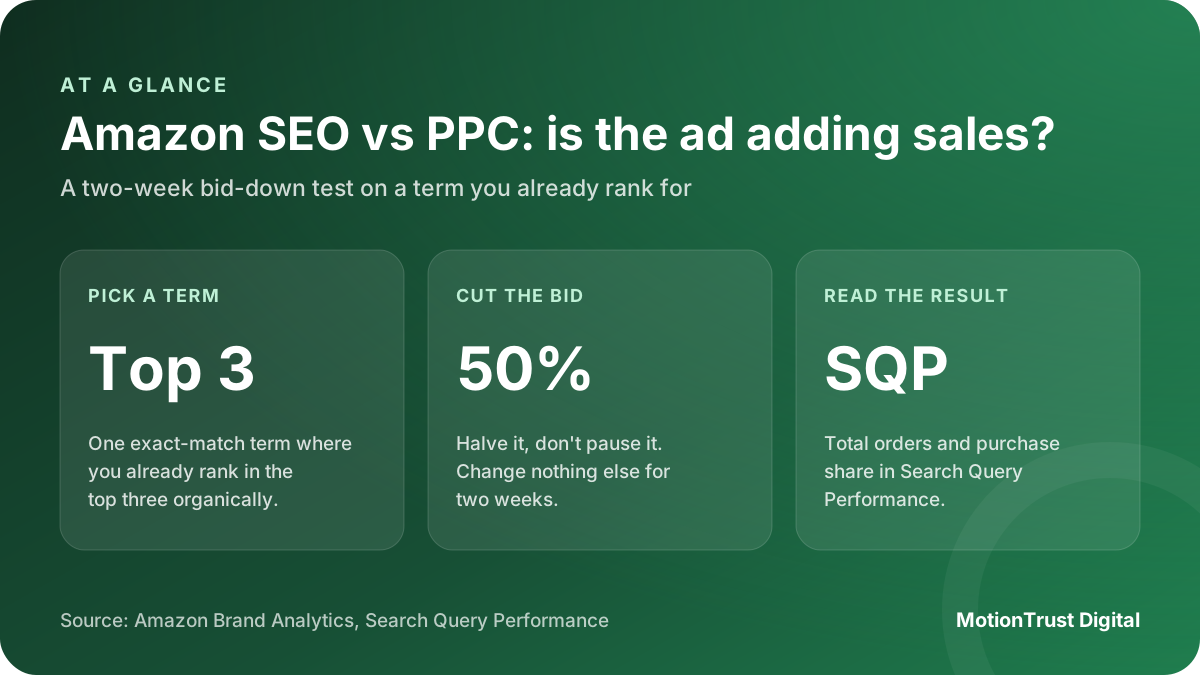
Run a two-week bid-down test on terms you already rank for
- Pick one exact-match term where you already sit in the top three organic results.
- Note two weeks of total orders for the product (Business Reports) and your purchase share for that term.
- Halve the bid for two weeks. Do not pause it, and change nothing else.
- Compare. If total orders hold, most of that spend was cannibalising. If they fall by roughly the ad orders you lost, the ads were genuinely adding sales.
Test one term at a time and stay away from Prime Day and other peaks, when everything moves at once. Spend defending your own brand name often stays worth it when competitors bid on it. The test tells you how much.
When Amazon Marketing Cloud is worth the effort
Amazon Marketing Cloud is Amazon’s privacy-safe clean room for advertisers. It shows the paths shoppers take across ad types before they buy, which is where questions about overlap get properly answered. It needs SQL or a partner who writes it, so it pays off once you run several ad types and a few per cent of wasted spend is real money.
AI shopping assistants: where Amazon SEO vs PPC now overlap
In the US, Amazon’s shopping assistant (Rufus, now part of Alexa for Shopping) answers questions inside the search bar using listings and reviews, and trade press reports sponsored answers appearing in it during 2026. It has not launched the same way in the UK yet, but the lesson carries: the bullets that answer buyers’ questions feed the organic answer and the paid one. Same loop, new placement.
If you would like an outside read on where your spend is leaking, run our free PPC audit tool, or talk to us about Amazon PPC management and Amazon SEO run as one plan.
Free tool
Curious where your ad spend is going?
Upload a search term report and our free audit tool shows wasted spend and the terms worth a closer look, in a few minutes.
Try the free PPC auditQuestions people also ask
Is Amazon SEO better than PPC?
Neither is better; they do different jobs in a sequence. SEO earns position you do not pay per click for but needs a converting listing and a sales history. PPC buys position immediately and produces the search term data that tells you which keywords deserve the SEO work.
Does Amazon PPC help organic ranking?
Indirectly, and genuinely. Ads produce sales, and sales velocity and conversion history on a keyword are ranking inputs regardless of whether the sale came from an ad. But ads pointed at a listing that converts poorly do the reverse, because poor conversion on a term is also a signal.
Should new Amazon products start with SEO or PPC?
Listing work before launch, then advertising heavily for the first thirty days. Roughly 30% listing and 70% ads during launch, inverting to 60/40 the other way from month two once you know which terms convert.
What should Amazon PPC campaigns teach the SEO team?
Which exact phrases shoppers typed and which of them converted, from the search term report. That is real language with money attached rather than a modelled volume estimate, and terms that convert consistently for four weeks have earned a place in the listing.
What is the biggest Amazon SEO and PPC mistake?
Advertising a listing that does not convert. It raises your cost per sale, and because conversion feeds ranking, the wasted clicks actively suppress the organic position you were trying to build. Fix the page first.
Should I run Amazon PPC before optimizing my listing?
No. A $30 product going from 10% to 15% conversion cuts cost per sale by about a third with no campaign change at all, and the same improvement feeds organic rank. Advertising a weak page buys expensive bounces.
What is a good ACoS for Amazon PPC?
Anything below your break-even, which is your contribution margin after Amazon fees, cost of goods and shipping. There is no universal benchmark — Amazon declines to publish one. Target roughly 70 to 80% of break-even if you want profit now, break-even itself if you want growth.
How often should I review my Amazon PPC search term reports?
Weekly. Promote converting terms into their own exact-match campaigns, and add non-converting terms as negatives at both campaign and ad group level. Fifteen minutes a week is worth more than most bid optimisation.
Can Amazon SEO replace PPC entirely?
Only in thin categories with a strong differentiator. In competitive ones, launching without ads means waiting for organic sales that do not come, because you have no rank without sales and no sales without rank. Even mature accounts usually keep ads to defend terms competitors bid on.
Do Amazon PPC and SEO compete against each other?
For budget, sometimes. For results, no — they compound. Each term you earn organically is a term you pay less to defend, and each term advertising proves converts is a term the listing should be built around.
How does Amazon SEO impact Amazon PPC?
It lowers what advertising costs. A better-converting listing needs fewer clicks per sale, so ACoS falls with no change to bidding, and terms you hold organically can be defended at lower bids rather than won at full price.
How long does Amazon SEO take to work?
Indexing happens within 24 to 72 hours of a listing change. Meaningful rank movement usually takes two to six weeks and depends on the listing converting. If nothing has moved after eight weeks, the issue is relevance or conversion rather than time.
How much should I budget for Amazon PPC per month?
Work from your break-even rather than a flat figure. During launch, set a total you are willing to lose over thirty days and judge it on organic rank rather than ACoS. After that, spend up to the point where the marginal sale still sits under your target ACoS.
Do Amazon ads cannibalise organic sales?
Sometimes, mostly on terms where you already rank in the top few organic results and on your own brand name. Check by halving the bid on one such term for two weeks. If total orders hold, the ads were mostly taking credit. If orders fall by about the ad orders lost, the ads were adding sales.
Should I bid on keywords I already rank for organically?
Often yes, but measure it. A paid slot above your organic listing can be cheap insurance when competitors bid on the same term. Reduce bids gradually and watch your share of purchases in Search Query Performance rather than pausing outright.
Written by Monjur Hossain, Founder & Amazon Strategy Lead at MotionTrust Digital, from the agency’s day-to-day work on client Amazon accounts and checked against the primary documentation listed under Sources below. Primary sources for this guide: Amazon Ads, Amazon Seller Central and Amazon.
Every figure attributed to Amazon or to another named organisation links to that organisation’s own page, with the month it was accessed. Anything drawn from our own client accounts is labelled as ours rather than presented as an industry figure, and where no primary source publishes a number this guide says so instead of estimating one. Last reviewed .
- Amazon Ads — ACoS — advertising cost of sales, accessed September 2026.
- Amazon Ads — Sponsored Products, accessed September 2026.
- Amazon Seller Central — Product title updates from 27 July 2026, accessed September 2026.
- Amazon — Amazon keyword research, accessed September 2026.
- Amazon — Brand Analytics: get data to grow your business (Search Query Performance), accessed October 2026.
- Amazon Ads — Amazon Marketing Cloud, accessed October 2026.
- Amazon — Meet Alexa for Shopping, accessed October 2026.
Monjur Hossain
Founder & Amazon Strategy Lead, MotionTrust Digital
Monjur incorporated MotionTrust Digital in September 2022 and leads Amazon strategy across the client base. Eight years in e-commerce and marketplace marketing, now on Amazon only — keyword strategy, listing architecture and advertising structure for growing brands.
MonjurAgency