
Amazon PPC agency vs in-house team: which one actually pays for itself?
 By Monjur HossainFounder & Amazon Strategy Lead
·
Published
·
Last reviewed
·20 min read
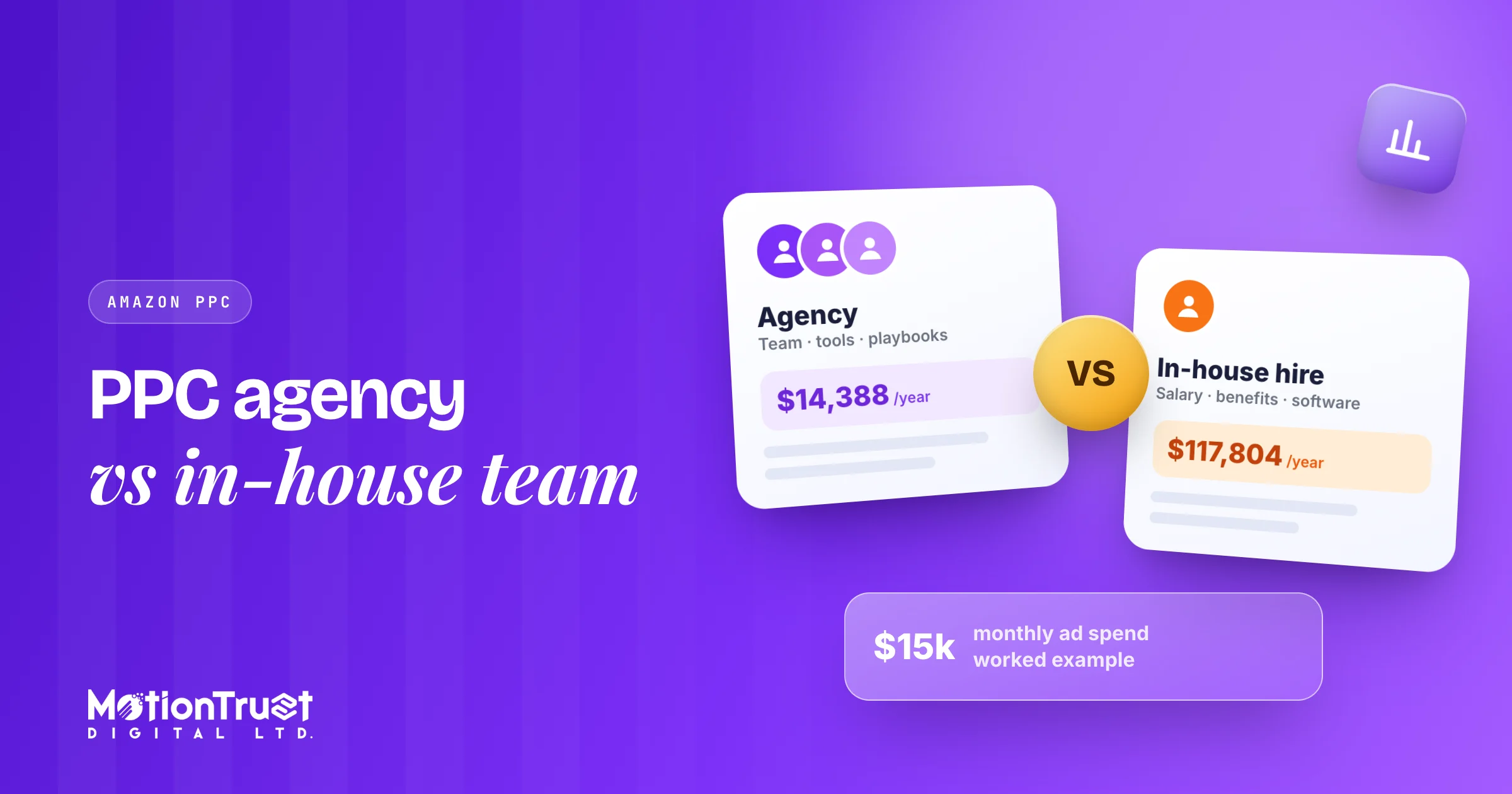
For most sellers, an Amazon PPC agency or skilled freelancer costs far less than an in-house hire. A US marketing specialist on the median wage costs about $112,500 a year once benefits are added, before tools. In-house usually wins on cost only from around $140,000 a month in ad spend, or when you already have the right person.
For most sellers weighing an Amazon PPC agency vs in-house team, an agency or a skilled freelancer costs far less than an in-house hire. A US marketing specialist on the median wage costs roughly $112,500 a year once benefits are added, before tools. In-house usually starts to win on cost at around $140,000 a month in ad spend, or sooner if you already have the right person.
The longer answer to Amazon PPC agency vs in-house depends on how much you spend, who on your team already understands search-term data, and how much of your own time you can give it. This guide puts real numbers on each option.
A note on bias before we start. MotionTrust Digital is our own agency, and we sell PPC management. We have used only published prices in this article, including ours, and we say plainly where an agency is the wrong answer. Salary figures come from the US Bureau of Labor Statistics, and the UK figures from GOV.UK.
Amazon PPC agency vs in-house: which should you choose?
Hire an agency when your ad spend is meaningful but too small to justify a full salary, or when nobody in-house has run Amazon campaigns before. Keep it in-house when spend is large enough that a salary is cheaper than a fee, and you can hire someone who has already managed accounts at your size.
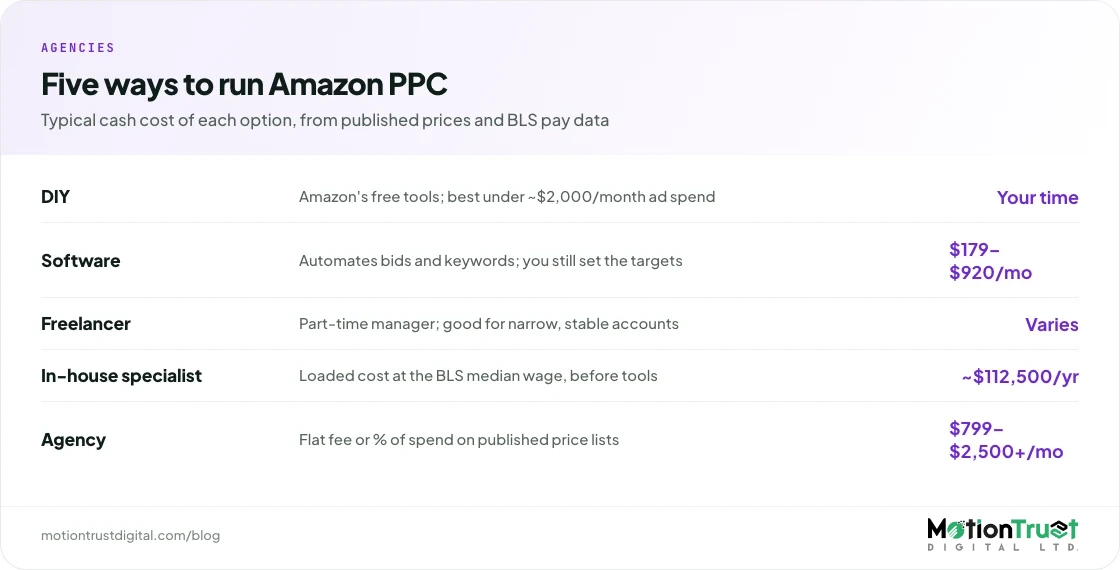
The mistake we see most often is framing this as a straight choice between two things. There are really five options, and most sellers move through several of them as they grow:
- Do it yourself in Amazon's Campaign Manager, using Amazon's free bidding and budget features.
- Software that automates bids, harvests keywords and adds negatives, run by you or a team member.
- A freelancer who manages the campaigns part-time, usually for several clients.
- An in-house specialist or team on your payroll.
- An agency that runs the account for a monthly fee or a percentage of spend.
Each option buys a different mix of hours, judgement and continuity. Software gives hours without judgement. An in-house hire gives hours and continuity, with judgement only as good as the person. An agency gives judgement drawn from other accounts, with continuity set by the contract.
| Option | Typical cash cost | Best for | Main risk |
|---|---|---|---|
| DIY | Your time only | Under ~$2,000/month ad spend, one or two products | Search-term work slips when you are busy |
| Software | $179–$920/month on the published plans below | Sellers with time and basic PPC skills | Automation scales a bad structure faster |
| Freelancer | Varies widely, usually hourly or a small retainer | Narrow, well-defined accounts | Single point of failure |
| In-house specialist | ~$112,500/year loaded at the US median wage | $140,000+/month ad spend, or an existing hire | Hiring the wrong person, turnover |
| Agency | $799–$2,500+/month on the published prices below | $2,000–$140,000/month ad spend | Paying for activity rather than results |
What does each option actually involve?
Amazon PPC management is the same set of jobs whoever does it: structure, bids, budgets, search terms, negatives, reporting and decisions about which products deserve spend. The options differ in who does each job and how often.
Doing it yourself
DIY means you build and run campaigns in the Amazon Ads console. Amazon gives you more for free than many sellers realise: automatic campaigns, dynamic bidding, budget rules and the Amazon Ads Academy, which Amazon describes as free courses, certifications and videos.
The weekly work is what breaks DIY. In the accounts we audit, the first thing to slip is the search term report: nobody downloads it, so wasted terms keep spending and converting terms never get their own exact-match targets. That is not a knowledge problem. It is a calendar problem.
Software and PPC tools
Amazon PPC software connects to your ads account and automates repetitive work: bid changes against a target ACoS, moving converting search terms into new campaigns, and adding negatives when a term passes a spend threshold. Good software can do in minutes what takes a person hours.
What software cannot do is decide what the target should be. It does not know that one product has a 45% margin and another has 18%, that a launch needs to lose money for six weeks, or that stock runs out in a fortnight. Software is a multiplier. It multiplies a good strategy and it multiplies a bad one.
An in-house specialist or team
An in-house PPC specialist works only on your brand. They know your margins, your stock position and your launch calendar without being told. They can change a bid on Saturday morning because a competitor went out of stock.
The catch is that one person sees one account, has no colleague to check their thinking, and takes the knowledge with them when they leave unless it is written down. And the person who interviews well about "optimising ACoS" is not always the one who can restructure a 400-campaign account.
An agency
An Amazon PPC agency runs your campaigns as part of a team that manages many accounts. The value is pattern recognition: they have seen the same problem in other categories and know which fixes work. You also get cover for holidays and illness, and usually a documented process.
The downside is attention. Your account competes with other clients for the same people's hours, and sellers often complain that the senior person on the sales call is not the one doing the work. If you want a primer on the wider scope, see what an Amazon agency actually does.
How much does an in-house Amazon PPC manager cost?
A mid-level in-house PPC specialist in the US costs about $112,500 a year on the median wage once employer benefits are included, plus $5,000 or more a year in software. A senior hire at manager level costs about $191,000 a year loaded.
The Bureau of Labor Statistics does not have an "Amazon PPC" job title. The nearest occupation is the one BLS calls "Market research analysts and marketing specialists" (SOC 13-1161). According to the BLS Occupational Outlook Handbook, the median annual wage for this group was $78,760 in May 2025. The lowest 10% earned less than $43,390 and the highest 10% more than $155,480.
If you want a person to own advertising strategy rather than execute it, the closer match is "Advertising and promotions managers" (SOC 11-2011). The BLS profile for advertising, promotions and marketing managers gives a median of $133,660 in May 2025 for advertising and promotions managers, and $166,790 for marketing managers.
Add employer costs, not just salary
Salary is not what an employee costs. The BLS Employer Costs for Employee Compensation release for June 2026 puts private-industry compensation at $46.89 an hour. Wages made up $32.82 (70.0%) and benefits $14.07 (30.0%). Put another way, for every $1 of wages, private employers spent about $0.43 on benefits such as health insurance, paid leave, retirement and legally required payroll taxes.
Apply that ratio and the numbers change quickly:
| Cost line (US, per year) | Specialist (BLS 13-1161 median) | Manager (BLS 11-2011 median) |
|---|---|---|
| Median salary, May 2025 | $78,760 | $133,660 |
| Benefits at the BLS ratio (~43% of wages) | $33,764 | $57,300 |
| Loaded employment cost | $112,524 | $190,960 |
| PPC software (Ad Badger Basic, up to $25,000/month spend) | $5,280 | $5,280 |
| Total before recruitment and management time | $117,804 | $196,240 |
| Per month | $9,817 | $16,353 |
These are national medians, not offers; big-city pay runs higher. The point is the shape of the maths: a salaried hire is a fixed cost of around $10,000 a month that does not shrink when ad spend does.
The costs that never appear on the payslip
- Recruitment. A recruiter fee, a job board, or weeks of your own time screening candidates.
- Ramp-up. Even an experienced hire needs weeks to learn your catalogue, margins and history before their changes are reliably better than the old ones.
- Management time. Someone has to set targets, review the work and approve budget increases. If that is the founder, the DIY time cost has not gone away.
- Turnover. If they leave after a year, you pay to recruit and ramp again. Documentation is the only protection.
If you hire in the UK
UK employers pay employer National Insurance at 15% on earnings above the £5,000 secondary threshold for 2026 to 2027, according to GOV.UK's rates and thresholds for employers, and the minimum employer pension contribution under auto-enrolment is 3%, usually on earnings between £6,240 and £50,270. On an illustrative £40,000 salary, that is £5,250 of National Insurance and £1,012.80 of pension, so about £46,263 before tools. Eligible small employers can claim the £10,500 Employment Allowance against their National Insurance bill, which narrows the gap for a first hire.
How much does an Amazon PPC agency cost?
Agencies charge either a flat monthly fee or a percentage of ad spend, usually with a minimum. On the prices agencies actually publish, PPC-only management starts at around $799 a month for small accounts and $2,500 a month at agencies with higher minimums.
Very few agencies publish prices. When we compared seven Amazon agencies for our own pricing page, not one published a figure. So we have used two agencies that do publish: our own, and Clear Ads Agency.
| Agency and plan | Published price | Spend covered | Notes |
|---|---|---|---|
| MotionTrust Digital PPC Starter (our agency) | $799/month | Up to $5,000/month, 3 parent ASINs | Sponsored Products; weekly bids, negatives and search terms |
| MotionTrust Digital PPC Growth | $1,199/month | Up to $15,000/month, 5 parent ASINs | Adds Sponsored Brands and Display where eligible |
| MotionTrust Digital PPC Scale | $1,799/month | Up to $30,000/month, 10 parent ASINs | Multiple scheduled reviews a week |
| MotionTrust Digital, $30,000–$60,000 spend | $2,499/month | Up to 15 parent ASINs | Above $60,000: custom quote |
| Clear Ads Agency | 7% of ad spend, minimum $2,500/month | Not capped | Tools and setup included, per its pricing page |
Our plans are on the MotionTrust pricing page. Ad spend is paid to Amazon from your own account and is never marked up, plans start with a 90-day initial engagement and then run month to month on 30 days' notice. Clear Ads Agency's pricing page lists 7% of ad spend with a $2,500 monthly minimum, so the percentage only takes over once spend passes about $35,700 a month.
Flat fee or percentage of spend?
A percentage of spend is simple and scales with the work, but it pays the agency more when you spend more, including in months when spending less is the right decision.
A flat fee removes that incentive but needs a clear scope, or an account that doubles in size gets the same hours. Neither is wrong. What matters is that you know which incentive you are buying. We go deeper in how much Amazon PPC management costs, and compare named firms in our list of the best Amazon PPC management agencies.
Amazon agency pricing
Want to see exactly what management would cost at your spend?
Every MotionTrust plan is published with what it includes, what costs extra and the contract terms. No quote call needed.
See published pricingWhat does Amazon PPC software cost, and can it replace an agency?
Amazon PPC software costs roughly $179 to $920 a month on the published plans for accounts spending up to $250,000 a month, sometimes plus a percentage of spend. It can replace the repetitive work of an agency but not the judgement, so it works best for sellers who already know what targets to set.
Here is what three well-known tools publish on their own pricing pages, checked in October 2026:
| Tool | Published price | Spend limit or fee |
|---|---|---|
| Teikametrics Essentials | $179/month billed monthly ($149 billed annually) | Up to $10,000/month ad spend |
| Teikametrics Advanced | Custom pricing | Plus 3% of ad spend over $10,000 |
| Ad Badger Starter / Basic / Professional / Platinum | $275 / $440 / $660 / $920 a month | Up to $5,000 / $25,000 / $75,000 / $250,000 spend |
| Helium 10 Diamond (includes Helium 10 Ads) | $359/month billed monthly | Plus a 2% management fee on spend managed through the tool |
The "agency vs software" question usually comes down to one test: can you write down your target ACoS for each product and explain why? If you can, software will execute it tirelessly. If you cannot, start with our guide to what ACoS is and the ACoS and TACoS benchmarks, because software will happily chase a target that loses you money.
Worked example: a brand spending $15,000 a month on ads
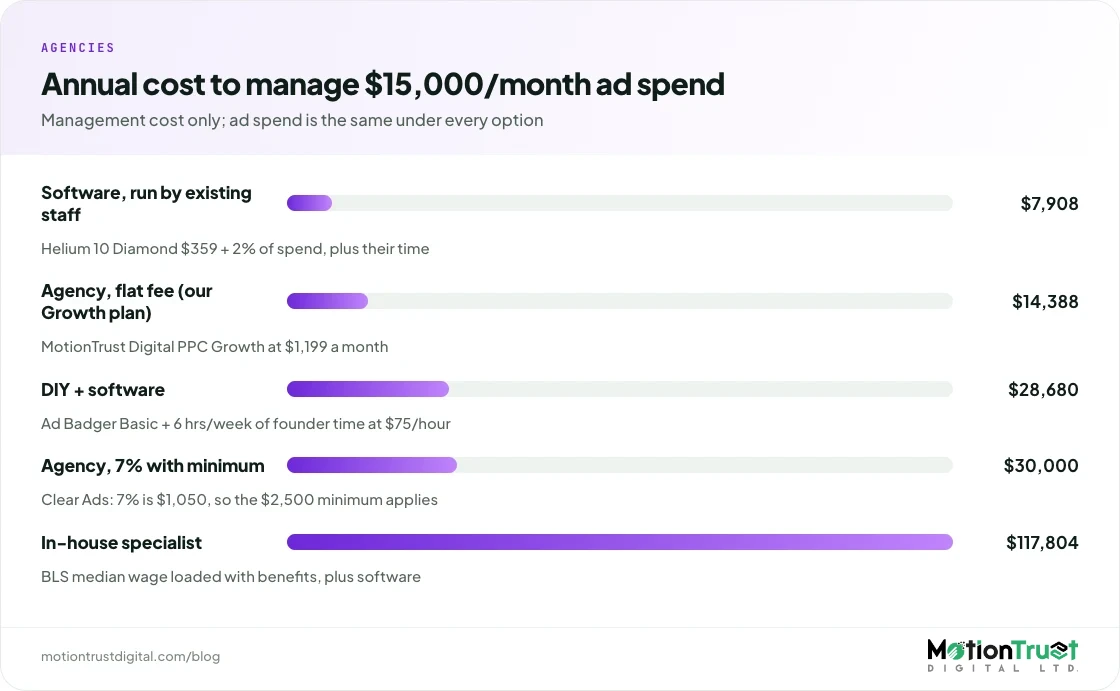
At $15,000 a month in ad spend, the Amazon PPC agency vs in-house maths is clear: an agency on a published flat fee costs about $14,400 a year, while an in-house specialist costs about $117,800. DIY with software is cheapest in cash but expensive in founder time.
Take a US brand selling five parent ASINs, spending $15,000 a month ($180,000 a year) on Sponsored Products and Sponsored Brands. Ad spend is the same under every option, so we compare only the cost of managing it.
| Option | How it is costed | Annual cost |
|---|---|---|
| DIY + software | Ad Badger Basic $440 × 12 = $5,280, plus 6 hours a week of founder time valued at $75/hour = $23,400 | $28,680 |
| Software, run by an existing staff member | Helium 10 Diamond $359 + 2% of $15,000 ($300) = $659 × 12 | $7,908 plus their time |
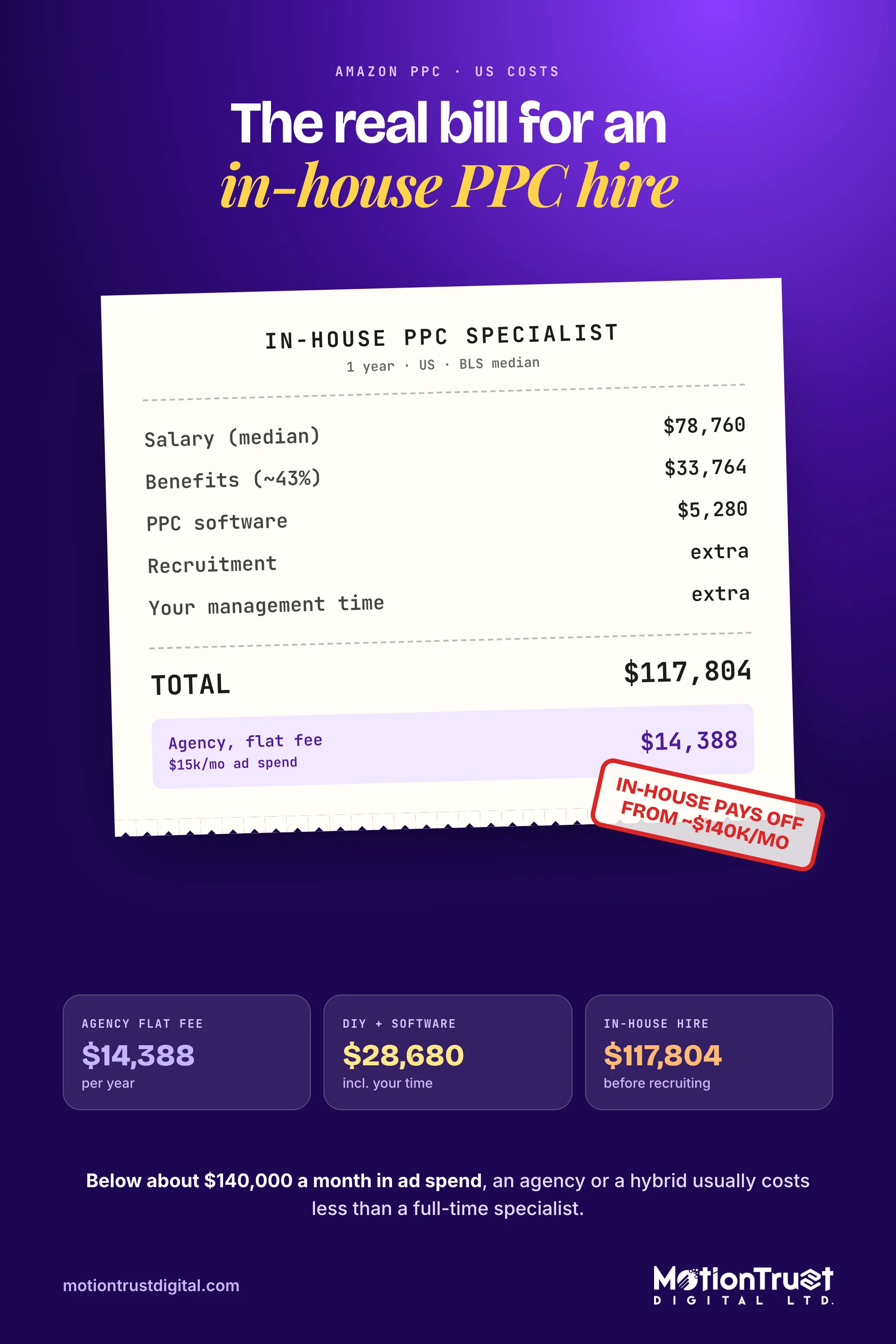
| In-house specialist | $112,524 loaded at the BLS median + $5,280 software | $117,804 |
| Agency, flat fee (MotionTrust Growth, our agency) | $1,199 × 12 | $14,388 |
| Agency, percentage with minimum (Clear Ads) | 7% of $15,000 = $1,050, so the $2,500 minimum applies; × 12 | $30,000 |
The six hours a week and $75 an hour are our assumptions for illustration. Change them to your own numbers: a founder whose time is worth $200 an hour on product development or retail deals has a very different DIY cost from one who enjoys the work and has evenings free.
Where in-house overtakes an agency
The break-even depends on the fee model. Against a 7% agency, an in-house specialist at $9,817 a month breaks even at about $140,000 a month in ad spend ($9,817 ÷ 0.07). At that spend the hire needs a bigger software plan too; with Ad Badger Platinum at $920 a month, the in-house cost rises to about $10,297 a month and the break-even to about $147,100.
Against flat-fee plans the crossover is higher still, because the fee does not rise with spend. In our experience, in-house pays below that level only when the hire brings something an agency cannot, such as daily contact with your product, supply chain and retail teams.
One more cost belongs in the comparison: the cost of being wrong. A management fee is small next to the ad spend it controls. On $15,000 a month, recovering even 10% of wasted spend is $1,500 a month, more than the flat fee. Equally, a poor manager of any kind can waste more than they cost. Judge every option by the change in profit, not by the size of the fee.
Which option fits your ad spend and team size?
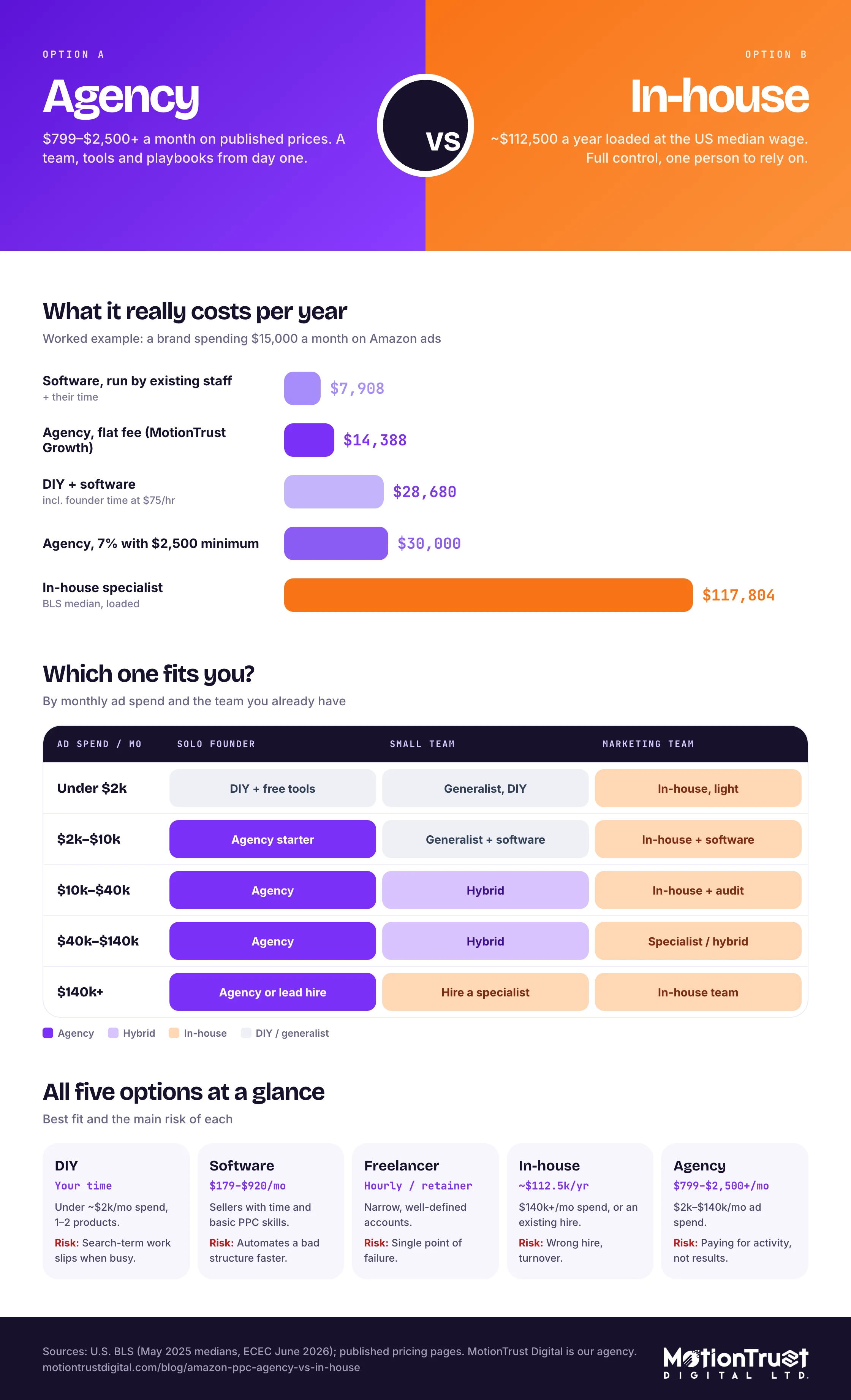
Use monthly ad spend to narrow the Amazon PPC agency vs in-house decision, then use your team to choose between them. Under $2,000 a month, DIY wins. From $2,000 to about $140,000, an agency or freelancer usually wins on cost, with a hybrid worth considering above $40,000. Above about $140,000, in-house usually wins, often with outside help for specialist work.
| Monthly ad spend | Solo founder | Small team with an ecommerce generalist | Marketing team with a paid-media person |
|---|---|---|---|
| Under $2,000 | DIY with Amazon's free tools; one-off audit | Generalist runs it, DIY | In-house, light touch |
| $2,000–$10,000 | Agency starter plan or freelancer | Generalist + software, or agency | In-house + software |
| $10,000–$40,000 | Agency | Agency, generalist owns targets (hybrid) | In-house + software, quarterly outside audit |
| $40,000–$140,000 | Agency | Agency with an in-house owner (hybrid) | In-house specialist or hybrid |
| $140,000+ | Agency, or hire a lead | Hire a specialist; agency for specialist work | In-house team + software |
A five-step decision flow
- Check that ads are the problem. If the listing does not convert, no manager will fix it. Look at click-to-order rates before blaming the campaigns.
- Measure the time. Log a fortnight of hours spent on PPC, including the hours you meant to spend and did not.
- Find the waste. Pull 60 days of search terms and total the spend on terms with clicks and no orders. That number is what management has to recover.
- Price the options at your spend. Use the tables above with your own salary, time value and published fees.
- Decide who owns targets. Whatever you choose, one named person in your business sets the target ACoS and TACoS and signs off budgets.
Step three is where most sellers change their mind: a messy account at $5,000 a month can have $1,000 going on terms that have never converted. Our guide to Amazon negative keywords shows how to find it.
Free PPC audit tool
How much of your ad spend is going on terms that never convert?
Paste your Sponsored Products search term report and the tool shows wasted spend and terms to negate. It runs in your browser, nothing is uploaded, and you get a number to weigh against any fee.
Run the free PPC auditIs a hybrid model better than agency or in-house alone?
For many growing brands, yes. A hybrid sidesteps the Amazon PPC agency vs in-house choice: it keeps strategy and targets in-house and buys execution or specialist skills from outside, so you keep control without paying for a full team.
The hybrids that work in the accounts we see:
- In-house owner, agency execution. Your ecommerce manager sets targets, approves budgets and holds the agency to account. The agency does the weekly work. This suits the $10,000 to $140,000 range.
- Agency builds, in-house runs. An agency restructures the account and documents it, then a trained staff member runs it with software. Good when the account is a mess but the team is capable.
- In-house team, outside audit. Your own specialist runs daily work, and an outside party reviews it each quarter. Cheap insurance against blind spots.
- Split by ad type. In-house runs Sponsored Products; an agency handles video, DSP or Sponsored Display, where specialist knowledge matters more. Our ad types comparison explains where each fits.
The hybrid that fails is the one with no owner. Write down who decides what.
Amazon PPC freelancer vs agency: where does a freelancer fit?
A freelancer suits a narrow, stable account where one skilled person can do the work in a few hours a week. An agency suits accounts that need cover, several ad types or work beyond PPC.
Freelancers are often cheaper and more personal. The risk is continuity: illness or a bigger client can leave your account unattended without warning. If you hire one, keep the accounts in your name, ask for a written change log and agree a handover clause. We compare the three routes in detail in Amazon agency vs freelancer vs in-house, and our guide on how to choose an Amazon agency has the questions to ask either.
How do you switch without losing performance?
Keep every account in your company's name, give the new manager their own login with the right permissions, export your history before anything changes, and run a short handover where nothing structural is touched. Most performance drops after a switch come from lost history and rushed restructures, not from the new manager's skill.
Account access and Amazon Ads user permissions
Never share your own password. In a Seller Central forum post on user permissions, an Amazon staff account advises sellers not to share passwords, to grant the minimum permissions needed, to review users regularly, and not to add external service providers as users: outside contractors and companies should be added as authorised partners.
In the Amazon Ads console, users get access through the account settings, with standard admin and editor levels. Since Amazon introduced custom access controls, admins can also limit a user to specific functions, such as billing for a finance team. Give your manager the access they need to run campaigns, and keep admin rights and payment settings with your own company.
Agencies can register with the Amazon Ads Partner Network, Amazon's self-service hub for agencies and tool providers, with a partner directory. A listing is a useful check, not a performance guarantee.
Data ownership
Campaigns, ad history and reports live in your Amazon Ads account, so they stay with you when a manager leaves, as long as the account is yours. What does not stay automatically:
- Rules, schedules and dayparting set up in the manager's own software seat.
- Custom dashboards and spreadsheets built outside Amazon.
- Negative keyword lists and target notes kept in the manager's own files.
- The reasons behind past changes, unless there is a change log.
Put a clause in the contract that these are handed over in a usable format on exit.
Handover checklist
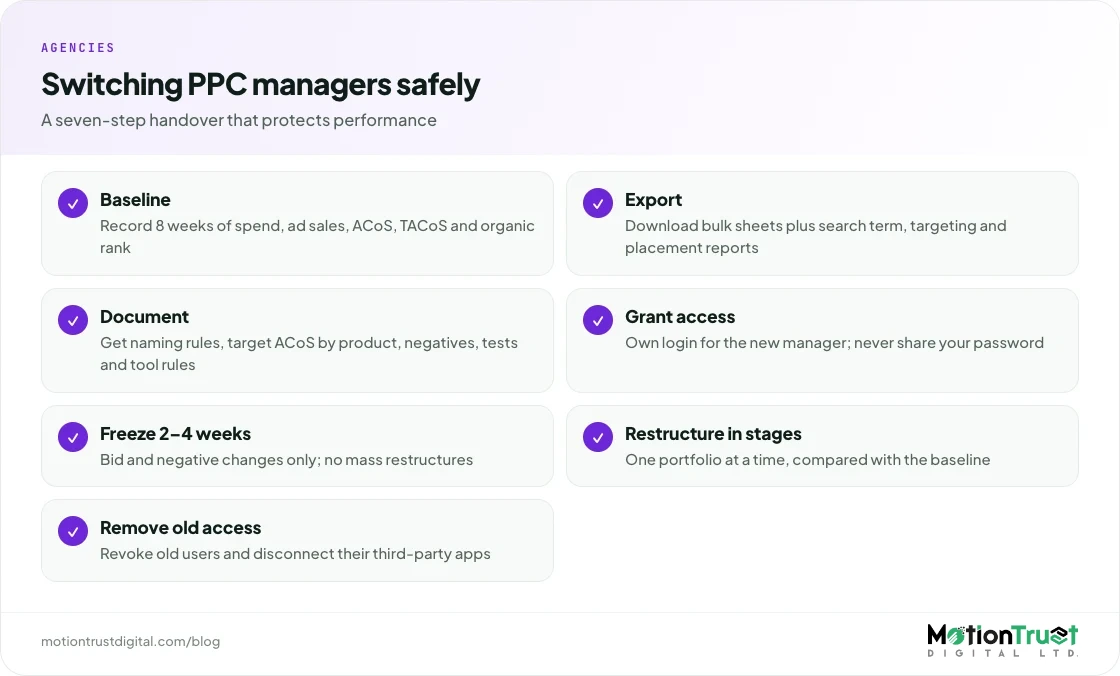
- Baseline. Record eight weeks of ad spend, ad sales, ACoS, TACoS and organic rank for your top terms before the switch.
- Export. Download bulk sheets of all campaigns plus recent search term, targeting and placement reports. Amazon's reports only look back a limited window, so do this before old access is removed.
- Document. Ask the outgoing manager for naming conventions, target ACoS by product, negative lists, active tests and any rules in their tools.
- Grant new access. Add the new manager with their own login and the right permission level.
- Freeze structure for two to four weeks. Bid and negative changes only. No pausing campaigns that carry ranking history, no mass restructures.
- Restructure in stages. Change one portfolio at a time and compare it with the baseline.
- Remove old access. Revoke users and disconnect any third-party apps the old manager connected.
Expect a settling period. In a 2026 r/FulfillmentByAmazon thread from a seller moving from three years of DIY to an agency, commenters suggested 3 to 6 weeks before meaningful results and advised keeping weekly check-ins at first. That matches what we see: the first month is mostly audit and clean-up.
Amazon PPC management
Switching to an agency and worried about the handover?
We take over in stages, with your accounts in your name, a written change log and a baseline agreed before anything moves.
See PPC managementWhat red flags should you watch for?
The biggest red flags are about control and incentives: anyone asking for your password, running ad spend through their own account, or refusing to show you a log of what they changed.
Agency and freelancer red flags
- Asks for your Seller Central password instead of a user invitation.
- Wants ad spend paid through them, or will not say whether it is marked up.
- Percentage-of-spend pricing with no cap, combined with constant pressure to raise budgets.
- Reports only ACoS, never TACoS or total sales. ACoS can improve while the business shrinks.
- No dated change log. Without one, you cannot tell management from monitoring.
- Guaranteed results, such as a promised ACoS in 30 days.
- Rules locked inside a proprietary tool with no export on exit.
- Long auto-renewing contracts with no notice period after the first term.
- The senior person on the sales call never appears again.
In-house red flags
- Hiring a general digital marketer who has never worked in an Amazon search term report.
- One person holds all the knowledge, with nothing written down.
- Nobody senior reviews the work, so success is defined by the person doing it.
Frequently asked questions
Is an Amazon PPC agency worth it?
Usually, once you spend more than about $2,000 a month on ads and cannot give the account several focused hours a week. Below that, there is rarely enough waste to recover to cover a fee. Judge it by profit: if the agency recovers more wasted spend and adds more profitable sales than its fee, it is worth it. Ask for a dated change log so you can see the work.
How much does an Amazon PPC manager cost?
In the US, the nearest BLS occupation, market research analysts and marketing specialists, had a median wage of $78,760 in May 2025. With employer benefits at the BLS private-industry ratio, that is about $112,500 a year, plus software. Published agency plans start at around $799 a month for small accounts, and a 7% agency fee matches an in-house salary at roughly $140,000 a month in spend.
Should I do Amazon PPC myself?
Yes, if you spend under about $2,000 a month, sell a handful of products and can review your search term report every week. Amazon's own tools and the free Amazon Ads Academy courses cover the basics. Hand it over when the weekly work starts slipping, when spend grows past a few thousand dollars, or when your time is worth more elsewhere in the business.
Is Amazon PPC software better than an agency?
Software is cheaper, from about $179 a month on published plans, and does repetitive bid and keyword work very well. It cannot set targets, read margins or plan launches, so it suits sellers who already know what they want. An agency brings judgement and usually its own tools. Many sellers run software in-house and pay for an outside audit each quarter.
How long does it take an agency to improve Amazon PPC results?
Expect the first month to go mostly on audit, clean-up and restructuring, with steadier results after that. Sellers in a 2026 r/FulfillmentByAmazon thread suggested 3 to 6 weeks before meaningful change. Agree a baseline of spend, ACoS, TACoS and sales before the start, and review against it monthly, with weekly check-ins during the first few weeks.
Do I keep my data if I leave an Amazon PPC agency?
Your campaigns, history and reports stay in your Amazon Ads account as long as the account is in your company's name. Rules in the agency's software, custom dashboards, negative lists kept in their files and the reasons for past changes do not transfer automatically. Put a clause in the contract requiring a handover in a usable format, and export bulk sheets before access is removed.
When should I hire an in-house Amazon PPC specialist?
When monthly ad spend is high enough that a salary costs less than a fee, roughly $140,000 a month against a 7% agency, or when you need someone working closely with stock, pricing and retail teams every day. Hire someone who has already managed an account at your size, budget for software, and make them write down how the account is run.
Sources
- U.S. Bureau of Labor Statistics — Occupational Outlook Handbook: Market Research Analysts (Market research analysts and marketing specialists, SOC 13-1161)
- U.S. Bureau of Labor Statistics — Occupational Outlook Handbook: Advertising, Promotions, and Marketing Managers
- U.S. Bureau of Labor Statistics — Employer Costs for Employee Compensation, June 2026
- GOV.UK — Rates and thresholds for employers 2026 to 2027
- GOV.UK — Workplace pensions: what you, your employer and the government pay
- Amazon Seller Forums — Seller Account User Permissions
- Amazon Ads — Custom access controls launch announcement
- Amazon Ads — Partner Network
- Amazon Ads — Amazon Ads Academy
- Clear Ads Agency — Pricing
- Ad Badger — Pricing
- Teikametrics — Pricing
- Helium 10 — Pricing
- MotionTrust Digital — Amazon agency pricing (our agency)
Monjur Hossain
Founder & Amazon Strategy Lead, MotionTrust Digital
Monjur incorporated MotionTrust Digital in September 2022 and leads Amazon strategy across the client base. Eight years in e-commerce and marketplace marketing, now on Amazon only — keyword strategy, listing architecture and advertising structure for growing brands.
MonjurAgencyTry the free tools
Seven Amazon tools that run in your browser — profit and ACoS calculator, PPC auditor, listing checker and more. No account, nothing uploaded.
Try the free toolsLast reviewed . We update articles in place rather than republishing at a new URL, so the link you have keeps working.
Keep your ACoS target working for you
Break-even ACoS is the starting point. One email a week with our newest PPC articles on targets, bids and wasted spend, plus listings and SEO if you want them. Email us to join.