
How to Sell Supplements on Amazon: The Full 2026 Launch Sequence
 By Monjur HossainFounder & Amazon Strategy Lead
·
Published
·
Last reviewed
·20 min read

To sell supplements on Amazon you need a Professional account, a product made in a cGMP facility and verified by an Amazon-approved TIC organisation, an FDA-compliant label, and listing copy that matches your Supplement Facts panel. Then launch with Brand Registry, a compliant listing, Vine reviews and tightly structured PPC.
If you are working out how to sell supplements on Amazon in 2026, you need a Professional seller account, a product made in a cGMP facility, and verification from an Amazon-approved testing, inspection and certification (TIC) organisation. You also need an FDA-compliant label and listing copy that matches your Supplement Facts panel. Only then does the launch work start: Brand Registry, a compliant listing, Vine reviews and a tightly structured PPC plan.
This guide follows the order we use to launch a supplement brand on amazon.com, with UK notes where the rules differ. FDA and Amazon rules are linked to their official pages. Where a change has only been reported by trade bodies or the press, we say so: Amazon's full policy sits behind the Seller Central log-in, so read it there before you order inventory.
Can you sell supplements on Amazon in 2026?
Yes, but supplements are a closely controlled category, and the bar has risen twice since 2024. An unverified product can be blocked before launch or removed later.
The short history, so you know which advice is out of date:
- 2024: Amazon's updated dietary supplement policy required products to be verified through an Amazon-approved TIC organisation, with results sent from the lab to Amazon rather than uploaded by the seller. Higher-risk types, including weight management, sexual enhancement, sports nutrition, bodybuilding and joint health products, face extra product testing.
- December 2025: the American Herbal Products Association reported that Amazon is rolling out a requirement for every dietary supplement seller to show cGMP compliance through a third-party TIC organisation. Contacted sellers get 90 days to start a documentation request. This is trade-body reporting of Amazon's notices, not a public Amazon page.
- 2026: trade press and sellers report stricter checks that listing copy, images and claims match the Supplement Facts panel exactly. We see this in the accounts we audit; confirm the detail in your own Seller Central notices.
If a guide says a certificate of analysis (COA) you upload yourself is enough, it is out of date.
What are Amazon's dietary supplement requirements?
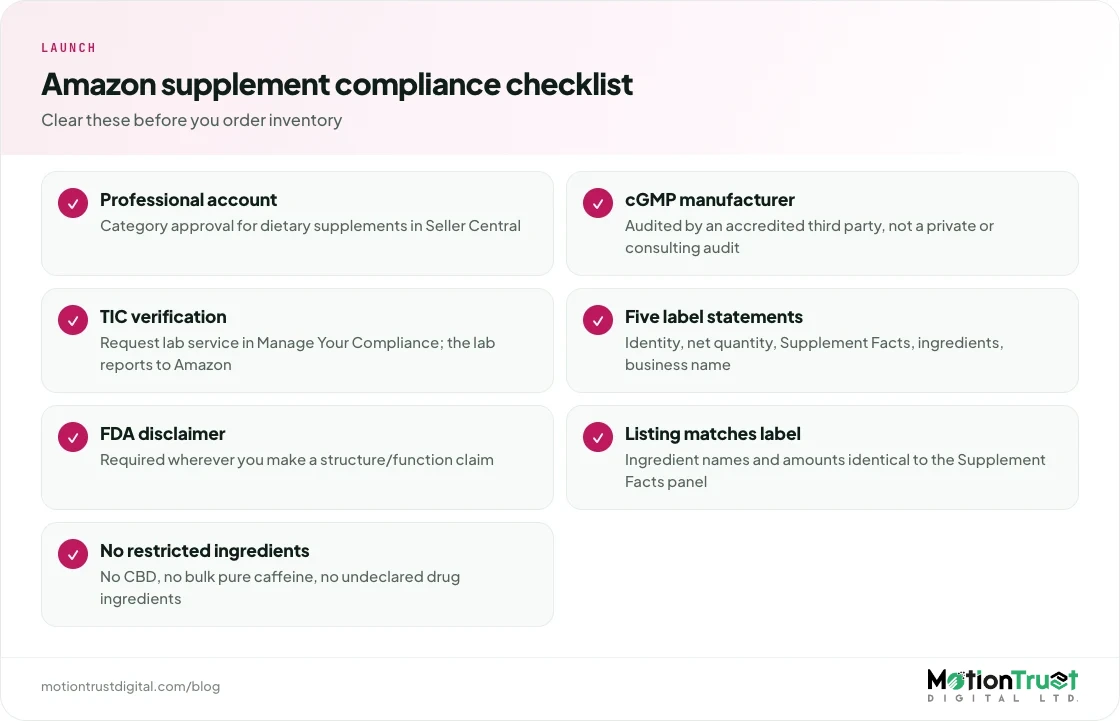
The first step in how to sell supplements on Amazon is meeting Amazon's requirements, which fall into four groups: who made the product, what is in it, what the label says, and what the listing claims. Each one is checked separately, and failing any of them can stop a listing.
| Requirement | What it means in practice | How sure we are |
|---|---|---|
| Professional selling account | Supplements need category approval; Individual accounts are not a practical route | Amazon category approval in Seller Central |
| cGMP manufacturing | Made in a facility that follows FDA current good manufacturing practice, verified by an accredited third party | FDA requires cGMP; the all-supplement Amazon audit rule is reported by AHPA (Dec 2025) |
| Product testing via an approved TIC | Identity, quantity and contaminant checks, with results sent by the lab to Amazon | Amazon policy since 2024, as described by approved labs and trade press |
| Extra testing for higher-risk types | Weight management, sexual enhancement, sports nutrition, bodybuilding, joint health | Reported by AHPA and NutraIngredients |
| Compliant label | The five FDA-required label statements, plus the disclaimer if you make structure/function claims | FDA |
| Listing matches the label | Ingredient names, amounts and claims on the page match the Supplement Facts panel | Trade press, and what we see in audits |
| No prohibited ingredients | No CBD, no undeclared drug ingredients, no bulk pure caffeine | FDA, plus Amazon's restricted products rules |
Testing and TIC verification
You do not choose any lab you like. In Seller Central, under Manage Your Compliance, you request a lab service from one of the approved TIC organisations listed there. The lab tests or reviews your product and reports to Amazon directly. You cannot submit the documents yourself.
The approved list changes, so check it in your account. If your product is already certified by a recognised programme, the lab may review existing evidence instead of retesting, which is cheaper and faster.
cGMP verification for every supplement
The newer rule is about the factory, not just the batch. According to AHPA's December 2025 update, the certification must be based on an audit by an accredited third party, and Amazon may skip outreach where it can already confirm compliance through third parties or public databases. Trade reports add that private, first-party and consulting audits are not accepted.
So before you sign with a contract manufacturer, ask which accredited body audits them for cGMP and whether Amazon recognises it.
Compliance Fast-Track
Amazon has started rolling out Compliance Fast-Track for some supplements. As reported by the trade publication NutraIngredients, Amazon collects certification status directly from partner organisations (BSCG, Clean Label Project, GRMA, Informed, NSF and USP), so the seller does not submit documents. AHPA notes that Fast-Track does not currently cover the extra testing for higher-risk categories, and that the programme is still changing.
Do supplements need FDA approval to sell on Amazon?
No. The FDA does not approve dietary supplements before they are sold, and it generally does not approve their claims or labels. Responsibility sits with the brand, and Amazon's checks are built on top of that responsibility.
The legal framework is the Dietary Supplement Health and Education Act of 1994 (DSHEA). According to the FDA's questions and answers on dietary supplements, the obligations that matter for a launch are:
- Not adulterated or misbranded: the brand must make sure the product is safe and the label is truthful.
- Current good manufacturing practice: manufacturers must follow FDA cGMP rules for supplements.
- Facility registration: facilities that manufacture, process, pack or hold supplements for US consumers must register with the FDA before they start.
- New dietary ingredients: if your formula contains a new dietary ingredient that is not already in the food supply in an unaltered form, you must notify the FDA at least 75 days before marketing.
- Serious adverse events: brands must record, investigate and forward serious adverse event reports to the FDA.
- Claim substantiation: structure/function claims must be backed by evidence that they are truthful and not misleading.
Never write "FDA approved" anywhere; it is not true for a supplement. And lock the formula early, because a 75-day notice for a novel ingredient can wreck a launch date.
What must a supplement label include?
The FDA requires five statements on every supplement label: the statement of identity, the net quantity of contents, the Supplement Facts panel, the ingredient list, and the name and place of business of the manufacturer, packer or distributor.
The FDA dietary supplement labeling guide says where they go. The statement of identity and net quantity belong on the front, the principal display panel. The Supplement Facts panel, ingredient list and business details go on the information panel, usually immediately to the right of the front. The statement of identity must include the words "dietary supplement", or a term such as "herbal supplement".
The structure/function disclaimer
If your label or listing says what a nutrient does for the body, such as "supports restful sleep", federal regulation 21 CFR 101.93 requires this disclaimer, word for word:
"This statement has not been evaluated by the Food and Drug Administration. This product is not intended to diagnose, treat, cure, or prevent any disease."
Use "These statements have" if there is more than one claim. On the label it must be in bold type at least one-sixteenth of an inch tall. If it is not right next to the claim, link it with a symbol such as an asterisk and set it in a box. You must also notify the FDA of the claim's text within 30 days of first marketing the product with it.
Why the label image matters on Amazon
Your listing is compared against your physical label, so upload a sharp image of the full Supplement Facts panel. If the panel says 500 mg of an extract, do not call it "10,000 mg" of raw herb unless the panel shows that equivalence. In the accounts we audit, this mismatch is the commonest reason a compliant product gets flagged.
What claims can you make on an Amazon supplement listing?
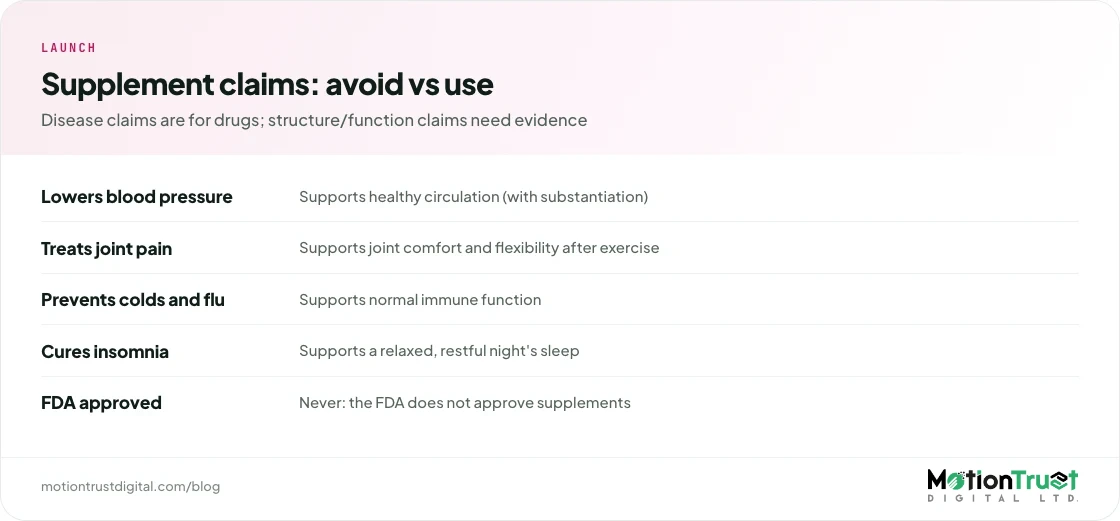
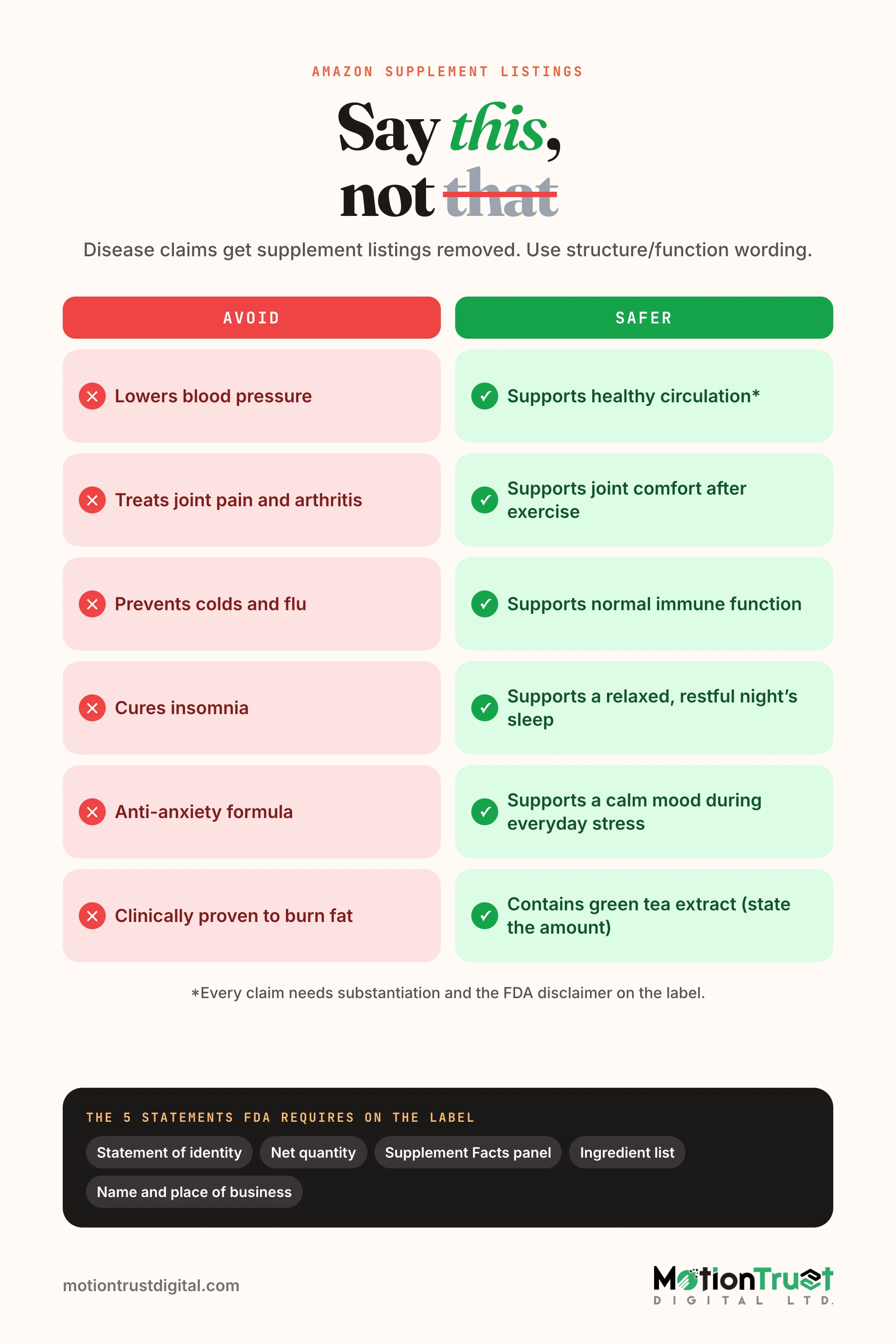
You can describe how an ingredient supports normal structure or function of the body. You cannot say or imply that it diagnoses, treats, cures, mitigates or prevents a disease, because only a drug can lawfully make that claim.
The FDA's page on structure/function claims gives examples such as "calcium builds strong bones" and "fiber maintains bowel regularity". Under 21 CFR 101.93(g), a statement becomes a disease claim if it suggests an effect on a specific disease, on the signs or symptoms of a disease, or on an abnormal condition that is uncommon or can cause significant harm. Images and product names count too.
| Avoid (disease or implied disease) | Safer structure/function wording |
|---|---|
| Lowers blood pressure | Supports healthy circulation (with substantiation) |
| Treats joint pain and arthritis | Supports joint comfort and flexibility after exercise |
| Prevents colds and flu | Supports normal immune function |
| Cures insomnia | Supports a relaxed, restful night's sleep |
| Anti-anxiety formula | Supports a calm mood during everyday stress |
| Clinically proven to burn fat | Contains green tea extract (state the amount); no result claim without trials |
The FTC's Health Products Compliance Guidance says health claims need "competent and reliable scientific evidence", which generally means randomised, controlled human trials. It also says the DSHEA disclaimer does not fix an otherwise deceptive claim.
UK note: authorised claims only
On amazon.co.uk the logic is stricter. Food supplements are regulated as foods, and the Great Britain nutrition and health claims register states that only authorised claims in the register may be used in Great Britain. That means "vitamin D contributes to the normal function of the immune system" is fine, while a US-style "supports immune health" may not be. Do not copy a US listing to the UK without rewriting the claims.
Which supplement ingredients are restricted on Amazon?
Some ingredients are off limits whatever your paperwork says. Others put you in the higher-risk group, with more testing and scrutiny.
- CBD and THC: the FDA states that THC and CBD products are excluded from the dietary supplement definition. Amazon's restricted products rules do not allow CBD in supplements.
- Pure and highly concentrated caffeine: the FDA warns that these are sold in bulk with up to thousands of servings per container, and it issued guidance on them in April 2018. Compliance labs list them among the products Amazon prohibits; treat bulk pure caffeine as unsellable.
- Controlled substances: anything on the DEA schedules is prohibited.
- Hidden drug ingredients: the FDA's health fraud pages flag weight-loss, sexual enhancement, bodybuilding, sleep and pain products as the categories most often found with undeclared drugs. That is why Amazon tests those types harder.
- Ingredients under FDA warning or recall: if the FDA has warned against an ingredient, expect Amazon to block it.
A plain magnesium glycinate is a far easier first launch than a "shred" stack with five stimulants.
Supplement brand growth
Launching a supplement and unsure what Amazon will flag?
We review your label, claims and listing copy against Amazon's supplement rules before launch, then run PPC, SEO and reviews as one plan.
See supplement brand growthHow do you set up Brand Registry for a supplement brand?
File a trademark for your brand name first, then enrol in Amazon Brand Registry with the application number. Amazon accepts pending trademark applications in some cases, so you do not have to wait for registration to start.
According to Amazon's Brand Registry page, you need a trademark from a government office in a country with an Amazon store, a logo with your brand name permanently on the product or packaging, and the trademark text must match the brand name on your application. Enrolment is free. If you do not yet have a trademark, Amazon's IP Accelerator connects you with vetted law firms.
For a supplement brand it is essential: it unlocks A+ Content, Vine, Subscribe & Save and Sponsored Brands. Amazon's New Seller Incentives also offer 10% back on your first $50,000 of branded sales, then 5% for the rest of the first year up to $1,000,000, plus a $200 Vine credit. Read the current terms in Seller Central, as incentives change.
How do you build a supplement listing under the 75-character title rule?
Since 27 July 2026, Amazon product titles in all categories except media are limited to 75 characters, with a separate 125-character searchable Item Highlights field. For supplements, that forces discipline: brand, ingredient, form, strength and count, and nothing else.
Title formula
A pattern that fits most supplements is: Brand + key ingredient + form + strength + count. For example, "Northvale Magnesium Glycinate Capsules 400 mg, 120 Count" is 56 characters. It names what the product is, matches the Supplement Facts panel, and leaves room for one more term if needed. Use the Item Highlights field for secondary details such as "third-party tested" or "vegan capsules", provided they are true and verifiable.
Keep benefit words such as "sleep aid" or "anxiety relief" out of the title; they invite a claims review.
Bullets and A+ Content
Write five bullets that each answer a shopper question: what it is, who it suits, how to take it, what it does and does not contain, and how it is made and tested. Keep claims within what you can substantiate, with the disclaimer.
Use A+ Content for an ingredient breakdown that matches the panel, a "how to take it" row and a comparison chart of your own range. Our guide to how to optimise an Amazon listing covers the wider page.
Backend keywords and Rufus
Backend search terms are limited to 250 bytes. Use them for synonyms and spellings that do not fit the visible copy, such as "magnesium bisglycinate", not for disease terms. Our guide to Amazon backend keywords explains what counts towards the limit.
Rufus, Amazon's shopping assistant, is now available to all US and UK customers, and quotes plain facts about form, dose and testing more readily than slogans. See our guide to Rufus optimisation.
Images
Plan seven images: main image on white, the full Supplement Facts panel, ingredients, how to take it, size against a familiar object, lifestyle, and quality and testing. Avoid doctors, hospitals, before-and-after bodies or disease imagery, which imply disease claims.
Amazon listing optimisation
Need a supplement listing that converts and stays compliant?
We write titles, bullets, A+ and backend terms within the 75-character rule and in claims language your label can support.
See listing optimisationHow should you price a supplement and use Subscribe & Save?
Price from your margin, not the cheapest competitor. Supplements are replenishment products, so a fair price plus Subscribe & Save beats a race to the bottom.
Start with Amazon's fees. On Amazon's pricing page, the US referral fee for Beauty, Health and Personal Care is 8% for items priced at $10.00 or less and 15% above $10.00, with a $0.30 minimum. The Professional plan is $39.99 a month. FBA fees depend on size and weight, and rose by $0.08 from 15 January 2026. Our free Amazon profit calculator works out the full picture.
Subscribe & Save is the most important pricing tool in this category. According to Amazon's Subscribe & Save page:
- You need Brand Registry, and FBA products are enrolled automatically if eligible; self-fulfilled products need a request to Seller Support.
- Eligibility depends on category, price, sales performance, fulfilment history and in-stock rate, so a brand-new ASIN may need some sales history first.
- The seller-funded discount starts at 0% and can be set to 5% or 10%. Amazon separately funds 5% on orders of five or more items.
- Amazon's internal data indicates that products with a 10% to 15% discount can see up to a 1.8 times conversion increase.
Stock-outs hurt Subscribe & Save badly, because subscribers who miss a delivery often cancel. Keep at least eight weeks of cover in the first 90 days.
How do you get your first reviews without breaking the rules?
Use only Amazon Vine and the Request a Review button. Do not offer free products, refunds, gift cards or bigger discounts for reviews, and do not ask only happy customers. A review problem on a supplement account is hard to recover from.
Amazon Vine
Vine sends free units to trusted reviewers, called Vine Voices, who post honest reviews.
Amazon's Vine page sets out the rules: you need Brand Registry, an FBA offer and fewer than 30 reviews on the detail page, and you can enrol up to 30 units per parent product. In the US, enrolment costs $0 for up to 2 units, $75 for 3 to 10 units, and $200 for 11 to 30 units. In the UK it is £60 for 3 to 10 units and £140 for 11 to 30 units. You are not charged if no Vine review arrives within 90 days.
Enrol before launch, as soon as the FBA listing is customer-ready. Vine reviews are honest, good or bad. Our analysis of whether Amazon Vine is worth it goes into the numbers.
Request a Review and inserts
The Request a Review button sits on the order details page in Seller Central and sends a standard Amazon message asking for a review. Use it on every eligible order. Product inserts can thank customers and explain how to take the product, but must not ask for a positive review or offer anything in return. Our guide to getting Amazon reviews compliantly covers inserts and wording.
Never quote a review in your A+ that makes a claim you could not make yourself; the FTC says testimonials do not replace evidence.
How should you structure PPC for a supplement launch?
Knowing how to sell supplements on Amazon profitably comes down to PPC discipline: run a small set of tightly separated campaigns, so you can see which search terms make money: research, proven exact terms, category competitors and your own brand. Expect a high ACoS for the first 30 to 60 days while reviews build.
| Campaign | Targeting | Purpose | Launch share of budget |
|---|---|---|---|
| SP Auto | Auto, all four match groups | Find terms and ASINs you had not thought of | 15% |
| SP Exact: hero terms | 5 to 15 exact terms such as "magnesium glycinate 400mg" | Rank for the terms that matter most | 40% |
| SP Phrase/Broad: discovery | Ingredient and form terms | Harvest converting terms into Exact | 20% |
| SP Product targeting | Competitor ASINs with weaker reviews or higher prices | Win shoppers already comparing | 15% |
| SP/SB Brand defence | Your brand name and ASINs | Keep competitors off your own page | 10% |
The split is our starting point for a single-ASIN launch, not an Amazon rule. Twice a week, move converting terms into Exact and add non-converting and disease-related searches as negatives. Our guide to Amazon negative keywords shows how.
Add Sponsored Brands once you have a Brand Store and a few reviews. Our comparison of Amazon ad types explains when each pays.
Judge launch PPC on TACoS and organic rank, not ACoS alone: 70% ACoS in week three can be fine; in month four it is a problem. See our ACoS and TACoS benchmarks.
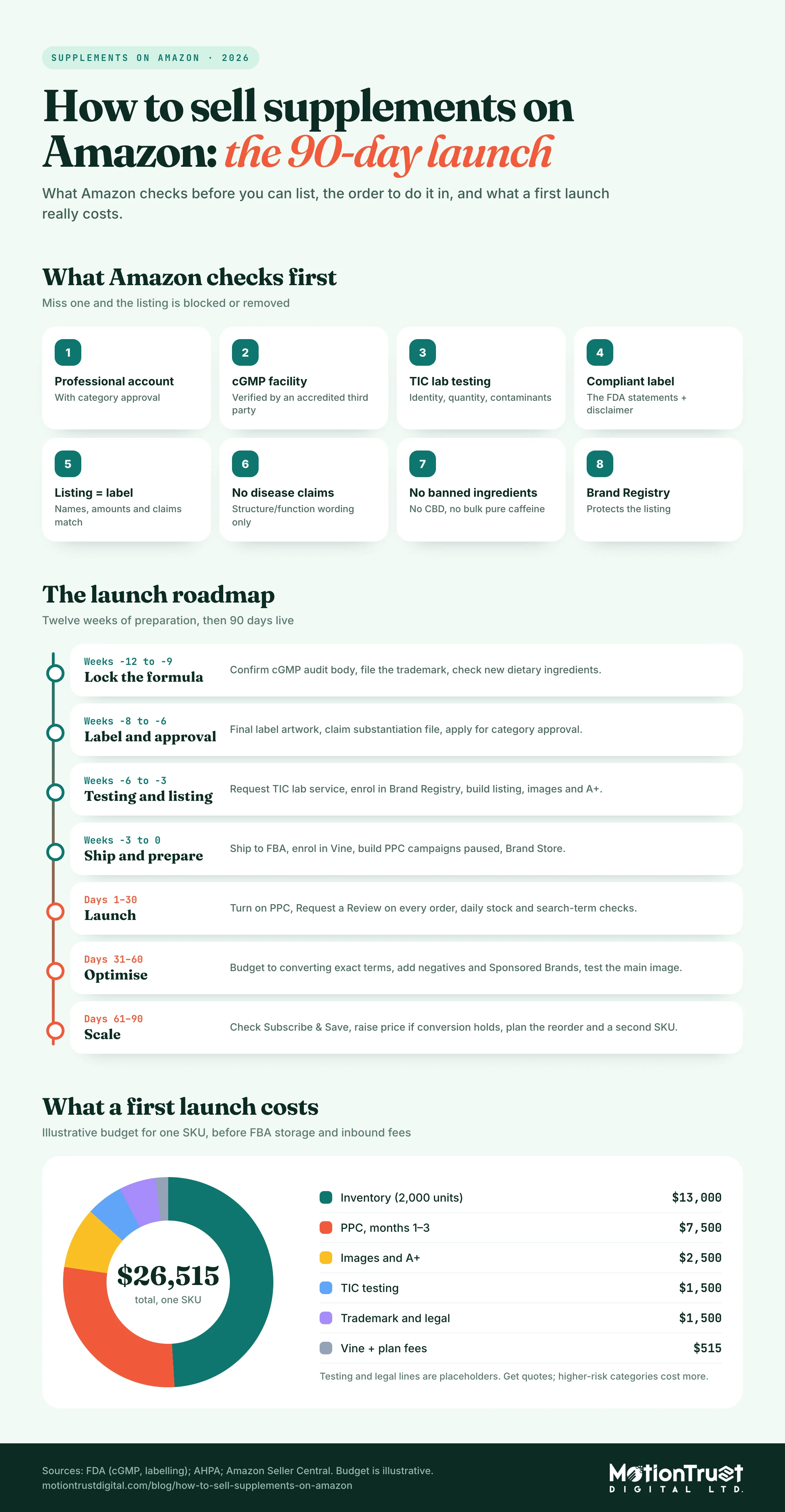
How to sell supplements on Amazon: a 90-day launch timeline
The 90 days after launch are only half the work. Compliance, testing and trademark filing should start at least 12 weeks before the first unit sells, and that pre-launch window is where most supplement launches slip.
| When | What to do | Check before moving on |
|---|---|---|
| Weeks -12 to -9 | Lock formula; confirm the manufacturer's cGMP audit body; file trademark; check for new dietary ingredients | No ingredient needs a 75-day FDA notice you have not filed |
| Weeks -8 to -6 | Final label artwork; claim substantiation file; apply for category approval | Label carries all five required statements and the disclaimer |
| Weeks -6 to -3 | Request TIC lab service; enrol in Brand Registry; build listing, images and A+ | Title within 75 characters; copy matches the panel |
| Weeks -3 to 0 | Ship to FBA; enrol in Vine; set up PPC campaigns paused; build Brand Store | Compliance status shows no open actions |
| Days 1 to 30 | Turn on PPC; Request a Review on every order; daily stock and search term checks | Conversion rate trending up as Vine reviews land |
| Days 31 to 60 | Shift budget to converting Exact terms; add negatives; add Sponsored Brands; test main image | TACoS falling week on week |
| Days 61 to 90 | Check Subscribe & Save eligibility; raise price if conversion holds; plan reorder and second SKU | Organic share of sales rising; at least eight weeks of stock |
Our Amazon product launch playbook covers the general sequence; supplements simply front-load compliance. Also read our guide to an Amazon listing suppressed status before launch day.
How much does it cost to launch a supplement on Amazon?
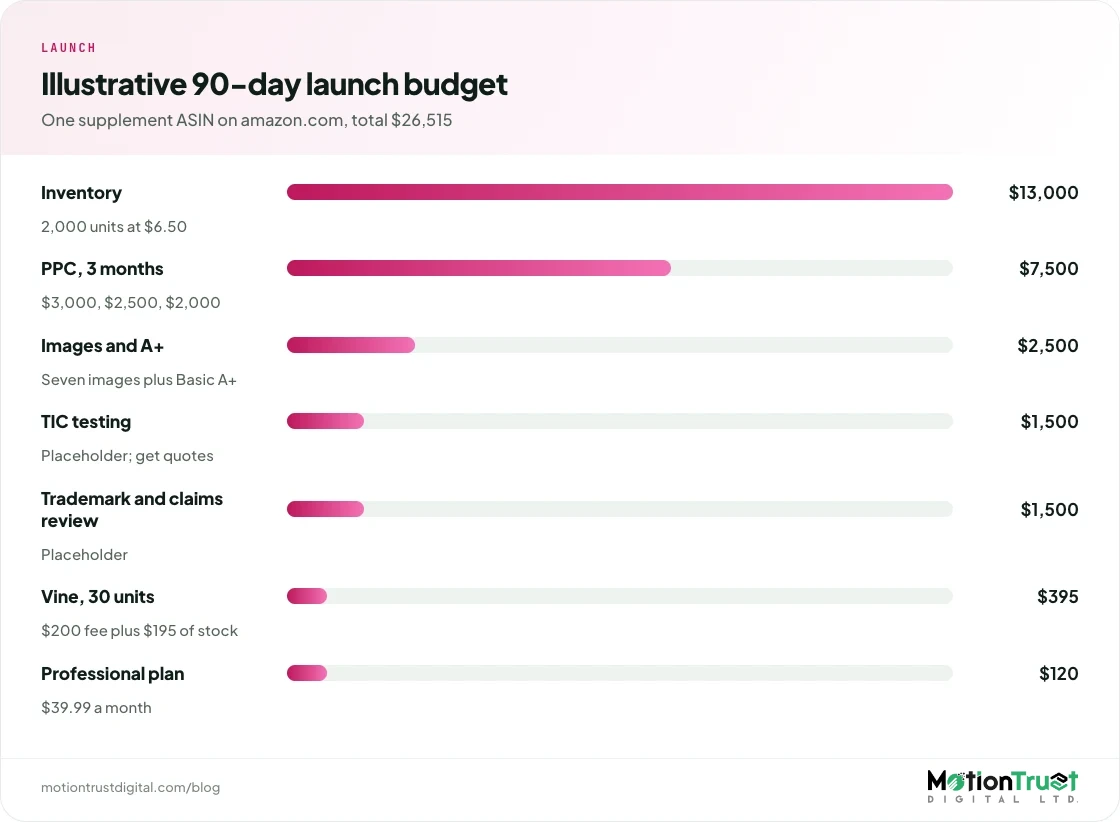
Budget is the part of how to sell supplements on Amazon that most guides skip. For a single supplement ASIN on amazon.com, a realistic launch budget is roughly $25,000 to $30,000 through the first 90 days, most of it inventory and advertising. The worked example below shows where the money goes. Every figure is illustrative: your quotes and fees will differ.
Worked example: a magnesium capsule launch
Assume a 120-count magnesium glycinate product sold at $29.99. Landed cost is $6.50 a unit. The referral fee at 15% is $4.50. We assume an FBA fee of $4.20 for this size; check yours in Seller Central. That leaves $14.79 per unit before advertising, so the break-even ACoS is about 49%.
| Budget line (illustrative) | Amount | Note |
|---|---|---|
| Inventory: 2,000 units at $6.50 | $13,000 | About five months of stock at 400 units a month |
| TIC testing and verification | $1,500 | Placeholder; get quotes, higher-risk categories cost more |
| Trademark and legal review of claims | $1,500 | Placeholder |
| Photography, images and A+ design | $2,500 | Seven images plus Basic A+ |
| Vine: 30 units | $395 | $200 fee plus $195 of stock; a $200 Vine credit may offset the fee |
| PPC: month 1, 2 and 3 | $7,500 | $3,000, $2,500 and $2,000 |
| Professional plan, 3 months | $120 | $39.99 a month |
| Total | $26,515 | Before FBA storage and inbound fees |
Now the advertising maths. If month one runs at a 70% ACoS, $3,000 of spend produces about $4,286 of ad sales, or 143 units. Those units earn $2,115 before ads, so ads lose about $885 that month. That is the cost of buying sales history and reviews. By month three, the target is an ACoS below the 49% break-even on hero terms, with organic sales covering the rest.
If the numbers do not work, fix landed cost or count size before cutting price.
Amazon product launch
Want a launch plan built around your numbers?
We plan the 90 days with you: compliance checks, listing, Vine, PPC structure and budget, then run it week by week.
See our product launch serviceWhy do supplement launches fail on Amazon?
Most supplement launches do not fail because of the product. They fail because a compliance step was missed, the listing over-claims, or the PPC budget ran out before reviews arrived. Use this table to diagnose a launch that has stalled.
| Symptom | Likely cause | What to do |
|---|---|---|
| Listing blocked before launch | No TIC verification or open compliance request | Check Manage Your Compliance; request lab service from an approved TIC |
| Live listing suddenly removed | Copy or images conflict with the Supplement Facts panel, or a disease claim | Audit title, bullets, A+, images and Brand Store against the label line by line |
| Clicks but few sales | No reviews, weak images, price out of line | Enrol in Vine; fix images 2 to 4; check price per serving against rivals |
| High ACoS after day 60 | Budget on broad terms; no negatives | Move spend to converting Exact terms; add negatives twice a week |
| Sales drop after a stock-out | Lost rank and cancelled subscriptions | Keep eight weeks of cover; reorder at day 45 |
| UK listing rejected | US-style claims not on the GB register | Rewrite claims using authorised wording |
Seller forums say the same: compliance, PPC burn and slow reviews kill supplement launches early. Do compliance first, launch with Vine enrolled, and fund three months of advertising before judging the product.
Frequently asked questions
Can I sell supplements on Amazon?
Yes, with a Professional seller account and category approval. Your product must be made in a cGMP facility, verified by an Amazon-approved testing, inspection and certification organisation, and carry an FDA-compliant label. Since December 2025, AHPA reports Amazon is requiring third-party cGMP verification for all supplements, so check Manage Your Compliance in Seller Central before you order inventory.
Do supplements need FDA approval to sell on Amazon?
No. The FDA does not approve dietary supplements before they are sold. The brand is responsible for safety, cGMP manufacturing, facility registration, truthful labels and claim substantiation. You must never call a supplement "FDA approved". If you use a new dietary ingredient, you must notify the FDA at least 75 days before marketing. Amazon adds its own third-party verification on top.
What testing does Amazon require for supplements?
Amazon requires verification through an approved TIC organisation, requested in Manage Your Compliance in Seller Central, with results sent by the lab directly to Amazon. Higher-risk types such as weight management, sexual enhancement, sports nutrition, bodybuilding and joint health face extra product testing. The approved provider list changes, so use the list in your account, not a blog.
How much does it cost to start selling supplements on Amazon?
For one ASIN on amazon.com, our illustrative example comes to about $26,500 over the first 90 days. That includes $13,000 of inventory, $7,500 of PPC, testing, trademark, images and Vine. Your figure depends on landed cost, testing quotes and category. Calculate your break-even ACoS before launch so you know how long you can fund advertising.
Can I use health claims on my supplement listing?
You can use structure/function claims, such as "supports normal immune function", if you can substantiate them and you include the FDA disclaimer. You cannot claim or imply that a supplement treats, cures, mitigates or prevents a disease. In the UK, only claims authorised on the Great Britain nutrition and health claims register may be used.
Is it hard to sell supplements on Amazon?
It is harder than most categories. You face compliance costs, strong established brands and high click costs on ingredient terms. Brands that do well usually pick a clear, simple formula, complete compliance before launch, enrol in Vine early, use Subscribe & Save for repeat orders, and fund at least three months of PPC before judging results.
Sources
- FDA — Questions and Answers on Dietary Supplements
- FDA — Dietary Supplement Labeling Guide: Chapter I
- FDA — Structure/Function Claims
- Legal Information Institute — 21 CFR 101.93 Certain types of statements for dietary supplements
- FDA — Regulation of Cannabis and Cannabis-Derived Products, Including CBD
- FDA — Pure and Highly Concentrated Caffeine
- FDA — Medication Health Fraud for Specific Diseases and Conditions
- FTC — Health Products Compliance Guidance
- GOV.UK — Great Britain nutrition and health claims (NHC) register
- Amazon (Sell on Amazon) — Brand Registry
- Amazon (Sell on Amazon) — Amazon Vine
- Amazon (Sell on Amazon) — Subscribe & Save
- Amazon (Sell on Amazon) — Selling fees and pricing
- Amazon (Sell on Amazon) — Customer Reviews tools
- American Herbal Products Association — Amazon expanding TIC cGMP requirement to all dietary supplements (trade-body report)
- NutraIngredients — Amazon expands TIC cGMP requirement to all supplement products (trade press)
Monjur Hossain
Founder & Amazon Strategy Lead, MotionTrust Digital
Monjur incorporated MotionTrust Digital in September 2022 and leads Amazon strategy across the client base. Eight years in e-commerce and marketplace marketing, now on Amazon only — keyword strategy, listing architecture and advertising structure for growing brands.
MonjurAgencyTry the free tools
Seven Amazon tools that run in your browser — profit and ACoS calculator, PPC auditor, listing checker and more. No account, nothing uploaded.
Try the free toolsLast reviewed . We update articles in place rather than republishing at a new URL, so the link you have keeps working.
Keep your ACoS target working for you
Break-even ACoS is the starting point. One email a week with our newest PPC articles on targets, bids and wasted spend, plus listings and SEO if you want them. Email us to join.