
Why Are My Amazon Sales Dropping? How to Find the Cause and Fix It
 By Monjur HossainFounder & Amazon Strategy Lead
·
Published
·
Last reviewed
·20 min read
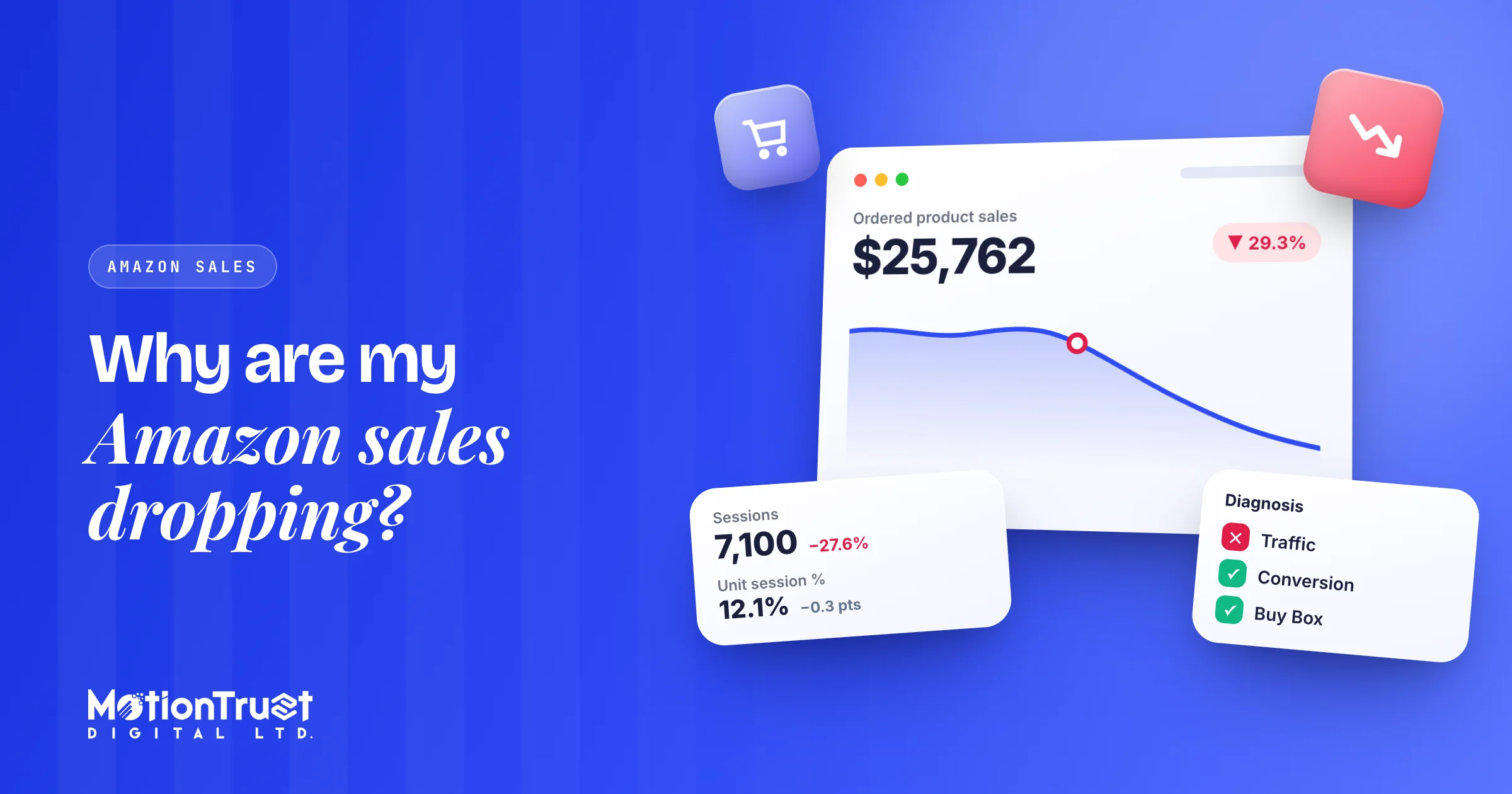
Amazon sales usually drop for one of three reasons: fewer shoppers reach your listing (a traffic problem), the same number visit but fewer buy (a conversion problem), or an account or policy issue limits what you can sell. Compare sessions, unit session percentage and Featured Offer percentage in Business Reports to see which.
Why are my Amazon sales dropping? The cause is almost always one of three things: fewer people are reaching your listing (a traffic problem), the same number are visiting but fewer are buying (a conversion problem), or an account or policy issue is limiting what you can sell. Business Reports tells you which one in about ten minutes.
That split matters because the fixes are completely different. Cutting your price will not bring back a listing that has dropped off page one. This guide walks through the checks in the order we run them, including the 2026 changes behind many of this year's drops.
Why are my Amazon sales dropping?
Your Amazon sales are dropping because one of the three numbers that make up revenue has fallen: sessions, conversion rate (unit session percentage) or average selling price. Find which one moved, on which ASIN, on which date, and the cause usually becomes obvious.
Revenue comes from a simple equation:
Sales = sessions × unit session percentage × average selling price
Sessions are visits to your detail page. Unit session percentage is units ordered divided by sessions, which is Amazon's version of a conversion rate. Average selling price is what you actually received per unit after coupons and deals. Usually one of them is doing most of the damage.
The causes then fall into three buckets:
- Traffic problems: lost organic rank, suppressed or stranded listings, keywords lost after an edit, a title shortened under the 75-character rule, Buy Box (Featured Offer) loss, stock-outs, ads paused or capped by budget, seasonality, new competitors, or a category change.
- Conversion problems: price, a falling star rating or a few new 1-star reviews at the top, a coupon or deal that ended, changed images or A+ Content, a slower delivery promise, or a lost Prime badge.
- Account and policy problems: a falling Account Health Rating, intellectual property complaints, listing removals or category restrictions.
Amazon's own community team gives the same split. In a Seller Forums post on using Business Reports to diagnose a sales drop, Amazon staff put it plainly: if sessions are down but conversion rate is stable, you have a traffic problem; if sessions are steady but conversion is dropping, you have a listing or pricing issue.
How do I tell if it's a traffic or a conversion problem?
Open Reports > Business Reports in Seller Central, choose the Detail Page Sales and Traffic by Child Item report, and compare the last 14 or 30 days with the same period before the drop. Look at sessions, unit session percentage and Featured Offer (Buy Box) percentage side by side for each ASIN.
Here is the routine we use:
- Pick two comparable windows. The 14 days before the drop and the 14 days since. If the product is seasonal, also pull the same 14 days last year.
- Sort by ordered product sales lost. A catalogue-wide drop and a single-ASIN drop have different causes. Usually one or two child ASINs explain most of the loss.
- Check sessions first. A fall of more than 10–15% that is not seasonal points to traffic.
- Then unit session percentage. A fall of more than a point or two on a steady product points to conversion.
- Then Featured Offer percentage. Amazon calculates it as the page views in which you were the Featured Offer divided by the total page views for your products. If it falls, shoppers are buying from someone else, or cannot buy at all.
Use the child item view: on a parent ASIN the Featured Offer percentage can read close to zero because the Buy Box only appears once a shopper picks a variation.
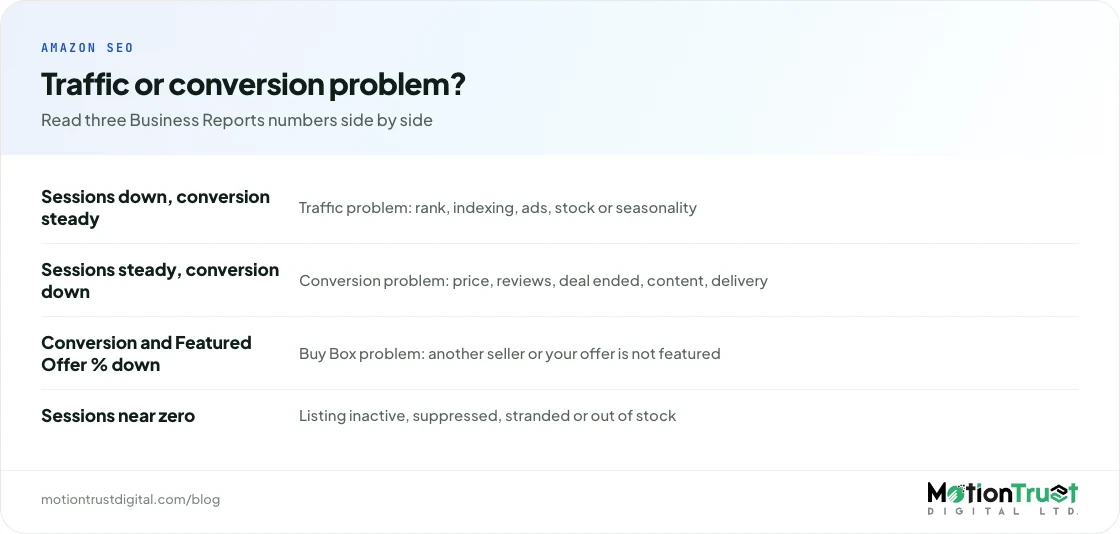
Once you have the three numbers, this matrix tells you where to look next:
| Sessions | Unit session % | Featured Offer % | What it usually means |
|---|---|---|---|
| Down | Steady | Steady | Traffic problem: rank, indexing, ads, stock or seasonality |
| Steady | Down | Steady | Conversion problem: price, reviews, deal ended, content, delivery |
| Steady | Down | Down | Buy Box problem: another seller, a hijacker, or your offer is not being featured |
| Down | Down | Steady | Usually a ranking slide caused by weaker conversion. Fix conversion first |
| Near zero | n/a | n/a | Listing inactive, suppressed, stranded or out of stock. Check Inventory and Account Health today |
If you are a brand owner in Brand Registry, add one more layer: the Search Query Performance dashboard in Brand Analytics. Amazon describes it as listing the top queries that led customers to your products, with impressions, clicks, cart adds and purchases for each. It shows which search terms traffic fell on, and whether search volume fell with it.
Why have my Amazon sessions dropped?
Sessions drop when your listing appears in fewer searches, ranks lower, or cannot be bought. The commonest causes we see are a lost keyword after an edit, a stock-out, ads stopped by a budget cap, a suppressed listing, and a competitor taking your position.
You lost organic rank
Organic rank follows sales. When units per day fall for any reason, rank slips, which cuts sessions and sales again. Amazon's own guidance on improving search rankings notes that competitive pricing can improve your ranking and that listing quality and account health can contribute to it. Our guide to the Amazon ranking algorithm covers the factors in more depth.
To confirm a rank loss, look at Search Query Performance for your top five queries. If your brand's impression share for a query fell while total search volume for that query held steady, you lost position. If the search volume itself fell, the market shrank, not your rank.
Your listing is suppressed, inactive or stranded
A suppressed listing is hidden from search and browse until you fix it. Stranded inventory is FBA stock sitting in a warehouse with no active offer attached to it, so nobody can buy it. Both can happen silently after a feed upload.
Filter Manage All Inventory by Search Suppressed and Inactive, then open Fix Stranded Inventory. Our guide to fixing a suppressed Amazon listing walks through the common reasons.
Keywords were de-indexed after an edit
If sessions fell within a day or two of you (or a feed tool, or a team member) editing the listing, start there. Removing a word from the title, bullets or backend search terms can remove you from searches for that word entirely. Backend search terms are limited to 250 bytes, and anything over the limit can stop the field indexing at all.
Test it: search the exact phrase plus your brand name on amazon.com. If your product does not appear, it is probably not indexed. Our backend keywords guide explains the byte limit and what counts towards it.
Your title was shortened under the 75-character rule
Since 27 July 2026, product titles in every category except media are capped at 75 characters, with a separate 125-character Item Highlights field that is also searchable. Many sellers trimmed titles quickly and lost words that drove traffic.
In the accounts we audit, this is the single most common cause of session drops in the second half of 2026. The typical pattern is a title that lost an audience word ("for cats") or a use case. Put the brand, product type and the most important qualifier in the title, then move secondary search terms into Item Highlights and backend search terms.
You lost the Buy Box (Featured Offer)
If another seller wins the Featured Offer on your ASIN, your sessions may hold steady while your sales fall, because shoppers buy from them. If no offer is featured at all, shoppers see "See All Buying Options", and conversion collapses.
Amazon changed how this works in 2026. In its Featured Offer update, Amazon said that from July 2026 it is removing the separate seller eligibility step, with the rollout complete by the end of 2026. Offers are ranked on total price including shipping, delivery speed, free shipping, free returns, seller performance and stock availability. Amazon says reviews, the Prime badge and fulfilment method are not ranking factors for the Featured Offer.
If your Featured Offer percentage has dropped since July with no new sellers on the listing, check whether your price is higher than elsewhere online.
You ran out of stock
A stock-out stops sales on the day and keeps hurting afterwards, because the sales history that supports your rank has a gap in it. In our experience, a short stock-out on a mature product recovers within two to four weeks if you support it with ads and a modest promotion when stock returns. A long stock-out on a competitive keyword can take longer, because a competitor has filled your position in the meantime.
Check the Inventory dashboard, restock recommendations and any FBA shipments stuck in receiving.
Seasonality and market-wide dips
Some drops are not your fault. An Amazon moderator replying to a seller whose sales had fallen 30–40% in days noted that sales can usually drop during summer times and pick up early September.
Compare year on year, not month on month, and look at search volume for your main queries in Search Query Performance. If search volume fell by about the same percentage as your sessions, you are looking at demand, not a listing problem.
New competitors or a category change
A new competitor with a lower price or an aggressive launch budget can push you down a page in a fortnight. Check the top 10 results for your main keyword for newcomers. Our guide to reverse ASIN research shows how to see which keywords a new rival is taking from you.
Category or browse node changes are quieter. If Amazon moves your ASIN into a different node, your Best Sellers Rank changes and you can lose visibility in category browse and filters.
Amazon SEO
Lost rank after the 75-character title change?
We rebuild titles, Item Highlights and backend terms around the queries that actually sell, then track impressions query by query until the traffic is back.
See our Amazon SEO serviceDid my Amazon ads cause the sales drop?
Often, yes. If your ads stopped serving, ran out of budget early in the day, or had bids cut by a rule or a new target ACOS, you lose sponsored traffic straight away and then organic rank as total sales fall.
Amazon Ads' Sponsored Products budget guide is clear on what happens: once a campaign is out of budget, your ads are not eligible to show until the next day, and the budget resets at midnight. Budgets are averaged over the calendar month, so a campaign can spend up to 25% more than its average daily budget on a given day.
Check these in Campaign Manager:
- Campaign status: paused, archived, or stopped by a failed payment.
- Out of budget: campaigns that ran out several times in the past week.
- Bid changes: a lower target ACOS in an automated tool can cut every bid in the account at once.
- Search terms: in the search term report, check whether spend has shifted to low-intent terms.
- TACOS trend: if total ad cost of sales rose while total sales fell, your ads are buying less. Our ACOS and TACOS benchmarks give you ranges to compare against.
The opposite mistake is just as common: cutting ad spend in a panic. Sponsored sales drop, organic rank follows, and a 15% dip becomes a 35% one. Fix wasted spend before you cut budget on campaigns that convert.
Amazon PPC management
Are your ads holding up your sales or draining them?
We audit budgets, bids and search terms, stop the waste, and keep your best-converting campaigns serving all day so organic rank has something to stand on.
See our PPC management serviceWhy are people visiting my Amazon listing but not buying?
If sessions are steady and unit session percentage has fallen, something on the detail page or in the offer has become less convincing. The usual suspects are price, a drop in star rating, a deal or coupon that ended, changed images, or a slower delivery date.
Price
Shoppers compare. If a competitor dropped their price or a coupon of theirs is now live, your conversion will fall even though nothing changed on your side. Check the top five competing listings and their price after coupons. Amazon's Automate Pricing tool is free with a Professional plan, but a rule set months ago can drift out of line with the market.
Reviews and star rating
A move from 4.4 to 4.2 stars, or two new 1-star reviews at the top of the page, can cut conversion noticeably. Read your latest 20 reviews. Our guide on how to handle negative Amazon reviews covers what you can still do now that public comments on reviews have been retired.
A coupon, deal or promotion ended
This is the most overlooked cause. A Lightning Deal, Prime Exclusive Discount or coupon lifts conversion while it runs, and when it ends conversion falls back. If the drop lines up with the end date of a promotion, you are looking at the baseline, not a problem.
Images, A+ Content or variations changed
New images or A+ Content can lower conversion if they are weaker than the old version. Variation changes matter too: if a popular size or colour was split off or merged, reviews and sales history can move with it. If you change content, test it with Amazon's Manage Your Experiments where you are eligible, rather than swapping it and hoping.
Delivery promise slipped or the Prime badge disappeared
The delivery date shown in search results and on the page is one of the strongest conversion signals on Amazon. If FBA stock is low and the remaining units are in a distant fulfilment centre, or your Seller Fulfilled Prime performance slipped and you lost the badge, the date moves out and shoppers choose a faster option.
Rufus, Amazon's AI shopping assistant, is now available to all US and UK customers, and shoppers ask it direct questions about fit, size and use. Our Rufus optimisation guide covers how to write for it.
Can account health issues stop my Amazon sales?
Yes. Policy violations, intellectual property complaints and a falling Account Health Rating can remove listings, restrict categories or, at worst, deactivate the account. Check Performance > Account Health whenever a drop has no obvious cause.
According to Amazon's Account Health Rating FAQ, the rating runs from 0 to 1,000. A score of 200 or more is Healthy, 100 to 199 is At Risk, and below 100 means the account can be deactivated. New sellers start at 200.
What to look for on the Account Health dashboard:
- Intellectual property complaints: a single complaint can remove a listing until it is resolved or retracted.
- Listing policy violations: restricted claims, pesticide or drug claims, and product safety issues remove listings, often without much fanfare.
- Performance Notifications: read every message from the past 30 days.
If your account is already at risk or deactivated, stop reading here and go to our guide on what to do when your Amazon account is suspended.
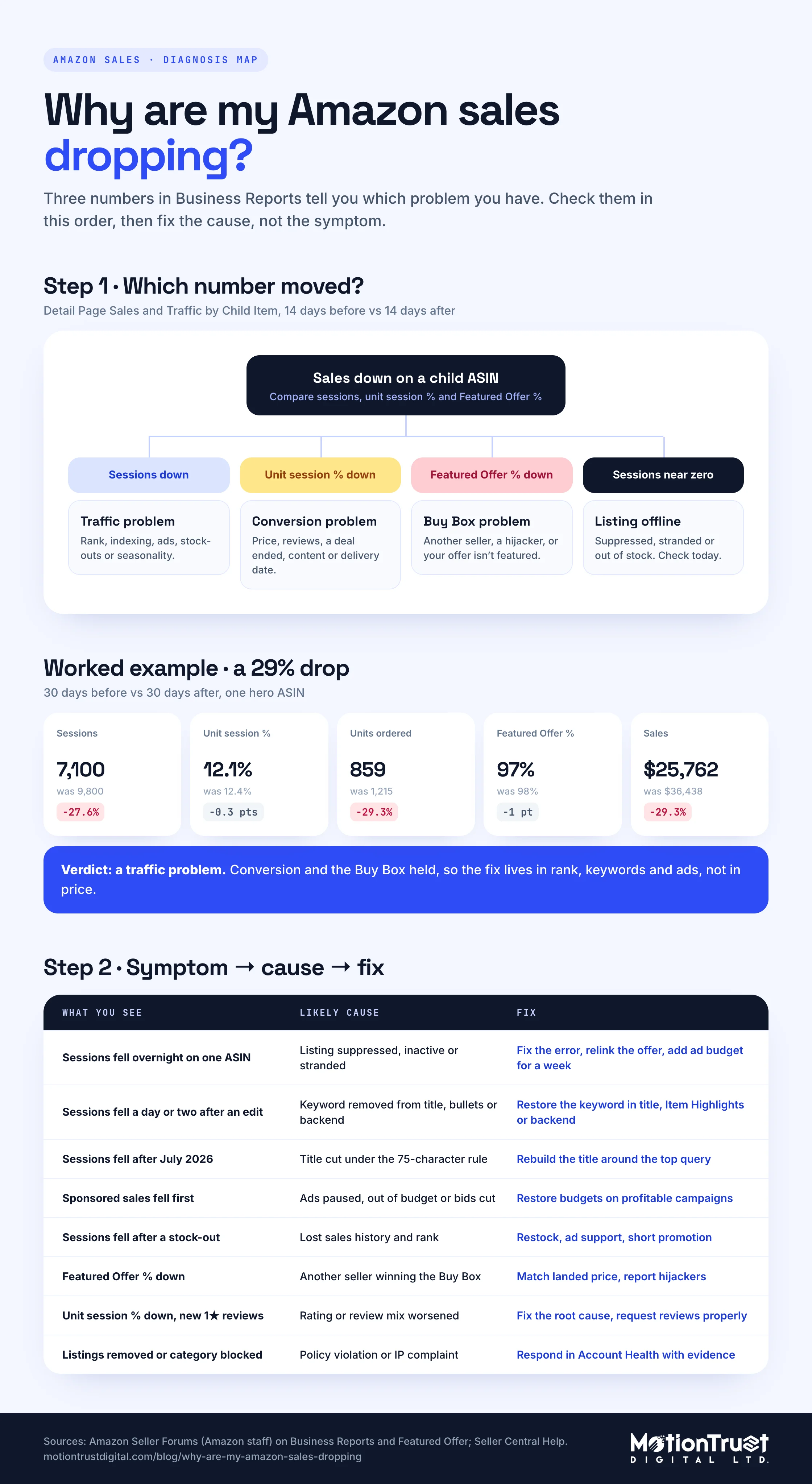
Amazon sales drop diagnostic table: symptom, cause, fix
Use this table once you know which number moved; it turns “why are my Amazon sales dropping?” into a short list of checks. Each row is a pattern we see repeatedly in audits.
| Symptom | Likely cause | Where to check | Fix |
|---|---|---|---|
| Sessions fell overnight on one ASIN | Listing suppressed, inactive or stranded | Manage All Inventory (Search Suppressed filter), Fix Stranded Inventory | Fix the listing error or relink the offer, then add ad budget for a week |
| Sessions fell a day or two after an edit | Keyword removed from title, bullets or backend terms | Edit history, search the phrase on amazon.com, Search Query Performance | Restore the keyword in title, Item Highlights or backend terms |
| Sessions fell gradually after July 2026 | Title shortened under the 75-character rule | Compare old and new titles, query impressions in Search Query Performance | Rewrite title around the top query and move qualifiers to Item Highlights |
| Sessions down, search volume down by a similar amount | Seasonality or market demand | Search Query Performance search volume, last year's Business Reports | Hold ad efficiency, plan stock and promotions for the next peak |
| Sessions fell, sponsored sales fell first | Ads paused, out of budget or bids cut | Campaign Manager status, budget and bid history, payment method | Restore budgets on profitable campaigns, add budget rules, cut wasted terms |
| Sessions fell after a stock-out | Lost sales history and rank | Inventory dashboard, FBA shipments, restock report | Restock, add ad support and a short promotion, set restock alerts |
| Sessions down, a new rival in the top results | New competitor taking position | Search results for your main keywords, reverse ASIN data | Strengthen price, images and ads on the contested terms |
| Sessions steady, Featured Offer % down | Another seller winning the Buy Box, or your price is higher than elsewhere | Business Reports (child item), offer listing page, pricing health | Match landed price, fix delivery speed, report hijackers via Brand Registry |
| Sessions steady, unit session % down | Competitor price cut or coupon | Top five competitor listings for your main keyword | Adjust price or add a coupon, or reinforce value in images and bullets |
| Unit session % down after a promotion ended | Return to baseline conversion | Promotions and Deals history | Decide whether to rerun the promotion on margin, not on habit |
| Unit session % down, new negative reviews | Rating or review mix worsened | Customer Reviews, Voice of the Customer | Fix the root cause, update listing and packaging, request reviews properly |
| Unit session % down, delivery date later | Low FBA stock or lost Prime badge | Live detail page delivery date, Inventory dashboard, SFP metrics | Rebalance stock, restore Prime eligibility |
| Listings removed or category blocked | Policy violation or IP complaint | Account Health dashboard, Performance Notifications | Respond to each violation with evidence; get help if the rating is At Risk |
Worked example: diagnosing a 29% sales drop
Here is a typical case. The numbers are illustrative; the pattern is one we see often. A brand sells a 2.5-litre stainless steel pet water fountain on amazon.com at $29.99. In September, sales on the main child ASIN fell from about $36,400 to about $25,800 compared with the previous 30 days.
Step 1: split the drop. Business Reports for the two 30-day windows:
| Metric | Before (30 days) | After (30 days) | Change |
|---|---|---|---|
| Sessions | 9,800 | 7,100 | −27.6% |
| Unit session percentage | 12.4% | 12.1% | −0.3 points |
| Units ordered | 1,215 | 859 | −29.3% |
| Featured Offer percentage | 98% | 97% | −1 point |
| Ordered product sales | $36,438 | $25,762 | −29.3% |
Step 2: attribute the loss. If conversion had stayed at 12.4%, 7,100 sessions would have produced about 880 units. So the traffic fall cost about 335 units (1,215 minus 880), and the conversion dip cost only about 21 units (880 minus 859). More than 90% of the loss is traffic. The Featured Offer is fine. This is not a price or Buy Box problem.
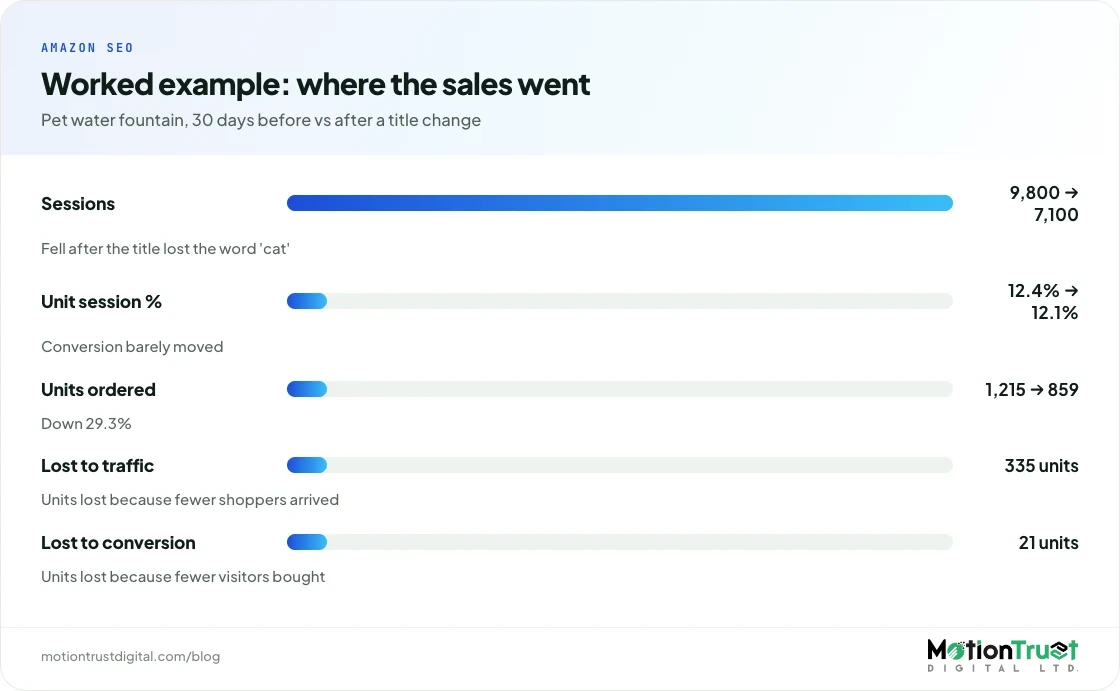
Step 3: find the traffic leak. Search Query Performance shows that impressions held up on "pet water fountain" and "dog water fountain", but the brand's impression share on "cat water fountain", the second-biggest query, fell from 4.1% to 1.6% in the week of 4 August. Search volume for that query was flat.
Step 4: find the trigger. The edit history shows the title was shortened on 3 August to meet the 75-character limit. The old title included "for Cats and Dogs". The new one says "Pet Water Fountain, 2.5L Stainless Steel". "Cat" now appears nowhere in the title, and the backend search terms had been filled with brand misspellings instead.
Step 5: fix and measure. The title becomes "[Brand] Cat & Dog Water Fountain, 2.5L Stainless Steel, Quiet Pump" (70 characters). "Filter included, dishwasher-safe, for cats and small dogs" goes into Item Highlights, and the backend terms are rewritten around cat-specific searches. An exact-match Sponsored Products campaign on "cat water fountain" supports it for three weeks.
Three weeks later, impression share on "cat water fountain" is back to 3.5% and sessions are running at about 9,200 per 30 days. Without Step 1, the brand would probably have cut its price and fixed nothing.
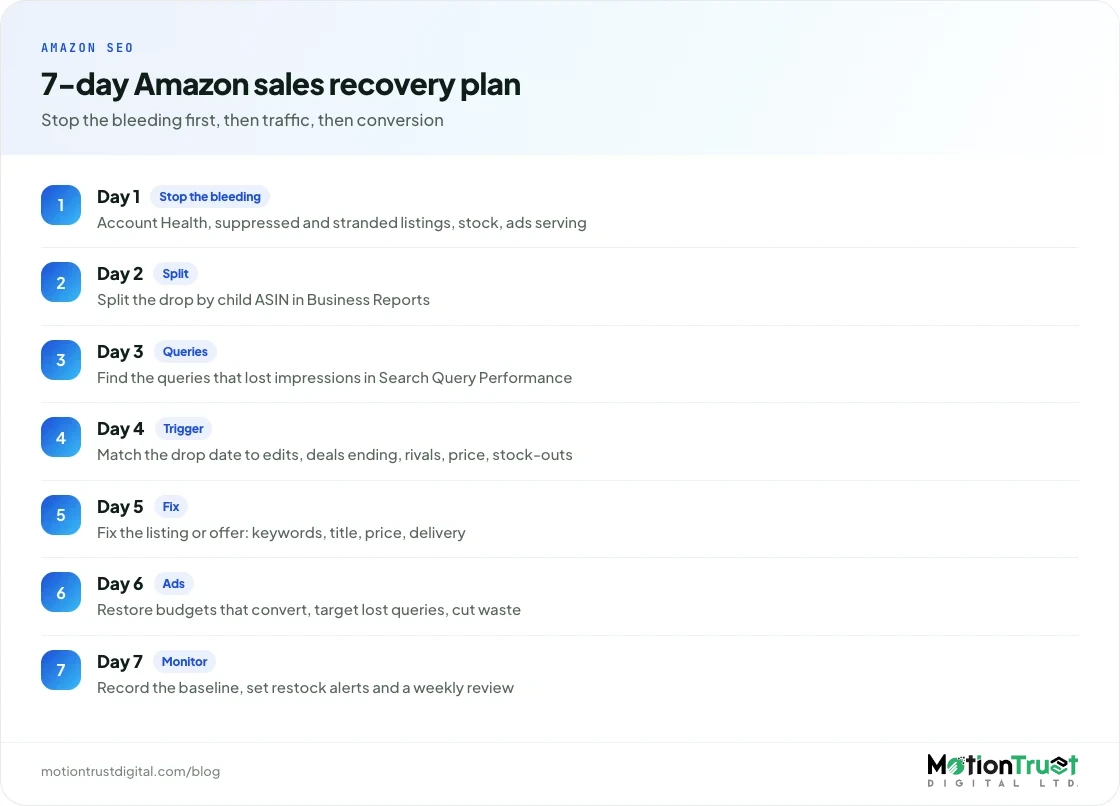
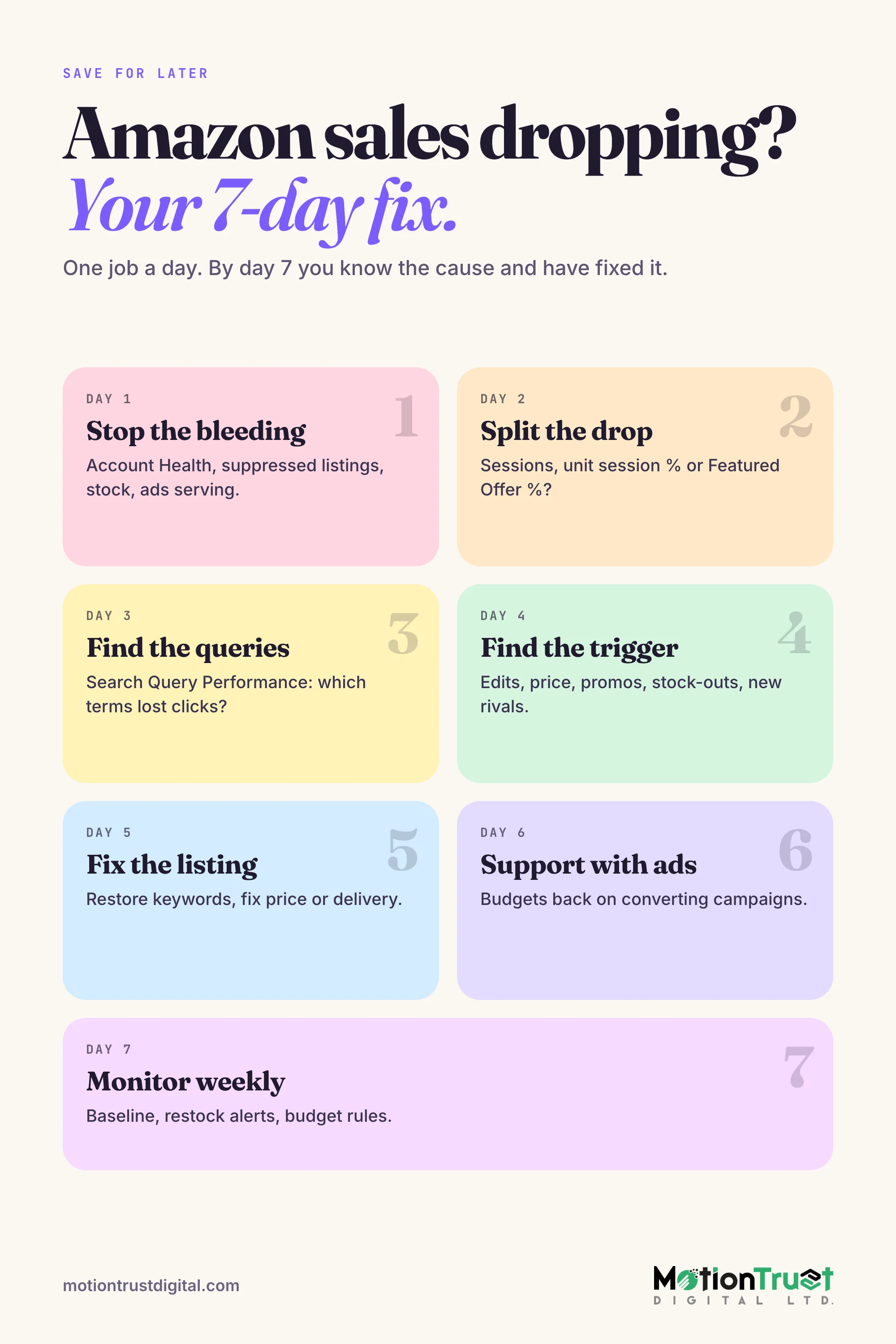
How do I recover lost Amazon sales? A 7-day plan
Work through the checks in order of how quickly each cause can hurt you: anything that stops sales completely first, then traffic, then conversion. Rank recovery can take a few more weeks; our guide to recovering Amazon organic ranking covers each cause.
| Day | Focus | What to do |
|---|---|---|
| Day 1 | Stop the bleeding | Check Account Health, Performance Notifications, suppressed and stranded listings, stock levels, and that ads are serving. Fix anything that is stopping sales outright. |
| Day 2 | Split the drop | Pull Detail Page Sales and Traffic by Child Item for before and after windows. Identify the ASINs and whether sessions, unit session percentage or Featured Offer percentage moved. |
| Day 3 | Find the queries | Use Search Query Performance to see which search terms lost impressions or clicks. Check search volume to rule seasonality in or out. |
| Day 4 | Find the trigger | Line up the drop date against listing edits, title changes, promotions ending, new competitors, price changes and stock-outs. |
| Day 5 | Fix the listing or offer | Restore lost keywords, rewrite the title and Item Highlights, correct price or delivery problems, and reply to the review issue at its source. |
| Day 6 | Support with ads | Restore budgets on campaigns that convert, add exact-match campaigns on lost queries, add negative keywords on waste. |
| Day 7 | Set up monitoring | Record the baseline, set restock alerts and budget rules, and schedule a weekly review of sessions, conversion and Featured Offer percentage. |
Change one major thing at a time so you can see what helped, keep dated notes, and give organic rank two to four weeks before deciding a fix has failed.
Free Amazon audit
Want us to find the cause of your sales drop?
Send us your ASINs and we will check traffic, conversion, Buy Box, ads and account health, then tell you what is driving the drop and what to fix first.
Get a free Amazon auditAre Amazon sales down for everyone right now?
Sometimes they are, and that is the first thing to rule out when you ask why are my Amazon sales dropping. Market-wide dips happen, but they are usually short and hit many categories at once. A drop that lasts more than two weeks on your ASINs alone is almost always something specific to you.
In April 2026, a seller on r/FulfillmentByAmazon with over $1 million in annual sales asked exactly that after impressions and clicks fell sharply over a weekend. Some replies had seen the same; others traced it to their own ad spend going to low-intent terms.
To tell the difference:
- Check search volume. If Search Query Performance shows search volume for your main queries fell, demand dropped across the market.
- Check your share. If your impression share held while volume fell, you are fine. If it fell, it is your problem.
- Check the timeframe. Market dips recover within days; anything lasting weeks needs the full diagnosis.
How do I stop Amazon sales dropping again?
Review the same handful of numbers every week, so you catch a drop in days rather than at month end, and never have to ask “why are my Amazon sales dropping?” weeks too late.
A weekly check that takes 20 minutes:
- Sessions, unit session percentage and Featured Offer percentage for your top 10 child ASINs, versus last week and last year.
- Impression share on your top five queries in Search Query Performance.
- Stock cover in days for each FBA SKU.
- Out-of-budget campaigns and TACOS trend in Campaign Manager.
- Account Health and any new Performance Notifications.
- Listing edits, with dates.
Spread search terms across the title, Item Highlights, bullets and backend fields, so a single edit cannot de-index you. Our step-by-step guide to optimising an Amazon listing covers how to do that within the 2026 rules.
Frequently asked questions
Why did my Amazon sales suddenly drop to zero?
Sales that fall to zero overnight usually mean your listing cannot be bought. Check Manage All Inventory for suppressed or inactive listings, the Fix Stranded Inventory page, your FBA stock, and the Account Health dashboard for removals or IP complaints. Also confirm your ads are serving and your payment method has not failed. A gradual drop has different causes than a sudden one.
How do I know if my Amazon listing has lost ranking?
Compare sessions in Business Reports before and after the drop, then check Search Query Performance in Brand Analytics. If your impression share on a key search term fell while that term's search volume held steady, you lost rank. If search volume fell too, demand dropped. You can also search the exact phrase on amazon.com in a private window and note your position.
Does going out of stock on Amazon hurt ranking?
Yes. While you are out of stock you make no sales, and organic rank follows sales, so competitors can take your position. In the accounts we manage, short stock-outs on established products usually recover within two to four weeks with ad support and a modest promotion when stock returns. Longer stock-outs on competitive keywords can take more time and budget to recover.
Why are my Amazon sessions high but sales low?
Steady sessions with falling sales is a conversion or Buy Box problem. Check your Featured Offer percentage in the child item Business Report first, because another seller may be taking the sale. If that is fine, compare your price with competitors, read your newest reviews, check whether a coupon or deal ended, and look at the delivery date shown on the live page.
Can changing my Amazon title reduce sales?
Yes. Removing a word from the title can remove your product from searches for that word, especially if it is not also in Item Highlights, bullets or backend search terms. Since 27 July 2026, titles in most categories are capped at 75 characters, so many sellers lost traffic by trimming the wrong words. Keep the main search phrase in the title and move qualifiers elsewhere.
How long does it take to recover Amazon sales after a drop?
It depends on the cause. Fixing a suppressed listing, a stopped campaign or a lost Featured Offer can bring sales back within days. Recovering lost organic rank usually takes two to four weeks of steady sales, often supported by ads on the affected search terms. Seasonal drops recover when demand returns, so the work there is protecting margin and stock until the next peak.
Sources
- Amazon Seller Forums (Amazon staff) — Sales Down? Use Business Reports to Identify Issues and Take Action
- Amazon Seller Forums (Amazon staff) — Featured Offer Update: Every Seller's Offers Are Now in the Running
- Amazon Seller Forums — Why have my Amazon sales suddenly dropped?
- Amazon Seller Central Help — Account Health Rating: Frequently Asked Questions
- Amazon Ads — Sponsored Products budget basics and best practices
- Amazon (Sell on Amazon blog) — Amazon Brand Analytics: Get data to grow your business
- Amazon (Sell on Amazon blog) — Amazon SEO: 7 ways to improve your product's search rankings
- Amazon (Sell on Amazon) — Automate Pricing
- Amazon (Sell on Amazon) — Manage Your Experiments
Monjur Hossain
Founder & Amazon Strategy Lead, MotionTrust Digital
Monjur incorporated MotionTrust Digital in September 2022 and leads Amazon strategy across the client base. Eight years in e-commerce and marketplace marketing, now on Amazon only — keyword strategy, listing architecture and advertising structure for growing brands.
MonjurAgencyTry the free tools
Seven Amazon tools that run in your browser — profit and ACoS calculator, PPC auditor, listing checker and more. No account, nothing uploaded.
Try the free toolsLast reviewed . We update articles in place rather than republishing at a new URL, so the link you have keeps working.
Keep your ACoS target working for you
Break-even ACoS is the starting point. One email a week with our newest PPC articles on targets, bids and wasted spend, plus listings and SEO if you want them. Email us to join.